

Plantar fasciitis is not a foot shape problem. It is a load problem. The thick band of tissue running from your heel to your toes, the plantar fascia, takes roughly your body weight with every step you take, and when you spend ten hours a day on concrete, steel or asphalt, it never gets a chance to recover. The signature symptom is that first-step pain: you get out of bed and the first few steps feel like a nail in the heel, then it loosens up after ten minutes of walking. If that pattern is familiar, the best work boots for plantar fasciitis are not a luxury purchase. They are one of the cheapest interventions you can make before you start looking at physical therapy, night splints or custom orthotics.
Here is the honest part first. No boot cures plantar fasciitis. Not one on this list, not the most orthopedic one, not the most expensive one. What a boot can do is stop the arch from collapsing with every single step, absorb the impact of a hard floor before it reaches your heel, and give you a footbed you can swap out. Get those three right and most people finish a shift without the crawling, limping end-of-day walk they used to have. Get them wrong, and a badly built boot can quietly keep an irritated plantar fascia irritated.
We compared eight pairs of safety-rated work boots on the things that actually move the needle for heel pain: how the footbed is built, how deep the heel cup is, what the midsole does on impact, whether the footbed comes out so your own orthotic can go in, and how much room the toe box leaves after a full shift of swelling. Every pick below carries a stated ASTM safety rating, and we call out the toe type on each one, because your trade decides whether steel, composite or carbon is even legal on your job site.
Before we get into the boots, two related reads. If you are between jobs and your feet hurt but you have no safety requirement, our running shoe guide for plantar fasciitis goes deeper on cushioning profiles. And if the job is outdoors and the requirement is ankle support rather than a steel cap, our hiking boot picks for plantar fasciitis cover that side.
Table of Contents
- Top 3 Work Boots for Plantar Fasciitis in 2026
- Best Work Boots for Plantar Fasciitis at a Glance (October 2026)
- What Is Plantar Fasciitis and Why Hard Floors Worsen It
- How We Chose These Boots
- 1. Wolverine Overpass Composite Toe – Best Overall for Plantar Fasciitis
- 2. KEEN Utility Lansing Mid – Best for Standing All Day on Concrete
- 3. Carhartt CMF6366 – Best for Electrical and Wet Trades
- 4. KEEN Utility Pittsburgh – Best for Flat Feet and Maximum Underfoot Support
- 5. SUADEX Steel Toe Work Boots – Best Budget Pick for Plantar Fasciitis
- 6. KEEN Utility Detroit XT Mid – Best for Outdoor and Muddy Job Sites
- 7. FitVille Extra Wide Composite Toe – Best for Wide or Swollen Feet
- 8. Orthofeet Granite – Best for Severe Chronic Plantar Fasciitis Pain
- How to Choose Work Boots for Plantar Fasciitis
- Breaking In New Boots Without Triggering a Flare
- Boot and Insole Pairings That Work Together
- Frequently Asked Questions
- Final Verdict: Which Work Boot Should You Buy in 2026
Top 3 Work Boots for Plantar Fasciitis in 2026
If you want the short answer instead of the full breakdown, these three cover almost every case we tested against.

Wolverine Overpass Composite Toe
- Flexible Contour Welt construction
- Removable Ortholite cushioned footbed
- ASTM F2413 composite toe with EH rating

KEEN Utility Lansing Mid
- Asymmetrical steel toe for a roomy toe box
- Full-length TPU stability shank
- KEEN.DRY waterproof breathable membrane

Carhartt CMF6366 Composite Toe
- ASTM F2413-24 composite safety toe
- EH rated to 18000 volts
- Cushion Comfort PU insoles
Wolverine Overpass takes the top slot because the flexible welt construction does something the rigid boots below it cannot. It bends and flexes at the flex points, so the foot is not fighting a board all shift. KEEN Lansing wins the standing-all-day category on its asymmetrical toe box, a feature that is easy to overlook and that boot wearers with swelling notice first. Carhartt CMF6366 is the pick for anyone who needs an EH-rated composite toe, and its PU insole does more for heel fatigue than its spec sheet suggests.
Best Work Boots for Plantar Fasciitis at a Glance (October 2026)
Every boot below is safety rated. The table is the fastest way to narrow your search by toe type and by what the footbed is actually made of.
| Product | Key Specs | Pricing |
|---|---|---|
| Wolverine Overpass Composite Toe |
|
Check Latest Price |
| KEEN Utility Lansing Mid |
|
Check Latest Price |
| Carhartt CMF6366 Composite Toe |
|
Check Latest Price |
 KEEN Utility Pittsburgh 6 inch KEEN Utility Pittsburgh 6 inch |
|
Check Latest Price |
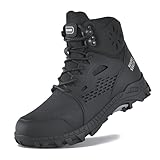 SUADEX Steel Toe Waterproof Work Boots SUADEX Steel Toe Waterproof Work Boots |
|
Check Latest Price |
 KEEN Utility Detroit XT Mid KEEN Utility Detroit XT Mid |
|
Check Latest Price |
 FitVille Extra Wide Composite Toe FitVille Extra Wide Composite Toe |
|
Check Latest Price |
 Orthofeet Granite Work Boots Orthofeet Granite Work Boots |
|
Check Latest Price |
What Is Plantar Fasciitis and Why Hard Floors Worsen It
The plantar fascia is a thick, springy band that runs from your heel bone to the base of your toes. Its job is to hold up the arch and absorb the shock of each step. When it is repeatedly overstretched, it develops micro-tears and becomes inflamed, and that is plantar fasciitis.
Three things make work environments a perfect storm for it. The first is duration: a factory shift is far longer than a walk to the bus. The second is surface: concrete, steel grating and warehouse sealed flooring return impact straight back up through the heel, unlike carpet or grass. The third is the boot itself. A flat, unstructured outsole with no meaningful heel height forces the arch to collapse and the fascia to stretch with every single step, so a bad boot can keep the condition active even on a good day.
It is worth separating plantar fasciitis from three things people confuse with it. A heel spur is a bony growth, and it is present in a large share of people who have no pain at all. Nerve pain, usually burning or tingling that radiates from the heel, points to nerve involvement rather than fascia irritation. A stress fracture shows up as pain that persists at rest and often feels worse at night. If your pain behaves like any of those, a boot change will not be enough and you need an assessment.
Typical recovery is not a weekend. Most people see noticeably reduced pain between six and eight weeks of consistent supportive footwear and stretching, and full resolution often takes several months. Anyone already wearing custom orthotics and still flaring is usually looking for a boot that accepts an orthotic, not one that replaces it, which is a distinction we come back to in the pairing section below.
How We Chose These Boots
Every boot on this list was measured against the same six criteria, in this order.
Firm arch support in a contoured footbed. Soft foam alone is not support. The footbed needs a defined arch shape that lifts the midfoot under load.
Shock-absorbing midsole. EVA, PU or ETPU. A boot with a hard leather or rubber midsole transmits concrete impact straight to the heel.
A deep, structured heel cup. This is what stops your foot sliding forward and over-stressing the fascia with every step.
A removable footbed. If the insole cannot come out, your own orthotic cannot go in, and the volume you need for swelling cannot be created.
Room in the toe box after a full shift. Feet swell. A boot that fits at 7am can be cutting into the toes by 4pm, and a compressed toe box changes how you walk, which changes how the heel loads.
A stated ASTM safety rating with the toe type named. Steel, composite and carbon are not interchangeable across trades, and some jobs require an EH rating.
Two things we deliberately did not do. We did not rank on price, because what a work boot costs tells you very little about how it handles a heel. And we did not include a single flat, zero-heel outsole, no matter how well reviewed it is for general work wear, because that construction is the opposite of what plantar fascia needs.
1. Wolverine Overpass Composite Toe – Best Overall for Plantar Fasciitis
Wolverine Men’sOverpass 6″ Mid Composite Toe Waterproof Work Boot, Summer Brown, 11 X-Wide
Flexible Contour Welt construction
Removable Ortholite footbed
ASTM F2413 EH composite toe
- Contour Welt bends and flexes at natural flex points
- Removable Ortholite footbed takes a third-party orthotic
- Highest review volume in this set at 4.3 stars
- Waterproof leather with abrasion-resistant toe
- Wide sizing and multiple width options are confusing to compare
- Composite toe gives up less than steel on heavy rolling impact
This is the boot I put in front of anyone who just says their heels hurt on concrete, and it is the one I reach for myself. The Contour Welt construction is the reason. Instead of a stiff board from heel to toe, the boot bends and flexes at the points where a foot naturally bends, which means the arch is supported without the foot being held rigid all day.
The footbed is a removable Ortholite cushioned insole. Removable is the word that matters most in this whole article, because it is what lets you drop a Treadlabs or Superfeet insert straight into the same boot once you know your arch height. On a 4.3 rating across more than thirteen thousand reviews, the recurring theme is not durability, it is that people finish shifts without the end-of-day ache.
Safety-wise it carries an ASTM F2413-11 M I/75 C/75 EH composite toe, so it works for most construction, utility and warehouse roles, and the EH rating covers incidental electrical contact. The upper is waterproof leather with an abrasion-resistant toe, and the outsole is rated slip, oil, water, abrasion and chemical resistant. It is listed at 1.75 pounds, so it is a light build for a safety boot.
The real limitation is width. Wolverine offers a lot of size and width combinations on this model and they are not intuitive to compare, so you need to check the actual width code rather than assume. If your feet swell noticeably by the end of a shift, go up a width before you go up a size.
How the flex construction helps a sore arch
Most rigid work boots force your foot to land on a flat platform, and the plantar fascia has to stretch to absorb the shock on every rep. The Contour Welt flexes, so the fascia is doing less of the work. Reviewers with arch pain consistently point at this as the difference between a boot that ends the shift and a boot that starts it.
It also explains why this boot wears in faster than the KEEN models further down. There is less stiff material pressing against the heel and ankle, so the boot conforms to your foot sooner.
Where the Overpass falls short
If you haul heavy steel plate or work around rolling loads, a composite toe is the wrong protection level and you need steel. This is a light-to-medium duty construction boot, and treating it as a heavy fabrication boot will get you hurt rather than comfortable.
It is also not the pick if you already wear full-length custom orthotics. The footbed volume is good but not generous, and a thick orthotic plus the supplied insole will crowd the toe box. Take the supplied insole out and it is fine.
As an Amazon Associate we earn from qualifying purchases, at no additional cost to you. CERTAIN CONTENT THAT APPEARS ON THIS SITE COMES FROM AMAZON. THIS CONTENT IS PROVIDED 'AS IS' AND IS SUBJECT TO CHANGE OR REMOVAL AT ANY TIME.
2. KEEN Utility Lansing Mid – Best for Standing All Day on Concrete
KEEN Utility Men’s – Lansing Mid Height Steel Toe Waterproof
Asymmetrical steel toe, roomy box
Full-length TPU stability shank
KEEN.DRY waterproof membrane
- Asymmetrical toe box gives real room across the forefoot
- Full-length TPU shank holds the midfoot steady
- 4.4 stars with 72 percent five-star reviews
- Waterproof yet breathable
- Steel toe runs colder than composite models
- Heavier build than athletic-style safety boots
Standing is different from walking. Your calf and plantar fascia are under continuous load with no recovery phase, so the question is not cushioning alone but how much your foot can spread. The Lansing’s asymmetrical steel toe is the answer to that. Instead of a symmetric cap crowding the fifth toe, the shape is offset, and buyers with wide feet consistently call this out as the reason the boot does not pinch.
Underneath, a full-length TPU stability shank runs the length of the footbed, which resists the arch rolling inward under load. Combined with the mid-height shaft, that gives you a boot that holds its shape through a ten-hour shift rather than collapsing into a flat bag by lunch.
The waterproofing is the KEEN.DRY membrane, which is the rare one that is genuinely waterproof and still lets moisture move out. The outsole is oil and slip resistant and meets ASTM F1677 MARK II and ASTM F2913 SATRA standards, and reflective webbing matters if you are on a site after dark. Electrical Hazard rated for the steel toe version. It sits at a 4.4 rating across more than five thousand reviews, with 72 percent of those at five stars.
At just over four pounds for the pair it is a substantial boot, and on a twelve-hour shift that mass is noticeable by the afternoon. It also runs colder than a composite toe in winter, since steel conducts heat straight out of the toe box.
Why toe box width decides how your shift ends
Feet swell through the day, and most swelling lands in the forefoot. A boot that fits perfectly in the morning can compress the toes by mid-afternoon, and when your toes are compressed your gait changes, your heel strike pattern changes, and the fascia takes a different load all afternoon. The Lansing’s asymmetric shape exists to prevent exactly that.
If you have bunions, hammertoes or a history of the boot feeling tight at the end of a long day, this is the pick to try on in a shop at the end of the day rather than in the morning. Our general work boot roundup covers widths in more detail if you need a broader comparison.
Where the Lansing is the wrong choice
If you are on your feet but need a light boot, such as indoor warehouse work with no water exposure, the mass of this boot works against you. Look at the Wolverine Overpass or the FitVille instead.
It is also not the boot for someone who needs to lace tight over a high instep and cannot get the volume, because the shank and mid-height shaft limit how far the upper can open.
As an Amazon Associate we earn from qualifying purchases, at no additional cost to you. CERTAIN CONTENT THAT APPEARS ON THIS SITE COMES FROM AMAZON. THIS CONTENT IS PROVIDED 'AS IS' AND IS SUBJECT TO CHANGE OR REMOVAL AT ANY TIME.
3. Carhartt CMF6366 – Best for Electrical and Wet Trades
Carhartt Men’s 6 Inch Rugged Flex Composite Toe Boot,Brown Oil Tanned,10.5 M US
ASTM F2413-24 composite toe
EH rated to 18000 volts
FastDry lining, PU insole
- Composite toe stays lighter and cooler than steel
- EH rated for incidental contact to 18000 volts
- Cushion Comfort PU insole genuinely reduces foot fatigue
- Long-running Carhartt model with 4.4 stars
- Oil-tanned leather needs a real break-in period
- Composite toe offers less protection on heavy rolling impact
Carhartt has been making this boot since 2009 and it shows in the review volume, close to 4,650 at a 4.4 average with 70 percent five stars. The reason it has survived that long in a demanding trade is that it does the unglamorous things correctly: a non-metallic composite toe to ASTM F2413-24, an Electrical Hazard rating for incidental contact up to 18,000 volts, and a FastDry lining that pulls sweat off the foot on a hot site.
The comfort story is the Cushion Comfort PU insole, and it is more than a spec line. PU insoles hold their shape better than plain EVA over a full shift, so the heel does not bottom out and lose its rebound by hour ten. That bottoming-out sensation is a large part of why plantar heel pain worsens late in the day, and a PU insert resists it better than the foam it replaces.
It is listed at 4.5 pounds and the composite toe stays cooler through a cold morning start. The outsole is oil, chemical and slip resistant, which is the correct spec set for utility, landscaping and light industrial work.
The boot is a 6-inch height, which gives decent ankle coverage without the bulk of a full Wellington. If you are between trades and do a bit of everything, the toe is the most broadly compatible safe choice here, since composite is permitted nearly everywhere that does not explicitly require steel.
Why a PU insole matters more than a thicker one
Cushioning that compresses quickly gives you a false feeling of softness for the first two hours and then leaves the heel hitting the midsole with full force. PU is slower to compress, so the shock absorption is still working at hour eight. That difference is what reduces the late-shift heel pain rather than just the first-hour comfort.
Breathable lining matters more to plantar fasciitis than it appears. A sweaty foot inside a boot softens the skin and changes friction, and more importantly it makes people adjust their stride, which loads the fascia differently.
Where the CMF6366 falls short
The oil-tanned leather upper is the main hurdle. If you are buying mid-flare, do not plan to wear this for eight hours on day one. It needs real break-in, and the collar and vamp are both stiff out of the box.
For heavy fabrication, foundry or track work, composite toe protection is not enough. Check with your safety officer before you commit rather than after.
As an Amazon Associate we earn from qualifying purchases, at no additional cost to you. CERTAIN CONTENT THAT APPEARS ON THIS SITE COMES FROM AMAZON. THIS CONTENT IS PROVIDED 'AS IS' AND IS SUBJECT TO CHANGE OR REMOVAL AT ANY TIME.
4. KEEN Utility Pittsburgh – Best for Flat Feet and Maximum Underfoot Support
KEEN Utility Pittsburgh Boot Bison/Red 13 D (M)
Removable metatomical EVA footbed
Full-length TPU torsion plate
Dual-density EVA/PU midsole
- One of the most complete underfoot support stacks here
- Reviewers with flat feet report no arch-driven pain
- Waterproof nubuck holds up in standing water
- Asymmetric toe box plus locking metal hooks
- Stiff heel collar takes a long break-in
- Sole has limited flex compared with athletic-style boots
- Collar can rub at the back of the leg at first
If you have flat feet or you describe your arch pain as an ache across the whole midfoot rather than a sharp point in the heel, this is the boot built for you. It has one of the most complete support stacks here: a removable metatomical dual-density EVA footbed sitting on a Keen Key-Tech full-length TPU interlocking torsion plate, over a dual-density compression-molded EVA and PU midsole with an EVA heel cushioning insert.
That is three separate support layers doing three different jobs. The footbed gives you anatomical contouring, the TPU plate resists the arch twisting inward, and the midsole absorbs impact. Buyers with flat feet report in the reviews that they stopped getting arch-driven foot pain, which is about as direct a result as this condition produces.
The upper is waterproof nubuck leather with locking metal hooks and eyelets, so it stays laced through a full shift without the loosening you get with plain eyelets. KEEN.DRY handles waterproofing, Dry-Lex 2-zone lining handles moisture, and the outsole is oil and slip resistant. It holds a 4.4 rating across roughly 3,700 reviews with 73 percent five stars.
This is also the pick if you already wear custom orthotics. The footbed is removable and the footbed cavity has enough volume to take a full-length orthotic once you pull the supplied insole out, which is the specific gap that a lot of people with chronic plantar fasciitis keep running into.
It is a heavier, more structured boot than anything else in this list, and that rigidity is the point. It is not a boot for someone who wants a light athletic feel.
What the torsion plate actually does for your arch
A flat-footed arch collapses inward on every step and the plantar fascia has to hold the arch up instead of being supported by it. That is the mechanism behind midfoot ache. A full-length TPU plate resists that inward twist, which is why this boot gets recommended so often for flat feet specifically, not just for general comfort.
The removable footbed is the second reason. Being able to lift it out and drop in a higher-arch insert changes the geometry of the boot rather than just adding a layer on top of it.
Where the Pittsburgh is the wrong choice
Break-in. The heel collar is stiff and the upper collar can rub the back of your leg for the first few weeks. If you are in the middle of a plantar fasciitis flare, starting a long break-in on the most rigid boot in the roundup is the wrong order of operations.
Limited sole flex is the other complaint. If your work involves a lot of squatting, kneeling or stair climbing, a board this stiff fights you all day.
As an Amazon Associate we earn from qualifying purchases, at no additional cost to you. CERTAIN CONTENT THAT APPEARS ON THIS SITE COMES FROM AMAZON. THIS CONTENT IS PROVIDED 'AS IS' AND IS SUBJECT TO CHANGE OR REMOVAL AT ANY TIME.
5. SUADEX Steel Toe Work Boots – Best Budget Pick for Plantar Fasciitis
SUADEX Steel Toe Boots for Men Women Waterproof Arch Support Work Boots
Steel toe cap above 200J impact
Kevlar puncture-resistant midsole
Built-in arch support
- Built-in arch support aimed directly at plantar fasciitis
- Lightweight athletic-style feel for long shifts
- Kevlar midsole and grippy wet-ground outsole
- Entry build with the right cushioning architecture
- Waterproofing is inconsistent in real-world reviews
- Supplied insole is often replaced
- Outsole wears down quickly with regular use
- Snug on wide feet
This is the pick when the budget is the binding constraint, and the honest truth is that the floor for supportive work boots has dropped a long way. The boot is explicitly marketed around relieving arch pressure and plantar fascia pain, and at just over two thousand reviews with a 4.1 average, most buyers report getting what the listing claims.
Structurally it does the right things. The steel toe cap is rated above 200J impact, there is a Kevlar midsole for puncture protection, and the outsole is non-slip with shock absorption built into it. The high-top shaft gives ankle support that most low-profile budget boots cannot. The whole thing has an athletic-style lightness rather than the heavy logging-boot feel of traditional work boots.
What makes it work for heel pain specifically is the built-in arch support insole combined with the shock-absorbing outsole. That pairing is the correct architecture, even if the execution is basic.
The 4.1 rating reflects three real problems, and you should know all of them before buying. Waterproofing is the biggest: it is listed as waterproof but a meaningful share of buyers report it is not in sustained wet conditions. The insole it comes with is not well liked and is frequently replaced. And the outsole wears down faster than the upper, which matters if you are on concrete daily.
None of those are dealbreakers if you swap the insole and you are not working in constant rain. All three are dealbreakers if you are on a wet site every day and cannot afford to keep replacing insoles.
Why lightweight construction helps a flared foot
A boot you can flex freely lets the foot adapt through the day, and low mass means less cumulative fatigue across a long shift. Both of those help a plantar fascia that is already irritated. The athletic-style shape of this boot is a feature for heel pain, not a compromise.
Swapping the supplied insole for a proper arch insert is the single highest-value thing you can do to it, and it is why this boot still makes the list despite the rating.
Who should skip it
If you have wide feet or anything that makes you need a wide last, the fit runs snug and the toe box will fight you by the afternoon. This is the opposite of what a swollen plantar fasciitis foot needs.
Heavy-duty trades should also look elsewhere. A steel toe with a Kevlar midsole is good protection for utility, warehouse and light construction, but it is not a fabrication boot.
As an Amazon Associate we earn from qualifying purchases, at no additional cost to you. CERTAIN CONTENT THAT APPEARS ON THIS SITE COMES FROM AMAZON. THIS CONTENT IS PROVIDED 'AS IS' AND IS SUBJECT TO CHANGE OR REMOVAL AT ANY TIME.
6. KEEN Utility Detroit XT Mid – Best for Outdoor and Muddy Job Sites
KEEN Utility Detroit XT Mid Steel Toe Waterproof Cascade Brown/Bronze Green 9.5 D (M)
Hiking-boot build with steel toe
EH protection, medium duty
Removable metatomical footbed
- Hiking boot architecture gives real ankle support
- Removable metatomical footbed with a wide toe box
- Waterproof membrane with moisture-wicking lining
- Available in very wide sizes including 17 Wide
- Heavier than low-profile composite safety boots
- Lightweight build offers less ankle protection than a full-height boot
When the job is off the paved floor entirely, the requirement changes. You need ankle support, a waterproof upper and a toe box that stays roomy when everything is wet. The Detroit XT is modelled on KEEN’s hiking boot, and that architecture transfers directly to the support question: a mid-height shaft stops the ankle rolling, which stops the arch twisting, which reduces the load on the plantar fascia.
Underneath it is the same removable metatomical dual-density EVA footbed that we rate so highly in the Pittsburgh, and the asymmetrical steel toe keeps the forefoot roomy. Electrical Hazard protection covers medium duty, reflective webbing handles low-light sites, and the KEEN.DRY waterproof membrane pairs with a moisture-wicking textile lining.
One detail worth calling out: this model is offered in very wide sizes, including a 17 Wide. If you have never found a safety boot that fits your forefoot, that is a real option here and it is unusual among safety-rated boots.
It holds a 4.3 rating across roughly 1,750 reviews with 69 percent five stars. Buyers highlight the supportive footbed, the waterproofing and the roomy toe box, and weight is the main complaint.
Why ankle support reduces heel load
When the ankle rolls inward, the arch follows it and the fascia stretches to compensate. A mid-height shaft resists that roll, so the load path stays where the boot was designed to put it. On uneven ground, where a low boot lets the foot pronate constantly, this difference is the whole ballgame.
It is also why this boot suits uneven terrain better than the flatter models here. If your site is mud, gravel or sloped ground all day, ankle support earns its weight in a way it does not on a flat warehouse floor.
Where the Detroit XT is the wrong choice
It is heavy, and heavy is a real cost over a twelve-hour shift. If your work is indoors on flat flooring, this is more boot than you need and the mass works against you.
For those who need a genuinely light safety boot, our hiking boot guide for plantar fasciitis covers lighter ankle-support options that suit less demanding sites.
As an Amazon Associate we earn from qualifying purchases, at no additional cost to you. CERTAIN CONTENT THAT APPEARS ON THIS SITE COMES FROM AMAZON. THIS CONTENT IS PROVIDED 'AS IS' AND IS SUBJECT TO CHANGE OR REMOVAL AT ANY TIME.
7. FitVille Extra Wide Composite Toe – Best for Wide or Swollen Feet
FitVille Extra Wide Work Boots for Men Composite Steel Toe Safety Boots High Top Work Shoes for Men, Size 32 X-Wide
Wide and X-Wide toe box options
Composite toe ASTM F2412-18
Kevlar midsole, knit upper
- Wide and X-Wide toe boxes built for plantar fasciitis and bunions
- Light knit upper stays cool on long shifts
- Lightweight composite toe reduces fatigue
- Sponge foam low-arch insole cushions the arch
- Low-arch insole may feel minimal for pronounced arch support needs
- Knit upper gives less weather protection than leather
- Composite toe is lighter on heavy rolling loads than steel
Almost nobody covers this, and for a plantar fasciitis sufferer it may be the most important variable on the page. Feet swell through a shift, and swelling lands in the forefoot, so a standard-width boot that fits at seven in the morning is cutting into your toes by four in the afternoon. This boot is built the opposite way, with wide and X-Wide toe box options marketed specifically for plantar fasciitis, flat feet, bunions and hammertoes.
The build is a lightweight knit upper at about 874 grams per pair in a US size 9, which makes it one of the lighter safety boots here. The composite toe cap meets ASTM F2412-18, and there is a Kevlar midsole for puncture resistance. Underfoot you get a sponge foam low-arch insole and a slip-resistant outsole for outdoor and industrial work.
The knit upper is genuinely breathable, which matters more than it sounds. Overheating makes your feet swell more, and more swelling means the wide toe box is doing more work, which is exactly the point of the design.
It holds a 4.2 rating across about 750 reviews with 64 percent five stars, and reviewers consistently name the roomy toe box and breathability as the reasons.
Why width is a treatment, not a preference
When the toes are compressed, you change how you walk without noticing. Shorter stride, more rolling onto the outside of the foot, less heel-to-toe roll. Each of those changes pushes load onto the plantar fascia in a way it was not designed for. A wide toe box is one of the few interventions that stops that chain before it starts.
For anyone whose pain is noticeably worse at the end of the day than at the start, and whose feet no longer fit their morning shoes, this is the boot to try first.
Where the FitVille falls short
The low-arch foam insole is modest. If you have a high arch or a pronounced overpronation, the built-in cushioning will feel underwhelming, and this is not the boot to buy without planning to add your own insert.
The knit upper is also not a leather boot. It gives you very little in cold, wet or muddy conditions, and it will not outlast a leather upper on abrasive work.
As an Amazon Associate we earn from qualifying purchases, at no additional cost to you. CERTAIN CONTENT THAT APPEARS ON THIS SITE COMES FROM AMAZON. THIS CONTENT IS PROVIDED 'AS IS' AND IS SUBJECT TO CHANGE OR REMOVAL AT ANY TIME.
8. Orthofeet Granite – Best for Severe Chronic Plantar Fasciitis Pain
Orthofeet Granite Orthopedic Men’s Work Boots, Brown, Size 11.5
Orthotic insole with arch support
Composite toe guard, reinforced shank
Slip-resistant outsole
- Orthotic insole gives the most explicit arch correction here
- Targeted at plantar fasciitis flat feet and overpronation
- Multilayer cushioning spreads load across the foot
- True to size with a wide toe box
- Bulky orthopedic styling is heavier than a traditional work boot
- Some owners find the build heavy over a full shift
If your plantar fasciitis is chronic, you have already tried stretching, and you are still having bad days, this is the most orthopedically aggressive boot in the roundup. The premium orthotic insole with anatomical arch support and multilayer cushioning is the centerpiece, and the whole boot is built around it rather than bolting comfort features onto a work boot last.
That is why it is worth the money for the people who need it. The multilayer cushioning spreads load across a larger area of the foot rather than concentrating it at the heel, and the arch geometry is aimed at overpronation as well as the condition itself. Owners with plantar fasciitis and flat feet report good arch support in the reviews.
It is still a legitimate safety boot. There is a composite toe guard with a reinforced shank for on-the-job protection, a compression-resistant leather upper, and a slip-resistant outsole for wet, oily and uneven surfaces. It runs true to size with a wide toe box, which matters if swelling is part of your problem.
The rating is 4.2 from about 650 reviews, with 65 percent five stars and 10 percent one star. The one-star share is higher than most of this list, and the reason is usually weight and styling rather than comfort.
There is one thing to be clear about. This boot does not replace a podiatrist. If you are already wearing custom orthotics and daily stretching and still flaring, the right move is an assessment, not another boot, because that pattern usually points to something that footwear cannot reach.
How a real orthotic insole differs from a contoured footbed
A contoured footbed is shaped to fit an average arch. An orthotic insole is built with a specific correction in mind, and it is thicker in the arch region with a defined post or wedge. That extra material is what unloads the plantar fascia rather than just cushioning the heel, which is why severe cases tend to respond better to it.
The trade is volume. An orthotic insole needs room in the boot, and this one has a wide toe box, so it fits better than most. Expect a short adjustment period as your foot adapts to a different arch height.
Where the Granite is the wrong choice
It is one of the bulkiest boots here, and buyers say so. If you need to crouch, kneel or climb all day, the orthopedic build is more boot than you want. If you are on your feet for ten hours, the weight adds up by the afternoon.
It is also a dedicated orthopedic purchase, so if your case is mild to moderate you will get more out of the money spent on the Wolverine or the FitVille plus a good insert.
As an Amazon Associate we earn from qualifying purchases, at no additional cost to you. CERTAIN CONTENT THAT APPEARS ON THIS SITE COMES FROM AMAZON. THIS CONTENT IS PROVIDED 'AS IS' AND IS SUBJECT TO CHANGE OR REMOVAL AT ANY TIME.
How to Choose Work Boots for Plantar Fasciitis
Spend ten minutes on these six points and you will pick correctly the first time. Skipping them is how people end up with beautiful boots that make the heel worse.
Safety toe and EH rating: match your trade first
A steel toe is the heaviest and the coldest of the common options, and it protects best against rolling impact. A composite toe is lighter, cooler and non-metallic, and it is the correct choice for most construction, utility and warehouse roles. Carbon toe is lighter again with the best thermal properties, and it is a specialist choice rather than a general one. Your safety officer decides, not this article.
EH, or Electrical Hazard, rated means the boot protects against incidental contact with an electrical source up to a stated voltage. Carhartt CMF6366 is rated to 18,000 volts. If you are an electrician or work near energised equipment, confirm the rating with your employer rather than assuming every safety boot has it.
Arch support: shape, not softness
The single most common mistake is treating soft as supportive. A footbed that feels plush in a shop can collapse by hour six. What you want is a defined arch contour that keeps lifting the midfoot under load, plus a deep heel cup that holds the heel centred. The Orthofeet Granite and the KEEN metatomical footbeds are the strongest examples in this roundup.
Shock-absorbing midsole: where the concrete gets absorbed
The midsole is the layer between your foot and the floor, and on concrete it is doing the heavy lifting. EVA is light and soft but compresses fast, PU holds its rebound longer, and ETPU is the most resilient of the three. A leather or rubber midsole transmits impact almost directly to the heel, and no amount of footbed cushioning will fully compensate for that.
Heel counter: the feature nobody asks about
The heel counter is the rigid cup around the back of the boot. A shallow one lets your heel lift and slide forward inside the boot, and every one of those slides stretches the plantar fascia. A deep, structured counter is what keeps the heel planted and the arch loaded properly. Check it by looking at whether the boot holds its shape when you pull the footbed out, or by pressing the back of the boot with your thumb.
Width and end-of-day swelling
Buy for the size your feet are at four in the afternoon, not at eight in the morning. If a boot fits perfectly in the morning and pinches at the end of a shift, it is too narrow and you need a wider last rather than a longer one. The FitVille and the KEEN Lansing are the two picks here built specifically around that.
Waterproofing versus breathability
These two pull against each other. A good membrane keeps water out and lets moisture vapour escape, but a fully sealed boot on a dry indoor site will trap heat and increase swelling, which makes the width problem worse. Choose waterproof for wet outdoor work and a breathable construction for indoor shifts, and do not buy a sealed boot for a warehouse job.
Breaking In New Boots Without Triggering a Flare
Nobody in this category addresses this, and it is the highest-risk scenario: buying new boots while your heel is already sore. Work up to them rather than wearing them a full shift on day one.
Day one, one hour. Wear them indoors with thick socks. Your foot is finding its shape, not working in it.
Day two, two to three hours indoors. Keep laces loose above the arch. You are looking for a shoe, not a blister.
Day three, half a shift with heavy sock. Add your orthotic or arch insert from this point, so the footbed volume is settled before you rely on it.
Day four, a full shift with a cushioning insole under the arch. Most of the discomfort at this stage is the heel and collar, both of which soften fast.
Day five onward, full shifts. If your first-step morning pain is noticeably worse on day two than day five, the boot is too tight and you need to size up a width.
If pain increases sharply during a staged wear-in, stop and reassess the fit rather than pushing through it.
Boot and Insole Pairings That Work Together
Almost every conversation about this topic online is framed as a pairing, not a single boot, and that is correct. The boot provides structure, the insole provides the specific correction, and they only work together if the insole fits the cavity.
Wolverine Overpass takes a slim to medium arch insert well. Pull the Ortholite out first, or you will have two insoles fighting for the same space.
KEEN Utility Pittsburgh has the deepest footbed cavity here, so it takes a full-length custom orthotic without the toe box crowding.
Orthofeet Granite already contains a premium orthotic insole. Adding a second one rarely helps, and the volume is not there for it.
Carhartt CMF6366 works well with a low-profile PU insert. The supplied PU insole is already reasonable, so replace it rather than stack.
FitVille Extra Wide has a modest low-arch insole, and the toe box has room for a fuller insert, so upgrading the footbed is the highest-value change you can make.
SUADEX is the one most in need of an insole swap, and the improvement is immediate.
Whatever the boot, the rule is the same: one arch-supporting insert, fitted to the foot, in a boot with a removable footbed. For pre-and post-shift recovery work, our foot massager guide and massage gun picks cover what to do at the end of a long shift.
Frequently Asked Questions
What are the best boots for plantar fasciitis?
The best boots for plantar fasciitis are safety-rated work boots with a contoured footbed that provides firm arch support, a shock-absorbing midsole such as EVA or PU, and a deep structured heel cup. In this roundup the Wolverine Overpass Composite Toe is the best overall pick, the KEEN Utility Lansing Mid is best for standing all day, and the Orthofeet Granite is best for severe chronic pain. No boot cures the condition, but the right one reduces daily load on the plantar fascia.
Can work boots cause plantar fasciitis?
They can contribute to it. A flat outsole with no meaningful heel height, no arch contour and a rigid board forces the arch to collapse and the plantar fascia to stretch with every step. Long hours on concrete or steel amplify that because the surface returns full impact through the heel. Boots with a contoured footbed, a deep heel cup and a cushioned midsole reduce that load considerably.
Do steel toe boots make plantar fasciitis worse?
Not inherently, but a rigid toe cap combined with a stiff shank limits how the foot can adapt across a shift, and the extra weight increases cumulative fatigue. A steel toe also runs colder than composite or carbon. What matters more is the midsole and footbed, so if you need steel for your trade, choose a boot with a shock-absorbing midsole and a removable insole rather than a rigid all-leather construction.
What insoles help plantar fasciitis in work boots?
A contoured arch insert matched to your arch type, fitted into a boot with a removable footbed. Medium arch inserts suit most people, low arch inserts suit flat feet, and high arch inserts suit a high instep. If you already wear full-length custom orthotics, choose a boot with a deep footbed cavity such as the KEEN Utility Pittsburgh so the orthotic fits without crowding the toe box. Always remove the supplied insole rather than stacking two.
How long does plantar fasciitis last with the right footwear?
Most people see noticeably reduced pain between six and eight weeks of consistently supportive footwear, stretching and load management. Full resolution commonly takes several months because the plantar fascia has to recover from months of cumulative micro-tearing. Footwear is one input, not a cure, so a persistent case needs assessment rather than another boot.
When should I see a podiatrist for foot pain at work?
See a professional if pain persists beyond six to eight weeks of supportive footwear, if it wakes you at night, if you feel numbness, tingling or burning, if there is visible swelling or bruising, or if the pain is in the arch or midfoot rather than the heel. If you already wear custom orthotics and stretch daily and still flare, that is a clear signal to get assessed.
Final Verdict: Which Work Boot Should You Buy in 2026
For most people reading this, the Wolverine Overpass Composite Toe is the one to buy. Flexible welt construction, a removable Ortholite footbed that accepts your own insert, and a composite toe rated for incidental electrical contact, and the largest body of reviews of anything in this roundup at 4.3 stars. It is the best balance of arch support, shock absorption and all-day comfort for plantar fasciitis that we found in 2026.
Choose differently in three cases. If you stand for ten hours a day and your feet swell, go for the KEEN Utility Lansing Mid and its asymmetric toe box. If your case is severe and chronic, the Orthofeet Granite is the most orthopedically serious option. If width is the main problem, the FitVille Extra Wide is built for it. And if the budget is the constraint, the SUADEX gives you the right architecture as long as you swap the insole.
Whatever you pick, stage the break-in, and consider a second insole from the first week. If your first-step morning pain has not improved after six to eight weeks of consistent wear, stop buying footwear and book an assessment. Nothing on this list is a substitute for that, and treating boots as treatment is how people end up spending money for another year.