

A digital protractor is an electronic angle gauge with a magnetic base and an LCD readout that measures the incline of a surface, typically to 0.1 degree resolution, for setting saw blades, fences and miters in a woodworking shop. If you want the short version, the Klein Tools 935DAG is the one most shops end up buying first.
There is one job these tools do better than anything else in the toolbox, and it is the reason most people go looking for one. A new compound miter saw that claims to stop at 30 degrees is very often not at 30 degrees, and a saw that reads 29.4 instead of 30 will ruin a run of crown molding, baseboard or picture frames. A cheap gauge is insurance against that kind of compounding error, and it takes under a minute to use.
Long-time users on woodworking forums also use them for the jobs a combination square handles awkwardly: bisecting an odd angle, copying a compound bevel onto a miter gauge, and checking blade tilt on a table saw. What they are not is a substitute for a machinist square on critical squareness work, and I will say more about that later. We looked at ten models for the best digital protractors for woodworking, updated for October 2026, covering the full spread from pocket-sized angle cubes to stainless steel rule-and-protractor combinations.
Table of Contents
- Top 3 Digital Protractor Picks for 2026
- All 10 Digital Protractors Reviewed in 2026
- 1. Klein Tools 935DAG Digital Angle Gauge – Best Overall
- 2. GemRed 82305 Digital Angle Finder – Best Value
- 3. Preciva T-Bevel Gauge – Best for Wide Angle Ranges
- 4. TREND DLB Digital Level Box – Best for Dim Shops
- 5. GemRed DAG-V1 Digital Angle Gauge – Best for Blade Tilt
- 6. General Tools 828 Digital T-Bevel – Best for Transferring Angles
- 7. TBVHOMM Digital Angle Finder – Best Budget Pick
- 8. RDINSCOS PT183 Digital Angle Gauge – Best for Tubing and Ducts
- 9. COROLLATA Digital Angle Finder and Laser – Best for Laser Layout
- 10. S&F STEAD & FAST Digital Angle Finder – Best Stainless Steel Build
- How to Zero and Calibrate a Digital Protractor in Five Steps
- Digital Protractor vs Digital Angle Cube vs Machinist Square
- How to Choose a Digital Angle Finder
- Frequently Asked Questions
- Final Pick for 2026
Top 3 Digital Protractor Picks for 2026

Klein Tools 935DAG
- 0-90 and 0-180 degree range
- Strong magnetic base
- V-groove edges
- Auto-rotating display

GemRed 82305
- Ruler and protractor combination
- Locking function holds reading
- Stainless steel construction

TBVHOMM Digital Angle Finder
- Dual-scale ruler and protractor
- Lock hold and reverse functions
- Two batteries included
All 10 Digital Protractors Reviewed in 2026
| Product | Key Specs | Pricing |
|---|---|---|
| Klein Tools 935DAG Digital Angle Gauge |
|
Check Latest Price |
| GemRed 82305 Digital Angle Finder Protractor |
|
Check Latest Price |
 Preciva T-Bevel Gauge and Protractor Preciva T-Bevel Gauge and Protractor |
|
Check Latest Price |
 TREND DLB Digital Level Box TREND DLB Digital Level Box |
|
Check Latest Price |
 GemRed DAG-V1 Digital Angle Gauge GemRed DAG-V1 Digital Angle Gauge |
|
Check Latest Price |
 General Tools 828 Digital T-Bevel Gauge General Tools 828 Digital T-Bevel Gauge |
|
Check Latest Price |
| TBVHOMM Digital Angle Finder Protractor |
|
Check Latest Price |
 RDINSCOS PT183 Digital Angle Gauge RDINSCOS PT183 Digital Angle Gauge |
|
Check Latest Price |
 COROLLATA Digital Angle Finder and Laser COROLLATA Digital Angle Finder and Laser |
|
Check Latest Price |
 S&F STEAD & FAST Stainless Steel Angle Finder S&F STEAD & FAST Stainless Steel Angle Finder |
|
Check Latest Price |
1. Klein Tools 935DAG Digital Angle Gauge – Best Overall
Klein Tools 935DAG Digital Electronic Level and Angle Gauge
0-90 and 0-180 degree ranges
Auto-rotating reverse-contrast LCD
Magnetic base and V-groove
3.5 ounce ABS housing
- Very strong magnet that grips saw blades without slipping
- Auto-rotating display stays readable in low light
- Compact enough to drop in a tool bag without losing calibration
- Zero calibration reference for relative angle work
- Display can cut out at certain tilt orientations
- Zero reference limited to angles close to 0
- Small screen in dim conditions
This is the gauge I reach for first, and the reason is not the specification sheet, it is the magnet. Owners consistently describe snapping it onto a saw blade or fence and walking away with hands free to adjust the bevel handle. The V-groove edges handle round stock and pipe as well, which is a bonus if you also do any metal trim work.
The auto-rotating reverse-contrast display is genuinely useful in a dark shop or under a bench. Flip the gauge upside down and the numbers rotate rather than becoming an unreadable mirror image. That single feature removes most of the fumbling that used to come with reading a gauge mounted overhead on a miter saw.
Two limits are worth knowing before you buy. The zero reference can only be set very close to zero, so you cannot use it to set an arbitrary reference like a custom 30 degree plane, and the display sometimes blanks if the gauge is tilted the wrong way. One long-term owner reported a unit that stopped powering on after roughly a year and a half despite fresh batteries, so keep a spare cell habit regardless.
What it gets right for a miter saw
The 0-90 and 0-180 ranges cover every position a compound miter saw detent is supposed to hit, and the reading is stable enough to confirm a detent is landing where the scale claims. Sit it on the miter handle or against the fence, watch the number, and tighten the lock screw if it disagrees with the mark.
When to pick something else
If you need to transfer an angle to a miter gauge with a long reach, this is not the tool. It is a small pocket gauge, not a long rule, and the reference edge is short. For compound miter and crown work where you want to lock an angle and carry it to the saw, a T-bevel style instrument is the better instrument.
As an Amazon Associate we earn from qualifying purchases, at no additional cost to you. CERTAIN CONTENT THAT APPEARS ON THIS SITE COMES FROM AMAZON. THIS CONTENT IS PROVIDED 'AS IS' AND IS SUBJECT TO CHANGE OR REMOVAL AT ANY TIME.
2. GemRed 82305 Digital Angle Finder – Best Value
GemRed 82305 Digital Angle Finder Protractor Stainless Steel 7inch 200mm
Ruler and protractor combination
0.1 degree resolution
Stainless steel construction
Locking function
- Accuracy frequently measured within 0.1 to 0.2 degree against known references
- Single button zeroing against the reference surface
- Readable LCD for aging eyes
- Steel arms feel rigid
- Spare battery included
- No backlight on the LCD
- Zero reference lost after auto shut-off
- CR2032 cell can slide partly out
- Locking head can feel stiff
The GemRed 82305 is the tool most people mean when they say digital protractor. It is a ruler with a hinged head and an electronic readout, so it covers inside and outside angles the way a cast protractor does, and the stainless steel arms feel far more rigid than the body suggests. For baseboard, trim and framing layout it is a straight replacement for the chalk-chart method.
Reviewers who checked it against a known reference report readings landing inside 0.1 to 0.2 degree, which is closer than the published specification of plus or minus 0.3 degree. Zeroing is one button press against the surface you are using as reference, so it is quick to re-zero between a horizontal and a vertical setup.
Total length is 400mm, folding to roughly 220mm, which makes it long enough to cover a wide baseboard run in one pass. The locking function freezes the reading at any angle, which is how you transfer a measured bevel onto a miter gauge without losing your number while both hands are busy.
What to watch before you rely on it
The LCD has no backlight, so bright shop lighting washes it out more than the pocket gauges do. The zero reference is also forgotten when the unit auto-shuts off, which means you should re-zero each session rather than assuming yesterday’s reference is still live. The CR2032 cell can partly pop out of the holder and trigger a shutdown, so reseat it if the display dies unexpectedly.
Where it fits in the shop
It is the pick for anyone who needs to find and copy an angle across a surface, not just verify a saw. Corners on cabinet parts, a compound miter on a miter gauge, or the angle on an existing piece of molding that you want to copy are all jobs where a long rigid arm genuinely helps. It is not a precision reference for squareness checks on a fence.
As an Amazon Associate we earn from qualifying purchases, at no additional cost to you. CERTAIN CONTENT THAT APPEARS ON THIS SITE COMES FROM AMAZON. THIS CONTENT IS PROVIDED 'AS IS' AND IS SUBJECT TO CHANGE OR REMOVAL AT ANY TIME.
3. Preciva T-Bevel Gauge – Best for Wide Angle Ranges
Preciva T-Bevel Gauge & Protractor with Horizontal and Vertical Bubble,0-338° Digital Angle Finder Protractor 230mm/8inch Display for Carpentry Woodworking, Metalworking, Construction
0-338 degree measuring range
Horizontal and vertical bubble levels
Dual-scale bevel ruler
Auto power off
- Wide 0-338 degree range covers compound miters and odd shop angles
- Dual-scale bevel ruler removes unit conversion
- Bubbles let you level before tracing
- Large readable LCD with a locking centre knob
- Lowest rating in this group at 4.3
- Plastic body feels less durable than aluminium rivals
- Reading takes a moment to settle
The Preciva covers 0 to 338 degrees, which is a wider sweep than the 0-360 gauges elsewhere in this list and more than most angle cubes offer. That matters when you are working on something like a compound crown cut where the head and the face are both off vertical. The dual-scale bevel ruler is a small touch that saves real conversion work.
The integrated horizontal and vertical bubbles are the feature I did not expect to care about and then used constantly. Before you trace a cut line off a wall that is out of plumb, you level the gauge, mark, and the angle you traced matches the angle you intended. Without the bubbles you are trusting a wall that may be out by more than you think.
Accuracy is specified at plus or minus 0.3 degree, which is fine for layout and for checking a saw, and less fine for segment work where a wedge sled or a mechanical stop is a better bet. Three large buttons cover lock and hold, reverse 180 degree read, and zero.
Who this suits
If your work involves baseboard, crown or general carpentry where angles are anything other than 90 and 45, the wide range and the bubbles make this the most self-contained layout tool in the group. The long body also gives you a bigger reference edge than a pocket cube, so it is steadier on a thin molding face.
Where it falls short
This is the weakest-rated pick here at 4.3, and the 1-star share in the reviews points at finish and durability rather than the electronics. The body is plastic, so it will not survive a drop onto a concrete floor the way the aluminium gauges will. Planer fence squareness is not what this is for, and I would not use it as your primary reference for anything that has to stay square for years.
As an Amazon Associate we earn from qualifying purchases, at no additional cost to you. CERTAIN CONTENT THAT APPEARS ON THIS SITE COMES FROM AMAZON. THIS CONTENT IS PROVIDED 'AS IS' AND IS SUBJECT TO CHANGE OR REMOVAL AT ANY TIME.
4. TREND DLB Digital Level Box – Best for Dim Shops
Trend Digital Level Box and Angle Finder, Magnetic Base and Backlit LCD Display for Table Saw, Miter Saw and Blade Angle Setup, Black, DLB
Compact aluminium body
Backlit auto-orienting LCD
Zero-relative function
One year manufacturer warranty
- Zero-relative function gives a true 90 or 45 reference on an unlevel surface
- Backlit display readable in a dim shop
- Compact enough to live in a tool bag
- Reported to survive repeated drops
- Accuracy reported around plus or minus 0.5 degree by some owners
- Magnet can lose grip on some ferrous surfaces
- Readings can drift between sessions
The TREND DLB is a small cube, and that is the entire argument for it. It measures 1.1 inch on a side, so it goes into tight spots where a long level simply will not fit, and the aluminium body means it can live in the sawdust corner of a truck bed. Woodworkers use it for squaring up chop saw stops and checking point level that a 48 inch level cannot reach.
The zero-relative function is the part that makes it more useful than a plain bubble. Set the zero against whatever surface you are working from and the next reading is relative to that, so you can get a true 45 or 90 reference even on a saw table that is not level. The backlit auto-orienting LCD with rise and fall arrows is easy to read in poor light.
How accurate can you expect it to be
Some owners report accuracy around plus or minus 0.5 degree, which is noticeably looser than the aluminium gauges that publish plus or minus 0.2. For rough setup and stop positions that is fine. For a compound miter you intend to hang crown molding from, I would pick something tighter.
Watch for drift
Two caveats show up repeatedly. Readings can drift between sessions, so calibrate before each use rather than once a month, and the magnet can lose grip on certain ferrous surfaces, which reads as a wrong number when the real problem is placement. If you are new to these tools, the calibration steps below are the single biggest quality improvement you can make.
As an Amazon Associate we earn from qualifying purchases, at no additional cost to you. CERTAIN CONTENT THAT APPEARS ON THIS SITE COMES FROM AMAZON. THIS CONTENT IS PROVIDED 'AS IS' AND IS SUBJECT TO CHANGE OR REMOVAL AT ANY TIME.
5. GemRed DAG-V1 Digital Angle Gauge – Best for Blade Tilt
GemRed Digital Angle Gauge DAG-V1 for Measuring and Layout
0-360 degree range
0.1 degree resolution
Aluminium alloy frame
Single AAA battery
- Advertised plus or minus 0.2 degree accuracy holds up in repeatability checks
- Backlit display readable in direct sun and in the dark
- Aluminium alloy main frame
- Readings are honest with no filler zeros
- Belt pouch and battery included
- Only the flat base is magnetic
- Readings are thrown off if the X axis is not flat when zeroing
- Carrying case feels cheap
This is the gauge I trust for table saw blade tilt. The 0 to 360 degree range in four 90 degree quadrants means you do not have to think about which face is up, and the plus or minus 0.2 degree accuracy with 0.1 degree resolution is tight enough to confirm a tilt lock really is where the scale says it is. It ships factory pre-calibrated, which is a good starting point but not a substitute for your own zero.
Two measuring modes cover most of what you need: true level, and relative angle between two surfaces. The relative mode is how you check whether your blade is square to the table without needing a square reference. The display flips for inverted reading, which matters more than it sounds when the gauge is stuck to the underside of a fence or saw guard.
A single AAA battery gives roughly 50 hours of use with auto shut-off after five minutes, and the ERROR indicator appears past 30 degree tilt so you know the reading is out of its comfortable zone. A belt pouch is included, which is a nice touch for a tool that is easy to leave on a windowsill.
Why blade tilt suits this one
Setting a tilted blade is a relative measurement, not an absolute one, and the DAG-V1 relative mode handles it without fuss. Zero it on the flat table surface, stick it to the blade, and the number you read is the tilt directly. The aluminium frame keeps it stable on a cast iron top, which is where lighter plastic bodies slide and give you a false reading.
What to watch out for
Only the flat base is magnetic, the sides are not, so mounting it to a vertical fence does not work the way you might expect. Readings also get thrown off if the X axis is not flat when you zero, which is the single most common self-inflicted error with this tool. The carrying case is thin and will crack if you drop it, so keep the gauge in a drawer instead.
As an Amazon Associate we earn from qualifying purchases, at no additional cost to you. CERTAIN CONTENT THAT APPEARS ON THIS SITE COMES FROM AMAZON. THIS CONTENT IS PROVIDED 'AS IS' AND IS SUBJECT TO CHANGE OR REMOVAL AT ANY TIME.
6. General Tools 828 Digital T-Bevel – Best for Transferring Angles
General Tools T-Bevel Gauge & Protractor – Digital Angle Finder with Full LCD Display & 8″ Stainless Steel Blade
8 inch stainless steel blade
Sliding bevel
CR2032 battery included
One year parts warranty
- Removes the math and chart steps of an old bevel gauge
- Readout visible in direct sun
- Locking knob holds the angle during transfer
- Long stainless blade for wide boards
- Self-zeroing can sit more than a degree off
- Fractional readings are not repeatable below a whole degree
- Blade nut can loosen in a tool bag
- Handle arris needs sanding
The General Tools 828 is the oldest design in this group and it is still the most direct answer to the question of how do I copy this angle. It is a sliding bevel with a digital readout, so you set the angle, lock the knob, and walk the number to wherever the cut needs to be. For cabinetry and furniture work where you are matching an existing angle across a large panel, that is the whole job.
Long-term owners credit it with saving huge amounts of time on framing and roof work compared with a traditional bevel gauge, and the outdoor readability of the LCD is a genuine advantage on a driveway project in bright sun. Four large buttons cover power, hold, reverse angle, flip display and clear readout, with automatic shut-off to protect the cell.
The accuracy criticism is the honest part. Self-zeroing can land more than a degree off, and decimal readings are not repeatable below a whole degree. That means you should treat this as a whole-degree instrument. Fine adjust the saw physically, re-read, and stop when the number stops changing rather than trying to chase a tenth of a degree that is mostly noise.
When this is the right call
Pick it when you need a long straight reference edge plus a repeatable whole number. Copying a bevel onto a miter gauge, matching a door casing angle, or laying out a compound cut on a full sheet of material are all cases where the 8 inch stainless blade does work that a 2 inch cube cannot.
Maintenance that matters here
The blade holding nut can unthread itself in a tool bag, and the small parts are easy to lose, so check it before you walk to the saw. The sharp arris on the plastic handle is uncomfortable out of the box and a few passes with sandpaper fixes it. Both are small annoyances rather than dealbreakers for this kind of tool.
As an Amazon Associate we earn from qualifying purchases, at no additional cost to you. CERTAIN CONTENT THAT APPEARS ON THIS SITE COMES FROM AMAZON. THIS CONTENT IS PROVIDED 'AS IS' AND IS SUBJECT TO CHANGE OR REMOVAL AT ANY TIME.
7. TBVHOMM Digital Angle Finder – Best Budget Pick
Digital Angle Finder Protractor, Angle Measuring Tool for Woodworking/Carpenter/Construction/Handmade Measurement,Angle Finder Ruler with 7inch/200mm(2 Batteries Included) (Enhanced ABS)
Dual-scale ruler and protractor
Lock hold and reverse controls
Two CR2032 batteries included
Enhanced ABS body
- Combines a dual-scale ruler with a digital protractor in one tool
- Very wide 0-999.9 degree range
- Lock hold and reverse-angle controls
- Two batteries included
- Keeps the core zero and hold functions at the low end
- Lightweight plastic body feels basic
- Plus or minus 0.3 degree is a step behind aluminium gauges
- No backlight for dark shop work
The TBVHOMM is the cheapest way into this category and it does not skip the functions that matter. Lock knob, hold button, reverse-angle read and zero are all present, which is more than some pricier gauges manage. The high-contrast ruler carries both millimeter and inch scales, so you can lay out and measure in one tool.
The 0-999.9 degree range sounds like marketing, and it is, but it is harmless and it means the tool does not blank out on an unusual orientation. Two CR2032 cells come in the box, one pre-installed and one spare, which removes the most common reason a cheap gauge stops working on a Saturday morning.
Accuracy is specified at plus or minus 0.3 degree with 0.1 degree resolution. That is enough to verify a saw is close to its mark and to lay out a trim angle. It is not enough for segment work on crown molding, where the compounding error over a long run shows up as a visible gap in the joint.
What you give up
The body is enhanced ABS, and reviewers consistently describe it as feeling basic in the hand. There is no backlight, so the screen is hard to read in a dark shop, and the plastic will not take the punishment a shop floor delivers. Treat it as a shop rag tool that lives in a drawer rather than one that lives on the saw.
Who should buy this one
A beginner, a student building a first project list, or anyone who wants a backup angle finder for occasional use. If you are setting up saws for the first time, this tells you whether the stock detents are close enough without asking you to trust a tool you cannot afford to replace. Once you outgrow it, you will know which direction you want to go.
As an Amazon Associate we earn from qualifying purchases, at no additional cost to you. CERTAIN CONTENT THAT APPEARS ON THIS SITE COMES FROM AMAZON. THIS CONTENT IS PROVIDED 'AS IS' AND IS SUBJECT TO CHANGE OR REMOVAL AT ANY TIME.
8. RDINSCOS PT183 Digital Angle Gauge – Best for Tubing and Ducts
RDINSCOS Digital Angle Finder Magnetic Table Saw Tool
V-groove magnetic base
Backlit LCD
Two AAA batteries included
Absolute and relative modes
- Magnets on all four sides unlike most single-sided gauges
- Bright backlit display in low light
- Calibration is quick once you read the instructions
- Strong value for tubing and chassis work
- Body feels clunky and large for small workpieces
- Magnet weak on some surfaces and can sit on blade teeth
- Display does not flip in reference mode
- Some reports of larger errors and corroded battery contacts
The RDINSCOS stands out for one thing: the V-groove magnetic base that works on all four sides. If you are notching tubing, setting up ductwork or working on a saw blade, that is the feature that removes the guesswork. Most competing gauges in this band only have a magnetic flat face, which limits where you can mount them.
It runs in absolute and relative modes and doubles as a digital spirit level, with a large backlit LCD powered by two AAA batteries. A storage pouch and a manual are in the box, and calibration instructions are supplied, so the tool can be corrected rather than binned when a reading looks wrong.
Accuracy reports are genuinely mixed in the reviews. Some owners see a consistent offset, one reported 3 degrees of error, and a few describe the calibration being off as delivered. The stated measurement accuracy is plus or minus 2.5 percent, which is a different way of expressing the same idea and worth reading carefully before you trust it on a precision cut.
Placement is the whole game
There is a specific failure mode here. On a saw blade, the magnet can settle onto the teeth rather than the flat body, and that skews the reading badly. Seat it on the flat of the blade or the arbor plate, and check the number twice from two positions before you act on it.
Maintenance
Battery contacts corrode over time in a humid shop, and a gauge that appears dead is often just a cleanable contact. The body is also described as clunky and slightly large, so it is not the tool for a delicate molding face. Keep it for metal, duct and general setup work, and use a finer gauge for woodworking accuracy.
As an Amazon Associate we earn from qualifying purchases, at no additional cost to you. CERTAIN CONTENT THAT APPEARS ON THIS SITE COMES FROM AMAZON. THIS CONTENT IS PROVIDED 'AS IS' AND IS SUBJECT TO CHANGE OR REMOVAL AT ANY TIME.
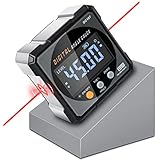
9. COROLLATA Digital Angle Finder and Laser – Best for Laser Layout
COROLLATA Digital Angle Finder & Gauge, Magnetic Dual Laser Inclinometer
0.05 degree resolution
Magnets on all four sides
USB-C rechargeable battery
IP67 rated
- Strong magnets on all four sides snap to saw blades without sliding
- Rechargeable USB-C battery holds a long charge
- Backlit display readable in bright and dark conditions
- Display auto-inverts for overhead measuring
- Dual lasers genuinely useful for matching horizontal lines
- Mode buttons occasionally need several presses
- Bottom face is not perfectly flat on some units
- Cracked plastic front reported on one unit
- Picks up fine metal shavings
- Accuracy reported around 0.05 to 0.2 degree
The COROLLATA is the most specified tool in the group and it earns that: plus or minus 0.2 degree accuracy at 0.05 degree resolution with 0.1 degree repeatability, an aluminium alloy body, magnets on all four sides, and an IP67 dust and water rating that means you can leave it in a dusty shop without worry.
The dual Class II lasers under 5mW are what set it apart from every other angle gauge here. They project a level line for matching horizontal references across a room, which turns an angle tool into a layout tool. The USB-C rechargeable 340mAh battery means no coin cells to lose, and the working range of 14 to 122 degrees F covers a cold garage in winter and a hot shop in summer, which you can confirm with one of our digital thermometer picks before you trust a reading taken in a cold garage.
Zero works at any angle, the display auto-inverts, and the pocket size of 2.4 inches with a belt bag makes it the easiest one to keep on your person. Owners rate it highly for miter saw setup, drywall layout, picture hanging and pipe work.
Is the precision real in the shop
Repeatability of 0.1 degree is the number that matters for woodwork, and that holds up in owner reports. The caveat is that some units have a base that is not perfectly flat, which introduces drift. Check it against a known flat surface on a granite surface plate or a quality straightedge once, and you will know whether your particular unit is honest.
Where the extras stop paying off
Mode buttons that need multiple presses before registering are an annoyance when you are trying to zero quickly, and a cracked plastic front reported on one unit is a reminder that the aluminium body does not mean impact-proof. It also collects fine metal shavings, which distort readings, so wipe it after metal work. If you do not need the lasers, you are paying for a feature you will not use, and a simpler gauge will serve the woodworking job just as well.
As an Amazon Associate we earn from qualifying purchases, at no additional cost to you. CERTAIN CONTENT THAT APPEARS ON THIS SITE COMES FROM AMAZON. THIS CONTENT IS PROVIDED 'AS IS' AND IS SUBJECT TO CHANGE OR REMOVAL AT ANY TIME.
10. S&F STEAD & FAST Digital Angle Finder – Best Stainless Steel Build
S&F STEAD & FAST Stainless Steel Digital Angle Finder Tool, 7 Inch / 200 mm
Stainless steel arms
0.05 degree resolution
Continuous 400mm scale
CR2032 battery included
- Etched stainless scales stay readable and resist corrosion
- Continuous scale across both arms up to 400mm
- Hold stores a reading that is hard to see in a tight spot
- Zero function makes relative angle work straightforward
- Individual serial number for quality traceability
- Smallest review base in this group at 849 ratings
- Coin cell rather than a rechargeable battery
- Plain LCD with no backlight mentioned
The S&F STEAD & FAST is a 7 inch stainless steel angle finder with a continuous etched scale running across both arms to 400mm total. The continuous scale is the quiet advantage. Most hinged digital protractors have a gap at the pivot, so a long measurement needs two passes and a mental average. This one reads across the whole span in a single placement.
Resolution is 0.05 degree and the large LCD can show decimal degrees or degrees and minutes, which is useful if you are matching a protractor scale marked in minutes. A zero button handles relative angles and a hold button stores a reading in memory so you can pull the gauge off a confined space and still see the number. Automatic power off after five minutes keeps the CR2032 alive, and it is pre-installed behind a pull tab.
Each instrument carries its own serial number for quality traceability, which is unusual at this level and tells you the manufacturer is tracking individual pieces rather than batching them. Buyers respond to the durable steel construction and to the hold and zero functions for trim, molding and table saw layout.
The honest limitation
With 849 ratings this is the newest listing in the group and the smallest review base, so there is not yet a deep record of long-term durability. That is a real consideration for a tool you may keep for a decade. There is no backlight mentioned, and the coin cell means no USB charging.
Who it suits
It is a good choice for a garage shop or a shop in a damp climate, because etched stainless steel will not corrode the way a painted blade does and it shrugs off a knock off a bench. If you mostly do trim and molding layout, the continuous scale and stored hold reading are the two features you will appreciate every week. If you mostly set saw angles on a cast iron table, a magnetic cube is the more natural tool.
As an Amazon Associate we earn from qualifying purchases, at no additional cost to you. CERTAIN CONTENT THAT APPEARS ON THIS SITE COMES FROM AMAZON. THIS CONTENT IS PROVIDED 'AS IS' AND IS SUBJECT TO CHANGE OR REMOVAL AT ANY TIME.
How to Zero and Calibrate a Digital Protractor in Five Steps
Almost every complaint about these tools being inaccurate comes down to a gauge that was never zeroed against a known reference. A few minutes here fixes the number one source of bad readings, and it is the single biggest quality upgrade you can make.
Get a genuinely flat reference. A granite surface plate is ideal, and a quality straightedge on a level table works well for most shop use. Do not calibrate against the saw table you are trying to measure, because that defeats the purpose.
Clean both surfaces. Dust and a fine film of sawdust on the reference is enough to shift a zero by a fraction of a degree, which then shows up as a wrong reading later.
Place the gauge on the reference with the measuring axis flat. If the gauge has a separate X and Y axis, confirm the axis you care about is the one sitting flat, because zeroing on the wrong axis is the most common error.
Press the zero button and confirm the display reads 0.0. Leave it in place for a few seconds while the reading settles before you assume it has taken.
Verify on a second angle. Set the gauge against a known 45 degree or 90 degree reference and check the reading. If it is off, repeat the zero on that surface, or accept that the unit needs calibration before any precision work.
Re-zero whenever you change reference surfaces, whenever the unit has been dropped, and at the start of each work session on the budget models that forget their zero after auto shut-off. On the products with a zero-relative function you can skip step one entirely and make any surface your zero, which is how you get a true 90 degree reading off a table that is out of level.
Digital Protractor vs Digital Angle Cube vs Machinist Square
Confusing these three categories is the reason a lot of buyers end up with the wrong tool, and the forum consensus is that they are not interchangeable. An angle cube is a pocket-sized magnetic block, usually with a vial and a laser option, and it is built for blade tilt, jointer fence checks and anywhere a long level will not fit. It is fast and accurate over a short reference edge.
A digital protractor with an integrated ruler is a different proposition. It has a long, rigid, graduated arm, so it can find an angle over a wide surface, copy it, and carry it to another location. That length is exactly what you want for layout work on trim, crown and cabinet parts, and exactly what you do not need when you are only checking whether a blade is at 30 degrees.
A machinist square is the one none of these tools can replace. It is a physical standard, not a sensor, so it cannot drift, cannot be mis-zeroed and does not need a battery. For the primary squareness reference on a fence, a blade or a jig you intend to rely on for years, a square or a machinist square stays on the bench. The digital gauge finds and sets angles; the square is what you check them against when it matters.
How to Choose a Digital Angle Finder
Start with accuracy versus resolution, because the two are routinely confused. Resolution is how finely the display can show a number, so 0.05 degree resolution means it can display 30.05. Accuracy is how close that number is to the truth, and a gauge can show two decimal places while being a full degree out. Buy on the accuracy figure, and treat resolution as a display nicety.
Range is the second decision. A 0-90 degree gauge covers saw bevels. A 0-180 model handles compound miters and slopes without flipping the tool. A 0-360 quadrant gauge measures any orientation, which is why the GemRed DAG-V1 suits blade tilt. Anything beyond 360 degrees is a spec-sheet flourish with no practical use in a wood shop.
Body length maps directly to the job, and this is where many buyers go too small. A 2 inch cube is right for blade tilt and fence checks. If you want to transfer an angle to a miter gauge, or copy a bevel across a 12 inch board, you need a longer arm and a locking mechanism, so you are looking at a T-bevel or rule-style protractor. Measure the longest cut you expect to check before you decide.
Magnetic base versus V-groove decides where the tool can live. A flat magnetic base holds on a cast iron saw top, a steel fence and a blade. A V-groove base adds round stock, pipe and ductwork, which matters if you do any metal trim. Some budget gauges magnetise only the flat face, so check whether the sides work before you plan to mount it vertically on a fence.
Finally, look at power, hold and backlight. Rechargeable USB-C removes coin cell anxiety entirely, and auto shut-off extends battery life on the coin cell models. A hold or data hold function stores a reading you cannot see in a tight spot, which is the difference between a useful measurement and a number you lose before you write it down. A backlit display is not a luxury in an unlit garage. If you are still choosing a saw to pair these with, our guide to cabinet table saws for woodworking pros covers the setups that reward accurate angle work.
One last trust point, because it comes up constantly on forums. Owners who verified a digital protractor against a Starrett combination square reported it dead on, and long-time users call it the best that can be had for shop use. The sceptics are not wrong that 90 and 45 degrees never needed a battery. They are right that a combination square handles those better. What the sceptics miss is that a gauge reading wrong, left unzeroed, is what turns a good tool into a bad one, and that is fixable in five minutes.
Frequently Asked Questions
What is the best digital angle finder for woodworking?
The Klein Tools 935DAG is the best digital angle finder for most woodworkers, with a strong magnetic base, auto-rotating display and both 0-90 and 0-180 degree ranges. For a long rule-and-protractor body that transfers angles across a wide surface, the GemRed 82305 is the better tool.
Are digital protractors accurate?
Yes, once they are zeroed. Budget models are typically specified at plus or minus 0.3 degree and aluminium-bodied gauges at plus or minus 0.2 degree. Most complaints about wrong readings come from a gauge that was never zeroed against a known flat reference, not from a defective sensor.
How do you calibrate a digital angle finder?
Place the gauge on a known flat surface with the measuring axis flat, press the zero button, and confirm the display reads 0.0. Then verify against a known 45 or 90 degree reference. Re-zero at the start of each session and after any drop, especially on models that lose their zero after auto shut-off.
Which digital angle gauge is better, the Wixey or the Klein?
On accuracy and construction the Klein 935DAG leads, with a magnetic base, V-groove edges and a 4.8 rating across more than sixteen thousand reviews. A Wixey gauge is a good alternative if you want a longer body for transferring angles to a miter gauge, and forum owners regularly run both together for different jobs.
Do I need a digital protractor when I have a combination square and sliding bevel?
Not for 90 and 45 degree work, where a combination square is faster and needs no battery. It earns its place for bisecting, copying unusual angles, verifying that a saw detent is truly at its mark, and reading a compound bevel you cannot otherwise set quickly.
Final Pick for 2026
The best digital protractors for woodworking come down to which job you do most. For checking a saw and getting a trustworthy number on any ferrous surface, take the Klein Tools 935DAG. For laying out angles across trim, crown and cabinet parts, the GemRed 82305 gives you the longer arm and the lock you need. For table saw blade tilt, the GemRed DAG-V1 with its 0-360 range and plus or minus 0.2 degree accuracy is the most convincing instrument in the group.
Whichever you choose, zero it before you trust it, and check the reading twice from two positions before you act on a saw adjustment. Every one of these tools was last verified against its published specifications and owner reports for October 2026, and the comparison above is meant to be your shortlist rather than a single answer.