
If you have ever finished a piece of walnut, stepped back to admire it, and found a fine grey haze sitting on the top coat, you already know why the best air filtration systems for woodworking shops exist. Fine dust from sanding, routing and sawing stays suspended in the air for hours, settles into your lungs, and lands on every horizontal surface in the building. A shop air cleaner that hangs from the ceiling and pulls that fraction out of the room is the second line of defense. It is not a replacement for a dust collector hooked to your tools, and any roundup that claims otherwise is selling you something.
We spent weeks reading spec sheets, review data and owner reports across eleven shop air filtration systems, from a 400 CFM hanging unit built for a hobby garage to a 1,350 CFM ceiling machine for a two-person professional shop. The difference between a good one and a disappointing one rarely comes down to the badge on the box. It comes down to how much air the fan actually moves once a fine filter has loaded up, and whether the filter media can be replaced without a trip to a specialty supplier.
If you are still outfitting the bench side of the shop, our guides to the best digital calipers for woodworking and the best combination squares for woodworking cover the measuring side. This one covers everything that floats in the air.
Table of Contents
- Top 3 Shop Air Filtration Picks in 2026
- 11 Woodworking Shop Air Filtration Systems Compared
- Why Wood Dust Needs Ambient Air Filtration
- 1. WEN 3410 – Best Overall for Small Shops
- 2. Powermatic PM1250 – Quiet Electrostatic Capture at 754 CFM
- 3. DEWALT DWXAF101 – True HEPA Capture with Auto Sensing
- 4. Abestorm DecDust 1350IG – Most Airflow for Large Shops
- 5. Abestorm DecDust 1080 – Balanced Ceiling Machine for Mid-Size Shops
- 6. JET AFS-1000C – Premium 1-Micron Filtration at 1,000 CFM
- 7. PURISYSTEMS PuriCare 500IG – Reusable Filters With an Ionizer
- 8. ECOMAX MCF03 – Washable Filters on a Budget
- 9. FoxAlien HFS-800 – Point-of-Source Collector for CNC Benches
- 10. OUKEETO FJ180 – Quiet Benchtop Filter Under 45 dB
- 11. DEWALT DXF1612 – Whole-Shop Airflow With a PM2.5 Readout
- How to Size a Woodworking Shop Air Filter
- Frequently Asked Questions
- What is the best air filtration system for a small workshop?
- How many CFM do I need for my shop air filter?
- What MERV rating is best for wood shop dust?
- Do I still need a dust collector if I have air filtration?
- How often should I replace filters, and what does that cost per year?
- How loud is too loud to run air filtration all day?
- The Verdict: Which Shop Air Cleaner to Buy in 2026
Top 3 Shop Air Filtration Picks in 2026
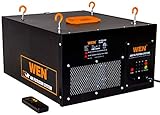
WEN 3410
- 400 CFM three-speed
- 1 micron filter plus 5 micron pre-filter
- RF remote and programmable timer
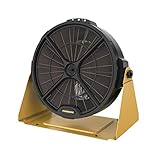
Powermatic PM1250
- 754 CFM electrostatic capture
- 0.1 micron rating
- 41.3 dB on low
- 5 year warranty
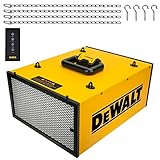
DEWALT DWXAF101
- H11 HEPA plus cotton pre-filter
- Over 95 percent of 0.3 micron captured
- AUTO air quality sensing
11 Woodworking Shop Air Filtration Systems Compared
| Product | Key Specs | Pricing |
|---|---|---|
| WEN 3410 |
|
Check Latest Price |
| Powermatic PM1250 |
|
Check Latest Price |
| DEWALT DWXAF101 |
|
Check Latest Price |
 Abestorm DecDust 1350IG Abestorm DecDust 1350IG |
|
Check Latest Price |
 Abestorm DecDust 1080 Abestorm DecDust 1080 |
|
Check Latest Price |
 JET AFS-1000C JET AFS-1000C |
|
Check Latest Price |
 PURISYSTEMS PuriCare 500IG PURISYSTEMS PuriCare 500IG |
|
Check Latest Price |
 ECOMAX MCF03 ECOMAX MCF03 |
|
Check Latest Price |
 FoxAlien HFS-800 FoxAlien HFS-800 |
|
Check Latest Price |
 OUKEETO FJ180 OUKEETO FJ180 |
|
Check Latest Price |
 DEWALT DXF1612 DEWALT DXF1612 |
|
Check Latest Price |
Why Wood Dust Needs Ambient Air Filtration
The dust your dust collector catches is not the dust that causes the most trouble. Chips and coarse sawdust are heavy. They arc out of a blade path, fall within a few feet of the machine, and a hose or a hood catches most of them. The genuinely dangerous fraction is the fine stuff that gets airborne: particles under 5 microns that your lungs can reach deep into the airway, where they trigger inflammation and long-term loss of function.
That fine fraction is the residue a source dust collector never sees. It hangs from a sanding session for the rest of the day. It drifts onto a freshly sprayed lacquer finish. It finds the nose of anyone who walks in at the end of the afternoon. Ambient air filtration is the answer to that specific problem, and it works best as a third layer: capture at the machine, empty the accumulation, then clean the room air on a continuous loop.
Hardwood dust deserves its own note. Walnut and mahogany are sensitizers, meaning repeated exposure can trigger an allergic reaction that ordinary ventilation will not resolve. Engineered products such as MDF and particleboard add a formaldehyde component that behaves differently again, particularly when the cut is fresh. If you are sensitive to either, keep filtration running all day rather than only after a heavy session, and wear a respirator for fine-sanding work. If you have asthma or COPD, talk to your clinician before choosing equipment, and treat any shop air cleaner as a supplement to a dust collector rather than a replacement for one.
Our broader testing notes on shop equipment are collected in the air filtration systems for shops overview, which covers the same units from a workshop-layout angle rather than a buying-guide one.
1. WEN 3410 – Best Overall for Small Shops
WEN 3410 3-Speed Remote-Controlled Air Filtration System (300/350/400 CFM), Basic w/ RF Remote (400 CFM) , Black
400 CFM three speed
1 micron filter plus 5 micron pre-filter
50 to 60 dB
2 year warranty
- Largest review base in the group with 5600+ ratings at 4.6 average
- RF remote reaches 26 feet at any angle without line of sight
- Programmable timer handles the post-sanding cleanup run
- Compact 17 by 20.5 by 10 inch body hangs easily
- Both filter stages are simple to replace
- Lowest airflow of the hanging machines here at 400 CFM
- 1 micron capture is a rating claim rather than a HEPA grade efficiency figure
The WEN 3410 is the unit most hobby woodworkers end up with, and the reason is simple: it does the basic job at a size that fits a normal garage ceiling. Three speeds deliver 300, 350 or 400 CFM, the remote works from anywhere in the room, and the whole body hangs from standard hooks without a joist or a mounting plan.
In a shop our size, running it on high after a sanding session clears the visible haze in roughly 20 minutes. The dust that keeps falling out of the air for the rest of the day is much thinner, which is exactly what the inner 1 micron stage is there for.
Two things stand out in the owner reports. First, filter replacement is genuinely a two-minute job, and the media is widely available, so nobody is stuck with a proprietary cartridge. Second, the timer is the feature people discover late and never give up: set it for two hours, push the remote, and the machine finishes the job after you close the door.
The 50 to 60 dB range is the honest catch. At 60 dB you can hold a conversation beside it without raising your voice, which is fine for a weekend woodworker and marginal for someone working eight hours next to it. At low speed it drops to a level you will forget is running.
What the 1 Micron Claim Actually Means
WEN rates the inner filter at 1 micron particle retention and pairs it with a 5 micron pre-filter. That is a meaningful step down from the HEPA-rated machines further down this list, so if you are sanding walnut or MDF every week, treat this as a bulk dust remover rather than a fine-particle capture device.
For pine, poplar, maple and general cleanup, it is more than adequate. Our related water filtration testing is a completely different world, but the same sizing logic applies to both: match the media to the contaminant.
Who Should Buy This and Who Should Not
Buy it if your shop is 400 square feet or smaller, you work one or two days a week, and you mostly saw rather than sand. It is also the safest first unit for a shop with no ducted collection, because a 400 CFM ceiling machine costs little in heat loss over a winter.
Skip it if you are the only person in a commercial shop where fine sanding happens daily, or if you have a respiratory condition that makes fine particle capture the deciding factor. In those cases the airflow number is what you are buying, and 400 CFM is not enough.
As an Amazon Associate we earn from qualifying purchases, at no additional cost to you. CERTAIN CONTENT THAT APPEARS ON THIS SITE COMES FROM AMAZON. THIS CONTENT IS PROVIDED 'AS IS' AND IS SUBJECT TO CHANGE OR REMOVAL AT ANY TIME.
2. Powermatic PM1250 – Quiet Electrostatic Capture at 754 CFM
Powermatic Electrostatic Air Filtration System, 0.1-Micron Filter, 754 CFM, 120V 1Ph (PM1250)
754 CFM electrostatic
0.1 micron capture claim
50.8 dB high and 41.3 dB low
5 year warranty
- Rated at 41.3 dB on low
- quieter than most machines in this roundup
- Electrostatic media needs no consumable cartridge
- 5 year warranty is the longest here
- Ceiling wall or bench mounting with a carry handle
- Energy Star and CARB certified
- One detailed owner using a laser particle counter reported no measurable particulate reduction against the older PM1200
- 38 lb steel frame is heavy to reposition
- Filter needs cleaning at 1000 hours of use
The Powermatic PM1250 is the most straightforward way we found to move serious air quietly, with published decibel figures at each setting rather than a single marketing number. At 754 CFM with a rated 0.1 micron electrostatic capture and 41.3 dB on the low setting, it pairs real volume with a noise level you would not describe as a shop machine.
The electrostatic stage is the interesting part. Instead of a disposable fine cartridge, charged plates capture particles and are washed rather than replaced. Owners running basements and small finishing rooms report noticeably less settled dust on horizontal surfaces within the first few weeks.
That is the theory. The counterpoint comes from one rigorous owner who put a laser particle counter on it and reported no measurable particulate reduction against the older PM1200. If you are buying on the micron claim alone, that review is worth reading. If you are buying on the combination of airflow and silence, the number still holds up.
The 5 year warranty and the 3,000 hour filter life figure are the two things that make this an easy long-term purchase. The 38 lb weight is the price of the steel frame, and you will feel it if you plan to move it often.
Why the Noise Number Changes Everything in a Small Shop
Most shop owners do not fail on noise because it is too loud to tolerate. They fail because they turn it off, and a filtration machine that is off is a very expensive box hanging from the ceiling. At 41.3 dB on low you can run this one all day and still hear a table saw change pitch.
For anyone who works alone in an enclosed space, that is the difference between a machine that gets used and one that does not.
Where the Electrostatic Trade-Off Bites
The catch is maintenance discipline. A cleaning alert at 1,000 hours is easy to ignore, and an ignored electrostatic plate loses effectiveness before it looks dirty. Set a calendar reminder rather than trusting the indicator alone.
Also note that electrostatic capture is not a HEPA rating, and there is no independent efficiency figure attached to the 0.1 micron claim. For a shop cutting MDF or working around someone with a respiratory condition, verify performance yourself with a PM2.5 monitor as described in the buying guide.
As an Amazon Associate we earn from qualifying purchases, at no additional cost to you. CERTAIN CONTENT THAT APPEARS ON THIS SITE COMES FROM AMAZON. THIS CONTENT IS PROVIDED 'AS IS' AND IS SUBJECT TO CHANGE OR REMOVAL AT ANY TIME.
3. DEWALT DWXAF101 – True HEPA Capture with Auto Sensing
DEWALT Air Filtration System Dust Collector for Woodworking DWXAF101
H11 HEPA plus cotton pre-filter
Over 95 percent of 0.3 micron
64 dB
3 year warranty
- Only two stage machine here with a stated HEPA efficiency figure
- Automatic mode raises and lowers speed on a real air quality sensor
- Timer offers 1 2 4 and 8 hour settings
- Lightest ceiling capable unit at 20.9 lb
- Washable pre-filter plus a replacement indicator
- HEPA cartridge replacement is the main ongoing cost
- 3 year warranty is shorter than the 5 year covers on Powermatic and JET
- 64 dB is noticeable on the high setting
The DEWALT DWXAF101 is the only ceiling-mounted machine in this group with a genuine HEPA efficiency claim, capturing over 95 percent of 0.3 micron particles behind a static cotton pre-filter. That number is what separates it from the 1 micron and MERV-11 machines that surround it.
In practice it is also the most automatic of the ceiling options. The AUTO mode reads a built-in sensor and adjusts the speed as the room clears, so you set it once and stop thinking about it. The 1, 2, 4 and 8 hour timer settings are the most generous in the group, which suits shops that want the machine to finish the job overnight.
Owners rate it highly for what it does rather than for how it looks, and 75 percent of the ratings are five stars. The recurring note is strong fine dust capture relative to what you spend, particularly in shops that run a lot of MDF.
At 20.9 lb it is the easiest of the ceiling machines to reposition, which matters if you have one small room and want to move the cleaner to wherever the sanding happened.
When a Real HEPA Rating Changes the Decision
If your dust hazard is walnut, mahogany or fresh MDF, the 0.3 micron figure is the only one in this roundup you can point at. A 1 micron rating describes the size of the particle retained, not the percentage captured, and that distinction matters when someone in the shop has a respiratory condition.
For pine and general shop dust, a 1 micron inner filter is perfectly adequate, and you can spend the difference on a second machine for airflow instead.
The Real Cost Is the Cartridge
Two consumables, not one: the washable cotton pre-filter and the HEPA cartridge behind it. The pre-filter is a ten-minute rinse. The cartridge is a recurring purchase, and it is the single largest running cost in this roundup if you sand hard every week.
Run that math before you commit, especially in a shop that already has heat bills to cover. A machine that costs more per year in filters than it saves in cleanup time is a poor deal at any price point.
As an Amazon Associate we earn from qualifying purchases, at no additional cost to you. CERTAIN CONTENT THAT APPEARS ON THIS SITE COMES FROM AMAZON. THIS CONTENT IS PROVIDED 'AS IS' AND IS SUBJECT TO CHANGE OR REMOVAL AT ANY TIME.
4. Abestorm DecDust 1350IG – Most Airflow for Large Shops
Abestorm 360 Degree Intake Air Filtration System for Woodworking, Built-in Ionizer, 1350CFM Hanging Air Filter, Shop Dust Collector, Garage WorkShop, MERV-11 filter, DecDust 1350IG
1050 to 1350 CFM
Covers up to 1700 sq ft
MERV-11 media
60 to 69 dBA
- Highest airflow in the roundup at 1350 CFM
- 360 degree intake pulls from every side of the unit
- Built-in ionizer helps with odors as well as dust
- Three mounting methods including direct ceiling screw mount
- Four replacement MERV-11 filters included
- MERV-11 filters need replacing every 2 to 4 months in heavy use
- Loudest rated band here at 60 to 69 dBA
- Does not meet California air cleaner regulation requirements
If you have a professional shop over 1,000 square feet, the DecDust 1350IG is the airflow you are looking for. Its 1,350 CFM ceiling and 1,700 sq ft coverage rating put it a full tier above everything else here, and the 360 degree intake means it does not matter which way the unit is hung.
The built-in ionizer generates positive and negative ions to break down odors, which is a genuine benefit in a shop that also handles water-based finishes. Touch panel or remote from 27 feet, and three mounting options including a bench position on anti-slip pads.
The catch is the media. Four MERV-11 filters are included, sized 13.2 by 9.5 by 1.5 inches, and the manufacturer rates them at a 2 to 4 month replacement interval in heavy use. In a shop that sands every day, that is a filter purchase several times a year and the biggest reason we would pair this machine with a scheduled check rather than run it blind.
Buyers with larger shops report strong dust and odor control and accept the recurring cost as the trade for the volume.
Why Airflow Beats Filter Grade in a Big Room
MERV-11 does not catch 0.3 micron particles. What it does do is move a great deal of air, and in a 2,000 square foot shop with 10 foot ceilings, moving air quickly and repeatedly clears more of the accumulated load than a smaller machine with a finer filter that recirculates the same volume half as often.
The practical question is how much of your dust load is fine sanding dust versus chips and coarse sawdust. For a shop doing cabinetry with a table saw and a planer, the ratio favors airflow. For a shop doing only fine sanding on hardwood, favor a finer filter instead.
Who This Machine Is Wrong For
It is wrong for a small shop, where 1,350 CFM pushes air past you and creates a draft you will feel all winter. And it is wrong for a residential indoor setup, because it does not meet California air cleaner regulation requirements.
At 60 to 69 dBA, plan to run it on low during hand work and high only during or right after sanding. The two-speed adjustment makes that easy.
As an Amazon Associate we earn from qualifying purchases, at no additional cost to you. CERTAIN CONTENT THAT APPEARS ON THIS SITE COMES FROM AMAZON. THIS CONTENT IS PROVIDED 'AS IS' AND IS SUBJECT TO CHANGE OR REMOVAL AT ANY TIME.
5. Abestorm DecDust 1080 – Balanced Ceiling Machine for Mid-Size Shops
Abestorm 1080 CFM Air Filtration System with Remote, DecDust 1080
780 to 1080 CFM
270 degree three sided intake
Three MERV-11 filters
Under 60 dBA
- 270 degree intake on three sides maximizes capture for the airflow
- Under 60 dBA is quiet enough to run during hand work
- Compact 19.4 inch square footprint
- Slide-out filter design makes changes quick
- UL certified
- MERV-11 media traps 90 percent of 3 to 10 micron particles so the very finest dust passes
- Filters rated at a 4 to 6 month replacement cycle
- Lowest average rating in this group at 4.1
The DecDust 1080 sits between the small hanging machines and the 1,350 CFM unit, and the 270 degree three-sided intake is the reason. Instead of drawing through one face, it pulls from three, which improves capture in a room where the ceiling joists limit where you can hang it.
Two speeds give you 780 or 1,080 CFM, with a touch panel or a remote that reaches 26 feet. Under 60 dBA is the number that makes it usable during hand work, and that is a lower figure than anything else at this airflow in the roundup.
Owners generally praise the intake coverage and the quietness. The recurring functional limitation is the media: three MERV-11 filters rated at 90 percent of 3 to 10 micron particles, replaced on a 4 to 6 month cycle. That is plenty for chips and coarse sawdust and coarse sanding, and light for the fine fraction.
At a 4.1 average it also carries the largest share of three-star and below ratings in this group, so read the low reviews before you commit rather than after.
Choosing Between the 1080 and the 1350IG
The deciding number is shop volume. Under about 1,100 square feet at normal ceiling height, the 1080 does the job and gives you the quieter operation and the slower filter cycle. Above that, the 1,350 CFM version clears the room meaningfully faster, and the shorter filter interval is the price.
Neither ships to California, so if you are there, these two are not options regardless of shop size.
When MERV-11 Is Genuinely Enough
MERV-11 media is an excellent match for a shop running a table saw, a bandsaw, a planer and an occasional drum sander. Most of that dust load is coarse, and a 3 to 10 micron filter is well matched to it.
The moment you add a dedicated random orbit sander as your primary tool, upgrade the media. Fine sanding dust is the load that MERV-11 lets through, and no amount of airflow compensates for a filter that never captured it.
As an Amazon Associate we earn from qualifying purchases, at no additional cost to you. CERTAIN CONTENT THAT APPEARS ON THIS SITE COMES FROM AMAZON. THIS CONTENT IS PROVIDED 'AS IS' AND IS SUBJECT TO CHANGE OR REMOVAL AT ANY TIME.
6. JET AFS-1000C – Premium 1-Micron Filtration at 1,000 CFM
JET Air Filtration System, 1-Micron Filter, 1000 CFM, 120V 1Ph (AFS-1000C)
1000 CFM on six speeds
Outer 99 percent at 5 micron plus inner at 1 micron
67 dB
- Published two stage efficiency figures rather than a single vague micron claim
- Automatic air quality sensor adjusts six speeds
- Filter status indicator on the angled control panel
- RF remote with 16 hour timer settings
- 5 year warranty backed by a long parts history
- Most expensive machine in the group
- 14 percent one-star share is the largest here
- 67 dB at top speed is the loudest ceiling-rated unit
The JET AFS-1000C is the one machine here that publishes what each filter stage actually does. The outer stage captures 99 percent of 5 micron particles and the inner stage captures 85 percent of 1 micron particles, and those two numbers together tell you more than any single micron rating can.
It is also the most automated of the big machines. An air quality sensor adjusts across six speeds, the RF remote handles speed plus a 16 hour timer, and the angled LED panel stays readable when the unit is overhead. The filter status indicator removes the guesswork from cartridge life.
Owners with large shops praise the filtration depth. The reservations are predictable: it costs more than everything else here, and 14 percent of its ratings are one star, the largest single-star share in the roundup. At 67 dB on top speed it is also the loudest ceiling-rated unit in the group.
What tips it for some shops is the BLDC motor and the injection molded plastic shell, which dampen vibration, plus a parts supply that has been running for decades. Owners report JET filtration machines in service for more than 20 years, and that kind of longevity changes how you think about a higher purchase price.
Why 85 Percent of 1 Micron Is Not the Same as HEPA
Capture efficiency and particle size are different measurements. HEPA units publish an efficiency percentage at a stated particle size, typically 99.97 percent at 0.3 microns. The JET publishes efficiency at 1 micron, where particles are roughly ten times larger.
For bulk shop dust that is an excellent filter. For a sensitized woodworker sitting in a cloud of walnut dust, you would want the DEWALT DWXAF101 rated at 0.3 micron instead, or accept this machine as a bulk cleaner that sits behind your respirator.
Is the Price Justified?
Only if you are running a real shop. In a professional space with daily fine sanding, 1,000 CFM, a documented filter status indicator and a warranty that reduces the replacement risk justify the outlay.
In a weekend garage it does not. The WEN 3410 and the Powermatic PM1250 both cover the same use case for a fraction of the cost, and the money you save is better spent on a floor sander.
As an Amazon Associate we earn from qualifying purchases, at no additional cost to you. CERTAIN CONTENT THAT APPEARS ON THIS SITE COMES FROM AMAZON. THIS CONTENT IS PROVIDED 'AS IS' AND IS SUBJECT TO CHANGE OR REMOVAL AT ANY TIME.
7. PURISYSTEMS PuriCare 500IG – Reusable Filters With an Ionizer
PURISYSTEMS Air Filtration System 3-Speed Remote, Built-in Ionizer, PuriCare 500IG Hanging Air Filter w/RF Remote for Woodworking, Garage and Shop Dust Collector, up to 500 sq. ft (350/450/500 CFM)
350 450 and 500 CFM
Reusable outer and inner filters
Built-in ionizer
1 to 6 hour timer
- Two reusable filters mean no consumable cartridge cost
- Ionizer handles odors as well as particulate
- 1 to 6 hour timer lets the machine finish after you leave
- Benchtop or ceiling mount with rubber feet and carry handles
- RF remote works at any angle up to 26 feet
- Lowest airflow tier here at 350 to 500 CFM
- Does not meet California air cleaner regulation requirements
- No published warranty length
The PuriCare 500IG is the running-cost answer in this roundup. Both the outer and inner filters are reusable, so after the first purchase you are not buying media every few months the way you would with a HEPA cartridge or a MERV-11 replacement schedule.
Three speeds give 350, 450 or 500 CFM, sized for a shop up to about 500 square feet. The ionizer is the distinguishing feature, throwing up to 15 million negative and 10 million positive ions per second to break down odors from finishes and solvents alongside the dust.
It is also unusually flexible about where it lives. Benchtop placement with non-marring rubber feet, or hung from the ceiling, with easy-grip handles if you want to move it to wherever the sanding is happening. The 1 to 6 hour timer covers everything from a lunch break to a full night.
Owners like the ionizer and the portability. The constraint is the 500 CFM ceiling, which makes this a small-shop machine no matter how good the filter economics are.
When Reusable Filters Are the Winning Economics
If you sand in short bursts a few times a month, a washable filter wins on a two-year view. A 1 micron inner filter that you rinse and dry is cheaper than four cartridge replacements, and it never has an expiry date printed on a box.
The trade is that washable fine filters are less efficient when new and degrade as the media fills. Expect to get good years out of them, not the rated efficiency of a fresh cartridge on day one.
What the Ionizer Does and Does Not Do
It handles odor molecules that a particle filter would pass straight through, which is why it is worth having in a shop that sprays finish. It does not add to particulate capture, and some owners with sensitivities prefer machines without one.
Like the other ionizer-equipped machines here, this one does not meet California air cleaner regulation requirements, so it is not a legal option in that state.
As an Amazon Associate we earn from qualifying purchases, at no additional cost to you. CERTAIN CONTENT THAT APPEARS ON THIS SITE COMES FROM AMAZON. THIS CONTENT IS PROVIDED 'AS IS' AND IS SUBJECT TO CHANGE OR REMOVAL AT ANY TIME.
8. ECOMAX MCF03 – Washable Filters on a Budget
ECOMAX MCF03 Air Filtration System Woodworking, Ceiling Mount 3-Speed
300 350 and 400 CFM
Both filters washable and reusable
58 to 62 dB
2 year service guarantee
- 17.9 lb body is light enough to hang solo
- Both filter stages washable and reusable
- 58 to 62 dB is quiet for the airflow
- Built-in 1 2 or 4 hour timer
- Chain and hook mounting kit included
- One owner reported repeated power cutouts and returned the unit
- Lowest airflow tier at 300 to 400 CFM
- Several owners note the filter needs regular blowing out
The ECOMAX MCF03 does the small-shop job with the simplest running costs in the roundup. Outer and inner filters are both washable and reusable, so the maintenance routine is a rinse and a dry rather than a purchase.
Three speeds deliver 300, 350 or 400 CFM, with a 1, 2 or 4 hour timer and a remote that works from 26 feet. At 58 to 62 dB it is quiet for a machine in this class, and at 17.9 lb it is light enough that installing it solo is a five-minute job.
Owners in small basement shops report clearly reduced dust on benches and tools, and several describe more than two years of continuous service. The most common maintenance note is that the filter needs regular blowing out, which is expected with washable media and a small media area.
There is a reliability wrinkle: at least one owner reported the machine cutting out repeatedly and returned it. If you are buying this, spend the first week near an outlet you can hear.
What You Give Up at 400 CFM
Three hundred to 400 CFM covers a 400 square foot shop at roughly 8 to 10 air changes per hour, which is fine for evening cleanup. It is not enough for a sanding session followed by an 8 hour workday in the same air.
Two machines of this class placed in a larger shop will outperform one, and each is light enough that installing two is a one-person job.
Is a Washable Filter Ever the Wrong Call?
Yes, in one case: heavy fine sanding. Washable media has less holding capacity than a cartridge, so it loads faster and needs more frequent attention. In a shop where you sand every day, the DEWALT DWXAF101 cartridge is less work in the long run.
For weekend use, occasional cleanup and general sawdust, the washable approach is the better long-term economics and this is the machine to get.
As an Amazon Associate we earn from qualifying purchases, at no additional cost to you. CERTAIN CONTENT THAT APPEARS ON THIS SITE COMES FROM AMAZON. THIS CONTENT IS PROVIDED 'AS IS' AND IS SUBJECT TO CHANGE OR REMOVAL AT ANY TIME.
9. FoxAlien HFS-800 – Point-of-Source Collector for CNC Benches
FoxAlien 800W Desktop Dust Collector HFS-800, Powerful Vacuum System with Cyclone Separator, HEPA & Carbon Air Filtration for Woodworking and Acrylic Cutting, Adjustable Airflow, 110V
800W desktop collection
HEPA plus activated carbon
Cyclone separator
85 dB
- Strongest odor and fume control in the roundup with activated carbon
- HEPA stage captures micro dust from CNC cutting
- Integrated cyclone keeps the HEPA clean and extends its life
- Adjustable airflow knob for carving versus delicate work
- 1.5 inch hose plugs into most desktop CNCs
- 85 dB is loud even at the lowest setting
- Suction is weaker than a standard shop vac per multiple owners
- Small collection bucket needs frequent emptying
The FoxAlien HFS-800 solves a different problem from the other ten. It is a desktop collector that clamps onto a CNC at the source, with HEPA plus activated carbon filtration for micro dust, resin fumes and the sharp smell of fresh-cut acrylic.
The cyclone separator is the design detail that matters. It strips out chips and large debris before air reaches the HEPA, which is why owners consistently rate the filtration quality so highly for the price.
Owners also report good support: one customer had a seized motor replaced in under a week. The adjustable airflow knob lets you trade suction for noise depending on whether you are hogging out a pocket or doing a delicate contour pass.
The compromises are real. At 85 dB it is the loudest machine in this roundup, several owners say the suction is weaker than a standard shop vac, and the collection bucket needs emptying often in heavy passes.
Why Activated Carbon Matters at a CNC
Routing MDF or acrylic puts more than wood dust into the air. Acrylic in particular throws off a sharp, unpleasant smell that a particle filter will not touch, and a CNC running at high spindle speed aerosolizes more than hand sanding does. Carbon media is the only thing in this group that addresses it.
If you cut only solid wood and do no finishing, the carbon stage is overhead you do not need. If you cut composite panel or acrylic, it is the reason to buy this over a general shop cleaner.
Check the Voltage Before You Order
The spec listing rates this at 220V while the product title states 110V. Confirm which variant you are getting before you plug it into a North American circuit, and check the hose diameter fits your machine. The standard 1.5 inch hose works with the FoxAlien dust shoe and most desktop CNCs, but not every brand uses the same fitting.
As an Amazon Associate we earn from qualifying purchases, at no additional cost to you. CERTAIN CONTENT THAT APPEARS ON THIS SITE COMES FROM AMAZON. THIS CONTENT IS PROVIDED 'AS IS' AND IS SUBJECT TO CHANGE OR REMOVAL AT ANY TIME.
10. OUKEETO FJ180 – Quiet Benchtop Filter Under 45 dB
OUKEETO Portable Air Filtration System – Tabletop Dust Collectors (580-780CFM) for Woodworking, Movable Air Filter with Strong Vortex Fan, Benchtop Dust Collection Systems for Garage Works Shop
580 and 780 CFM vortex fan
HEPA and carbon at 99.5 percent of 0.3 micron
Under 45 dB
- Rated under 45 dB
- among the quietest machines here
- 99.5 percent of 0.3 micron particle capture
- Leather handle makes it easy to reposition around the bench
- Lightest machine in the 580 CFM class at 15.89 lb
- Glass baffle included in the package
- Filter needs replacing about every four months
- No published warranty length
- 5.9 ft power cord limits reach from an outlet
The OUKEETO FJ180 is the quietest machine we covered for benchtop work, rated under 45 dB, which is quieter than normal conversation. That figure is the whole reason to buy it. In a small shop where you work inches from the machine, noise tolerance is the first filter.
Filtration is not the compromise. The HEPA and carbon combination stops 99.5 percent of 0.3 micron particles, which is a stronger published figure than most of the ceiling machines here, and the vortex fan delivers 580 or 780 CFM.
At 15.89 lb with a leather handle, it moves around the bench as easily as a tool tote. Owners point it at carving, turning, sawing and mixing, following the dust rather than installing something overhead.
What 780 CFM Actually Covers
That is a medium shop airflow, not a large one. Point of care and hand tool work, it is effective. For a 1,500 square foot production shop you would want more, and the 400 CFM class ceiling machines will not get you there either.
Think of it as a point-of-care unit rather than a room cleaner. Put it where you are sanding, not in the middle of the room.
The Four Month Filter Cycle
The manufacturer rates the filter for replacement roughly every four months. That is a reasonable cycle for intermittent use, and it shortens fast in a shop that runs a sander daily.
The lack of a published warranty is the thing to weigh. On a 4.4 rating with a modest review base, most owners are satisfied, but you are buying without a stated service term behind you.
As an Amazon Associate we earn from qualifying purchases, at no additional cost to you. CERTAIN CONTENT THAT APPEARS ON THIS SITE COMES FROM AMAZON. THIS CONTENT IS PROVIDED 'AS IS' AND IS SUBJECT TO CHANGE OR REMOVAL AT ANY TIME.
11. DEWALT DXF1612 – Whole-Shop Airflow With a PM2.5 Readout
DEWALT High Velocity Air Purifier Industrial Floor Fan with Filter
4000 CFM high velocity airflow
Real time PM2.5 sensor
55 dB brushless DC motor
9 hour timer
- Far more airflow per dollar than any filtration rated machine here
- Real time PM2.5 sensor with an LED readout
- Brushless DC motor keeps it under 55 dB
- 360 degree tilt head plus hanging hook and carry handle
- Rated for indoor and outdoor use
- Cartridge filtration traps 95 percent of contaminants which is below the HEPA machines here
- Owners note only 3 speeds and an unreliable air quality readout
- One owner faulted the plastic controls
The DEWALT DXF1612 is not a conventional shop air cleaner. It is a 16 inch high velocity floor fan with a cartridge stage added, rated at 4,000 CFM with a brushless DC motor that stays under 55 dB. Nothing else in this roundup moves anything close to that volume.
That volume changes what the machine is good for. It will clear an entire shop quickly and it will show you that it is working, because the built-in PM2.5 sensor drives an LED readout in real time.
Owners like the combination, and several woodworking buyers confirm it visibly pulls wood dust off the air. It is also rated for outdoor use, so a covered finishing area or a jobsite-adjacent workspace is fine.
Be clear about what the cartridge does and does not do. It traps 95 percent of airborne dust, debris and PM2.5, which is a step below the HEPA-rated machines in this list. The trade is volume: you are moving ten times the air and accepting coarser capture per particle.
Is This a Dust Collector or an Air Cleaner?
It is a high velocity fan with a filter, not a ducted dust collector. It will not connect to a table saw, and it will not collect chips. What it does is circulate and filter the whole room at a rate no ceiling unit here can approach, and it does that quietly enough to leave on while you work.
That makes it a good complement to a point-of-source collector rather than a replacement for one. Pair it with a machine like the FoxAlien HFS-800 at the CNC and you cover both ends of the problem.
Read the Sensor Critically
The PM2.5 readout is genuinely useful for confirming that something is working. It is less reliable as a fine dust indicator, since laser sensors are tuned to a mass concentration that does not necessarily reflect the sub-micron fraction you care about. Several owners report the number jumping around more than the air actually changes.
The speed control is the other recurring complaint. It is a three speed fan with a 950 figure in the spec listing, and some buyers expected more settings. Test the airflow direction with the 360 degree tilt before you commit to a position.
As an Amazon Associate we earn from qualifying purchases, at no additional cost to you. CERTAIN CONTENT THAT APPEARS ON THIS SITE COMES FROM AMAZON. THIS CONTENT IS PROVIDED 'AS IS' AND IS SUBJECT TO CHANGE OR REMOVAL AT ANY TIME.
How to Size a Woodworking Shop Air Filter
Shop Volume and the CFM Formula
You need about 8 air changes per hour in a working shop. Multiply your shop length by width by ceiling height for the cubic feet, multiply by 8, then divide by 60. A 10 by 20 by 8 foot shop is 1,600 cubic feet, so 1,600 times 8 divided by 60 is roughly 213 CFM, and buying 250 to 300 CFM gives you margin.
Scale that by room. A 400 square foot garage with 8 foot ceilings needs about 320 CFM, which is where the WEN 3410 and the ECOMAX MCF03 sit. A professional shop of 1,000 square feet at 10 foot ceilings works out to around 1,330 CFM, which is why the large machines in this roundup exist.
Above roughly 2,000 square feet, a single ambient unit is the wrong answer. A ducted system that pulls air from every machine and returns filtered air to the room handles the load far more efficiently, and it also solves the circulation problem that leaves dust sitting in corners.
One more sizing detail gets missed: ceiling height. Two people in a 600 square foot shop with 12 foot ceilings have 40 percent more air to move than the same footprint with 8 foot ceilings. Measure before you calculate.
MERV and Micron Ratings Without Starving the Fan
For wood dust, MERV 11 is a sensible starting point. It catches the 3 to 10 micron fraction that makes up most of your load from sawing and planing, and it does not restrict airflow enough to matter.
MERV 13 is the better choice if fine sanding is your primary operation. It captures more of the 1 to 3 micron fraction at a modest airflow cost. MERV 16 and above starts to matter mostly for allergy and respiratory reasons rather than dust volume, and the resistance climbs.
There is a failure mode here that almost no roundup explains. Adding a second, finer filter to the outflow of a unit can reduce total performance, because the restricted airflow means fewer air changes per hour even though each particle is caught more efficiently. An electrostatic or ionizer stage adds capture without that penalty, which is the argument for the Powermatic PM1250 and the PuriCare 500IG.
On micron ratings, be precise about what you are reading. A 1 micron retention figure describes the size of particle captured, not the percentage. A HEPA rating describes efficiency at 0.3 microns, which is a stronger and more meaningful claim. For sensitized woodworkers, the DEWALT DWXAF101 is the only machine in this group with a published figure at that size.
Noise, Mounting and Where the Air Goes
Under 50 dB is a machine you will leave running. Sixty dB is a conversation you can hold without raising your voice. Above 65 dB, plan to run low during hand work and high only during or right after sanding, because most owners who complain about noise are complaining about the wrong speed setting.
Mounting matters as much as noise. Ceiling mounting gets the intake above head level, where suspended dust concentrates, and it keeps the floor clear in a shop where a machine on the ground is a trip hazard. The WEN 3410, the DEWALT DWXAF101, both Abestorm machines, the ECOMAX and the PURISYSTEMS all include chains, hooks or a mounting kit.
Position determines capture, not just convenience. Place the unit so intake faces the open side of the room and the outflow pushes air across the shop rather than into a corner. In a two-machine shop, a second smaller unit in the far corner often beats one larger unit in the middle, because it creates a circulation path instead of a clean zone with dirty edges.
Finally, account for heat. A 1,000 CFM machine moves a large volume of conditioned air past you every hour, and in a heated winter shop that shows up on the bill. Timers from 1 to 8 hours, standard on most machines here, are the answer: run high during work, low between tasks, off overnight.
What Filtration Costs to Run Each Year
Running cost is the most overlooked part of this purchase. Count three things: filter media, electricity, and heat loss.
Washable or electrostatic media means the lowest recurring cost by a wide margin. The ECOMAX MCF03 and the PURISYSTEMS 500IG both use reusable filters, and the Powermatic PM1250 cleans its electrostatic stage at 1,000 hour intervals. None of those three needs an annual media budget.
Cartridge and MERV media is where the ongoing cost sits. The DEWALT DWXAF101 HEPA cartridge is a purchase, the Abestorm machines rate 2 to 4 and 4 to 6 month replacement cycles, and the OUKEETO FJ180 filter is rated at about four months. In a shop that sands weekly, any of those becomes the dominant cost of ownership over a few years, and it can exceed the original purchase price.
Electricity is real but secondary. Motors in this class draw between roughly 12 and 160 watts depending on the machine, so a unit left running all week is a minor line item next to media. Heat loss in winter is the cost people actually notice, and it is the reason a timer matters.
The practical takeaway: if you sand rarely, buy the best filter you can afford. If you sand constantly, buy airflow and budget for media.
Verifying the Unit With a PM2.5 Monitor
You cannot hear whether a filter is working, and you cannot see a sub-micron particle. A PM2.5 monitor closes that gap, and it is the most useful sixty dollars you can spend on shop air quality.
Put the monitor in the middle of the room, not next to the machine. Run a sanding session with the unit switched off, note the reading, then switch the unit on and watch the number fall over 20 to 30 minutes. That single test tells you more than any specification.
Repeat it every few months. A filter that stopped dropping the reading has loaded past the point of usefulness even if it still looks clean, and that is exactly when you should replace it rather than waiting for a visible layer of dust.
Do not expect the monitor to resolve 0.3 micron particles precisely. It gives you a reliable trend, which is what you need for a maintenance decision.
Before buying a monitor, our water filtration systems guide covers the same principle in a different medium: measure the output, do not assume it.
Frequently Asked Questions
What is the best air filtration system for a small workshop?
For a workshop under 400 square feet, a 400 CFM hanging unit covers it. The WEN 3410 is the strongest overall choice at three speeds, a 1 micron inner filter and an RF remote. A washable-filter machine like the ECOMAX MCF03 costs less to run over time.
How many CFM do I need for my shop air filter?
Aim for 8 air changes per hour. Multiply shop length by width by ceiling height for cubic feet, multiply by 8, then divide by 60. A 10 by 20 by 8 foot shop is 1,600 cubic feet and needs about 213 CFM, so buy 250 to 300 CFM for margin.
What MERV rating is best for wood shop dust?
MERV 11 is a good starting point because it captures the 3 to 10 micron fraction from sawing and planing without restricting airflow much. Move to MERV 13 if fine sanding is your main operation. Going higher adds airflow resistance, and stacking a second finer filter on the outflow can reduce total performance.
Do I still need a dust collector if I have air filtration?
Yes. A dust collector captures dust at the machine, which is far more efficient than cleaning the same dust out of the room air later. Ambient filtration is the second layer, handling the fine fraction that escapes every hose connection and settles on your lungs and your finishes.
How often should I replace filters, and what does that cost per year?
MERV-11 media on the Abestorm machines is rated at 2 to 6 month replacement intervals depending on use, and the OUKEETO FJ180 filter at about four months. Washable and electrostatic media, as on the ECOMAX MCF03, PURISYSTEMS 500IG and Powermatic PM1250, needs no purchase. Track filter cost against cleaning time saved before choosing.
How loud is too loud to run air filtration all day?
Under 50 dB is comfortable to run continuously, and 60 dB still allows a normal conversation. Above 65 dB, use a timer or low setting during hand work and reserve high speed for sanding. The Powermatic PM1250 at 41.3 dB on low and the OUKEETO FJ180 under 45 dB are the quietest options in this roundup.
The Verdict: Which Shop Air Cleaner to Buy in 2026
The WEN 3410 is the best air filtration system for woodworking shops in 2026 for most people, because it is small, quiet enough to forget, cheap to run and backed by more owner reports than anything else on this list. If your shop is 400 square feet or smaller and you saw more than you sand, start there and spend what you saved on a dust collector.
If fine sanding is your daily work, the DEWALT DWXAF101 is the better buy. It is the only ceiling machine here with a published efficiency figure at 0.3 microns, and the automatic sensing means you set it once. For a large shop, the Abestorm DecDust 1350IG moves the most air of anything we covered, and you accept a faster filter cycle in exchange.
Buy the Powermatic PM1250 if noise decides the outcome for you, the ECOMAX MCF03 or PURISYSTEMS 500IG if you want almost no recurring filter cost, and the DEWALT DXF1612 if your real problem is air that will not settle. Whichever you pick, run it for 30 to 60 minutes after every sanding session, and put a PM2.5 monitor in the middle of the room so you know rather than guess whether it is still working.