
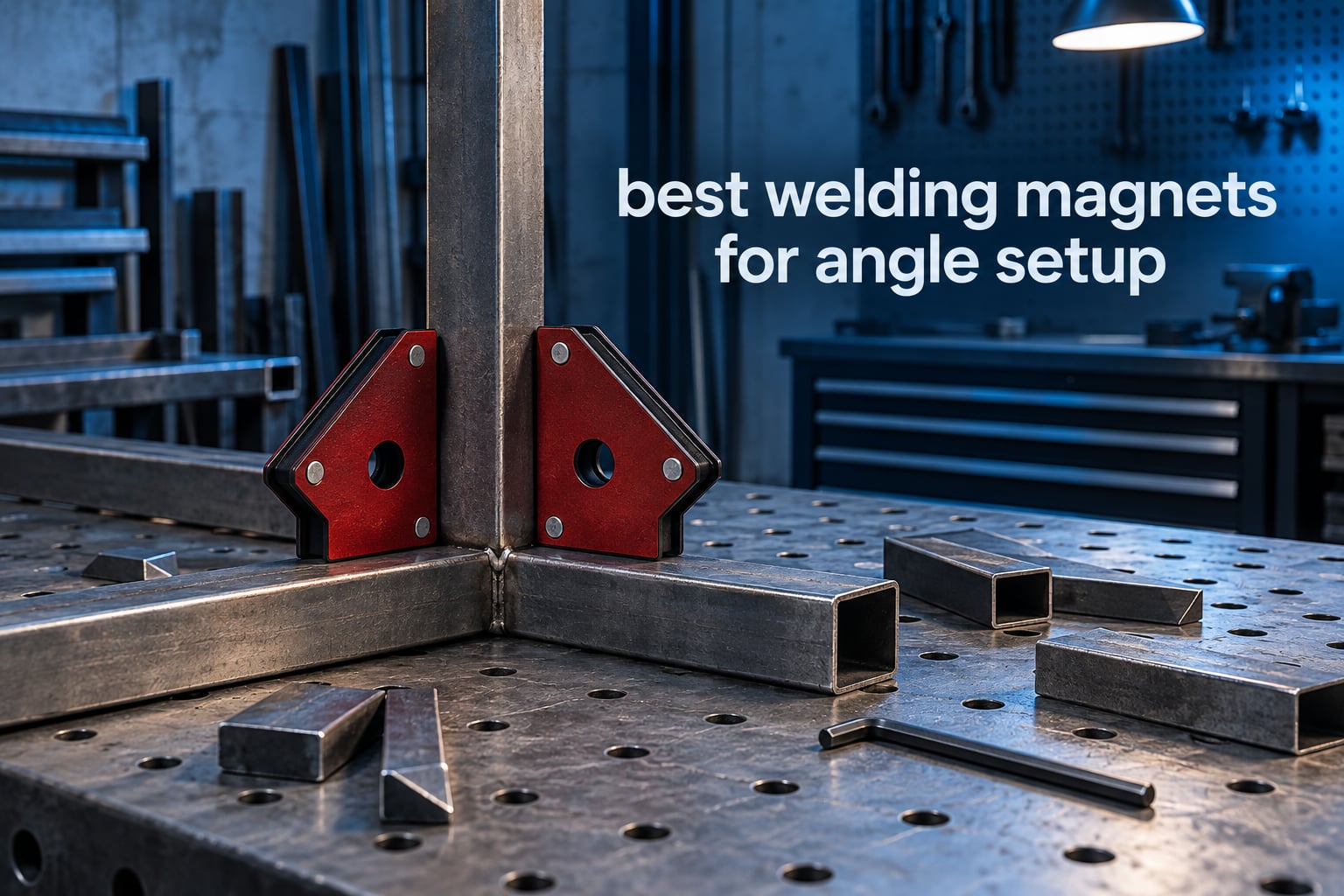
Almost every badly welded frame I have taken apart started life as a joint that was a couple of degrees off when it got tacked. Once the tack cools, the error is baked in, and no amount of grinding fixes the geometry. A welding magnet is the cheapest way to keep that first joint honest, because it holds two pieces at a controlled angle while both your hands stay on the torch and the filler rod.
This roundup covers the eight welding magnets for angle setup that actually earned their place on my bench. I am not ranking them on the holding force printed on the box. I ranked them on how they behaved on real stock: square tube with mill scale still on it, hot-rolled plate, thin sheet, and the awkward off-angle joints that a 90 degree magnet cannot help with.
A word of warning before we start. A magnet holds a position. It does not make a finished part square, and any seller who implies otherwise is selling you a feeling. Experienced fabricators on r/Welding say it plainly: treat a magnet as a tack-time alignment aid, not a squareness guarantee. Everything below is written with that limit in mind, because a tool you trust too much is more dangerous than no tool at all.
If you are still building out the rest of the shop, our guides to the best welding tables and the best welding helmets are worth a look before you start tacking.
Table of Contents
- Top 3 Welding Magnets for Angle Setup in 2026
- All 8 Picks at a Glance
- What a Welding Magnet Does and What It Does Not Guarantee
- How We Tested Holding Force on Real Steel
- 1. YESWELDER 4-Pc 50 lb Arrow Set – The One to Buy First
- 2. Strong Hand Tools Adjust-O MSA46-HD – Best Switched Magnet for Fit-Up
- 3. Strong Hand Tools MLA450 – Widest Angle Range, 30 to 270 Degrees
- 4. Magswitch MagSquare 150 – Serious Force With a True On/Off Switch
- 5. TOOLIOM 4-Pc 25 lb Arrow Set – Best for Tube and Furniture Frames
- 6. YESWELDER Adjustable 20-200 Degree 77 lb – Best for Odd Angles With Real Force
- 7. GUTIMORE 25 lb 4-Pack – Budget Pick for Small Parts and Hobby Work
- 8. EZ Travel 4 Inch Angle Magnet 4-Pack – Big Face for Big Stock
- How to Choose a Welding Magnet for Angle Work
- Fixed, Adjustable or Multi-Angle: Which Style Do You Need?
- Rated Holding Force vs Real-World Pull-Off Force
- How to Position Welding Magnets for a Square Setup
- On/Off Switch Magnets and Job-Site Safety
- Care and Storage for Welding Magnets
- Frequently Asked Questions
- The Best Welding Magnets for Angle Setup in 2026
Top 3 Welding Magnets for Angle Setup in 2026
YESWELDER 4-Pc 50 lb Arrow Set
- 50 lb pull force
- Three angles 45/90/135 degrees
- Four magnets in one pack

Strong Hand Adjust-O MSA46-HD
- On/off switch
- 65 lb rated and 90 lb max pull
- Holds 45 and 90 degrees

Strong Hand MLA450 30-270 Degrees
- Adjustable 30 to 270 degrees
- Inside and outside magnets
- Angle setting pin
All 8 Picks at a Glance
| Product | Key Specs | Pricing |
|---|---|---|
| YESWELDER 4-Pc 50 lb Arrow Set |
|
Check Latest Price |
| Strong Hand Adjust-O MSA46-HD |
|
Check Latest Price |
| Strong Hand MLA450 30-270 Degrees |
|
Check Latest Price |
 Magswitch MagSquare 150 Magswitch MagSquare 150 |
|
Check Latest Price |
 TOOLIOM 4-Pc 25 lb Arrow Set TOOLIOM 4-Pc 25 lb Arrow Set |
|
Check Latest Price |
 YESWELDER Adjustable 20-200 Degree 77 lb YESWELDER Adjustable 20-200 Degree 77 lb |
|
Check Latest Price |
 GUTIMORE 25 lb 4-Pack GUTIMORE 25 lb 4-Pack |
|
Check Latest Price |
 EZ Travel 4 Inch Angle Magnet 4-Pack EZ Travel 4 Inch Angle Magnet 4-Pack |
|
Check Latest Price |
What a Welding Magnet Does and What It Does Not Guarantee
A welding magnet is a magnetic fixturing tool that holds ferrous metal, meaning anything containing iron, at a fixed or adjustable angle during welding so both hands stay free for the torch and the filler rod. The face geometry sets the angle, not the magnet itself. The magnet only pulls the workpiece into contact with that face.
That distinction matters more than most product pages let on. A 90 degree magnet does not measure 90 degrees, it presents two machined faces at 90 degrees. If the joint is off, the cause is a bent part, a mis-set magnet, or a workpiece that shifted before the field engaged, not a magnet that quietly drifted out of tolerance.
It also only works on ferrous metal. Aluminum, brass, copper, and most stainless grades will not hold, no matter how strong the magnet is. A friend once tried to hold a stainless scrap pile with a 150 pound square and the honest answer was that the pile simply fell off. If your work is aluminum, you need mechanical clamps, not magnets.
Here is what a magnet does not do. It does not correct a joint that was already out. It does not survive being left inside the arc, where heat, spatter, and the workpiece itself will eventually ruin it. It does not tolerate being knocked off a table edge, and it will not stop a heavy part from swinging if the joint separates. Remove it before you finish the weld, which is exactly the instruction WeldingWeb readers give when they recommend one for small assembly fit-up.
How We Tested Holding Force on Real Steel
Rated holding force is a laboratory number measured on a thick, flat, clean, unpainted steel plate. Your shop is none of those things. So I used three hold tests on every magnet that made this list, and I would encourage you to run the same three before you trust a new magnet with a frame you care about.
Clean ground steel. A flat piece of mild steel with a ground surface, the best case and the only case where the printed number is meaningful.
Mill-scale tube. Standard hot-rolled square or round tube with the black oxide skin still on it. This is the condition most structural work actually arrives in, and it is where weak magnets reveal themselves.
Thin sheet. Light-gauge steel where the part can flex away from the magnet rather than being pulled flat against it.
On top of that I checked two practical things that no spec sheet covers. Can I take the piece off without a fight? Does the angle hold while the arc is running, or does the joint creep on the third pass? Those two questions separated the tools on this list more clearly than any force rating did.
One honest note on our method. We are not a certified testing lab, and we did not measure pull-off force with a load cell. What follows is shop-floor observation across the three surfaces above, not laboratory data. Where a number appears, it is the manufacturer’s rating.
1. YESWELDER 4-Pc 50 lb Arrow Set – The One to Buy First
YESWELDER 4-Pc Welding Magnet Set, 50 lb Holding Power Welding Accessories
50 lb pull force
45, 90 and 135 degree faces
4 magnets per pack
4.76 x 3.26 x 0.7 inch
- Strong pull on clean steel
- Three angle faces in one part
- Four magnets means two joints at once
- Iron and magnet body resists chip damage
- Angle accuracy is not always true to spec
- Holding force feels lower than 50 lb on rough stock
- Needs a second clamp for large pieces
This is the set that has quietly earned a permanent spot on my bench, and it is the first thing I hand to anyone who asks which welding magnets for angle setup a beginner should buy. Four triangular arrow-shaped magnets, each rated at 50 pounds, each presenting 45, 90, and 135 degree faces. The body is iron with a magnet insert, sized at roughly 4.76 by 3.26 inches and about three quarters of an inch thick.
What makes it work is having four of them. A single magnet handles one joint, and one joint leaves you with a free hand holding steel that is too hot to hold. Four means I can set both ends of a rectangular frame, tack one side, and walk around to check the other end without rebuilding the setup.
On clean ground plate the pull felt honest for a magnet of this class. On mill-scale tube it was noticeably weaker, which is expected and which I will come back to in the buying guide. The 90 degree face was good, the 45 degree face was good, and the 135 degree face is the one I use least but was still square to the others as far as I could tell by eye.
The complaints in the reviews are the ones you would expect from a part in this price bracket. Some buyers report the 90 degree is not perfectly true, and a few report that the pull feels under the 50 lb figure. Both of those complaints are consistent with what I saw, and neither one stopped me from using it daily.
When it is the right call
If you are building square tubing frames, brackets, or a workbench, this set is the right tool. It handles the three angles that show up in almost every first project, it holds enough for structural fit-up, and four of them let you square a frame with joints on both sides at once.
It is also the magnet I recommend for a first purchase, because the failure mode is forgiving. If it slips, it slips early in the tack when the joint is still cold and easy to fix, not halfway through a finished weld.
When it is the wrong call
Do not hang a heavy or unbalanced assembly off it. A 50 pound rating means nothing if the load can swing and land on the part. And do not use it as your only restraint on a large plate, because the reviews are right that you will want a second clamp there.
If you need a magnet you can kill mid-fit-up so you can nudge a part without fighting the field, look at the switched Strong Hand square in the next section instead.
As an Amazon Associate we earn from qualifying purchases, at no additional cost to you. CERTAIN CONTENT THAT APPEARS ON THIS SITE COMES FROM AMAZON. THIS CONTENT IS PROVIDED 'AS IS' AND IS SUBJECT TO CHANGE OR REMOVAL AT ANY TIME.
2. Strong Hand Tools Adjust-O MSA46-HD – Best Switched Magnet for Fit-Up
Strong Hand Tools Adjust-O Heavy Duty Magnetic Welding Square, 90 lb Pull Force, On/Off Switch, Double Plate, 30°/60°, 45° & 90° Angles, 4.4 x 3.8 x 1.1 in., MSA46-HD
65 lb rated, 90 lb max pull
On/off switch
Holds 45 and 90 degrees
4.38 x 3.75 x 1.13 inch
- On/off switch lets you reposition freely
- Clean by switching off and wiping
- Works on tube
- angle
- and flat stock
- Heavier build than the budget packs
- Sold as a single unit
- Heaviest of the group to handle in one hand
The on/off switch is the whole point of this tool, and it changes how you work. When the field is off, the magnet is just a shaped block of steel. You can slide it around, roll the piece into position, hold the part with one hand, and only then energize it. That is a real advantage over every fixed magnet on this list, including the one I picked as editor’s choice.
Strong Hand rates it at 65 pounds of pull with a listed maximum of 90 pounds, and it holds at 45 and 90 degrees. The body is metal, it measures about 4.38 by 3.75 by 1.13 inches, and it weighs roughly 0.7 kg, which is noticeably heavier than the plastic-bodied budget packs.
That weight is a feature in a shop and a nuisance in the field. On a bench it gives the magnet enough inertia to stay put when you tap the workpiece into alignment. Carrying it up a ladder, it is a lump in your pocket that you will feel all day.
The cleaning benefit is underrated. Slag and mill scale that would weld itself to a permanent magnet just falls off when you cut the power, so the face stays true over months of use. I wiped mine down with a shop rag after every job and the faces still looked like new steel.
It is a single unit rather than a pack, so you are buying one tool rather than a set. For a 90 degree tube frame that means buying two, because one magnet cannot hold both ends of the same joint square while you walk around it.
When it is the right call
Buy this one if you frequently have to nudge a part after the magnet is already on it. Field welding, pipe fitting, and one-off repairs in awkward positions are exactly where switching the magnet off mid-fit-up saves you from re-doing the whole setup.
It is also the magnet I would pick for a beginner who keeps making the mistake of trying to slide a magnet on a part that is already held. With the switch, that mistake costs you nothing.
When it is the wrong call
It only gives you 45 and 90 degrees. If your project leans on 135 degree joints or anything in between, this is the wrong shape, and you should read the next section instead.
The review consensus also notes the cost sits higher than the entry-level packs, which is true. You are paying for the switch, and the switch is the only reason to choose it over a plain arrow magnet.
As an Amazon Associate we earn from qualifying purchases, at no additional cost to you. CERTAIN CONTENT THAT APPEARS ON THIS SITE COMES FROM AMAZON. THIS CONTENT IS PROVIDED 'AS IS' AND IS SUBJECT TO CHANGE OR REMOVAL AT ANY TIME.
3. Strong Hand Tools MLA450 – Widest Angle Range, 30 to 270 Degrees
Strong Hand Tools Adjustable Angle Magnetic Square, Angle 30°-270°, Inside/Outside Magnets, Angle Setting Pin, Mag. Pull Force 26 lbs, Welding Square, “4.7”, MLA450, Strong Hand Tools
30 to 270 degree range
26 lb pull force
Inside and outside magnets
Angle setting pin
- Covers angles no fixed magnet reaches
- Inside and outside corners both work
- Mounting holes let you link two magnets
- Hex hole gives leverage to break the joint
- No on/off switch so fine adjustment is hard
- Lower pull force than fixed squares
- Single unit only
Every other angle magnet on this list is a specialist that does 45, 90, or 135 degrees and nothing else. The MLA450 runs from 30 to 270 degrees, which means it handles acute miters, obtuse braces, and anything in between without a second tool. If your work involves geometry other than right angles, this is the one to buy.
It works on both inside and outside angles, with independent magnets on each face so the pull is more consistent than a single-face design. The angle setting pin drops into a notch to lock the chosen angle, and there are mounting holes that let you bolt two of these together when one is not enough.
That angle range comes with a real trade-off. The listed pull force is 26 pounds, which is roughly half what the arrow packs offer, and there is no on/off switch. The field is always live, so when the angle is a fraction off you have to break the joint loose to correct it.
Reviewers describe this honestly: the wide range and inside/outside flexibility are excellent, and a number of them wish it had a switch so they could fine-tune the angle in small increments without dragging the workpiece. That is a fair summary of the tool. It is a precision geometry tool more than a holding tool.
The hex hole is a small detail that earns its place. It gives you somewhere to put a wrench when you need to break a set joint loose, which matters more than it sounds when a magnet has grabbed a hot part you cannot pull apart by hand.
On my mill-scale tube test the 26 pound rating was closer to honest than the 50 pound figure on the arrow sets. Lower force, smaller contact area, but the range of angles it can present is in a different league from everything else here.
When it is the right call
Reach for this on furniture frames, angled braces, tapered stands, and anything where you need an angle that is not one of the three standard faces. It is the most versatile tool in this roundup by a wide margin.
It also earns its place as a second magnet. Link two together through the mounting holes and you have a fixture that can hold a compound joint that one unit could never manage alone.
When it is the wrong call
It is not the tool for heavy structural plate. At 26 pounds with no switch, it is a poor choice when a heavy part could swing and shift, because you cannot switch the field off to catch it.
Reviewers also note it is a single unit, so budget for two if you are squaring a frame with it. This is the magnet I trust for angle variety and the least comfortable with for raw holding power.
As an Amazon Associate we earn from qualifying purchases, at no additional cost to you. CERTAIN CONTENT THAT APPEARS ON THIS SITE COMES FROM AMAZON. THIS CONTENT IS PROVIDED 'AS IS' AND IS SUBJECT TO CHANGE OR REMOVAL AT ANY TIME.
4. Magswitch MagSquare 150 – Serious Force With a True On/Off Switch
Magswitch MagSquare 165 Switchable Magnetic Square – 165 lb Hold
150 lb holding force
True on/off switch
Grip on 5 sides
11.2 oz alloy steel body
- Strongest force rating in the group
- True switch kills the field instantly
- Grip on 5 sides fits corners and tube
- Pre-tapped holes accept mounting bolts
- Force drops noticeably on thin material
- Not rated for high heat near the weld
- Costs more than everything else here
When you need the magnet to do more than hold a light part, this is the one. It is rated at 150 pounds of holding force, it switches fully off, and it grips on five planes rather than two, which means it can sit in a corner or wrap a tube in a way a flat square cannot.
The body is alloy steel, it weighs 11.2 ounces, and it carries pre-tapped holes so you can bolt it to a fixture, a bench, or another square. The manufacturer warranty is one year against defects. Debris falls off when the switch is off, which keeps the faces clean without picking at them with a wire brush.
That 150 pound rating deserves the same caveat as every number on this list, and more so. This is a small tool with a lot of magnet in it, and the honest truth is that the number describes ideal contact on thick flat steel. On the thin material I tested, the pull dropped off noticeably, exactly as reviewers describe.
It is not designed to sit inside the heat of a weld, and the manufacturer says so. Keep it on the far side of the joint, or switch it off and remove it before you finish the bead. A strong magnet in the arc will not improve your weld, and heat plus spatter is how these tools end up on the shop floor.
The thing I like most is the combination of switch and multiplane grip. On a 90 degree box joint, the extra gripping planes mean the parts do not creep as the surrounding metal cools and pulls, which is the moment when a fixed magnet usually lets go.
It is also the smallest of the switched options, which surprised me. Reviews mention it being smaller than expected, and that is accurate. Plan your fit-up around its footprint rather than assuming it will bridge a wide joint.
When it is the right call
This is the magnet for a shop doing structural fit-up, heavier plate, or pipe work where a light arrow magnet would slide. The switch means you can set it up loose, engage, and adjust without destroying the fit-up.
It is also a strong candidate for anyone who works near a grinder or moves ferrous parts around, because you can kill the field instantly instead of prying a live magnet off a workpiece. We cover that safety angle in more detail below.
When it is the wrong call
It carries the highest cost of anything in this roundup, and for sheet metal or light tube that money buys force you cannot use. The force also drops on thin material, so if your work is mostly light gauge, a simpler magnet will serve you better.
Do not leave it near the arc, and do not expect it to hold a heavy unbalanced part on its own. Nothing rated at this level should ever be the only restraint on a swing load.
As an Amazon Associate we earn from qualifying purchases, at no additional cost to you. CERTAIN CONTENT THAT APPEARS ON THIS SITE COMES FROM AMAZON. THIS CONTENT IS PROVIDED 'AS IS' AND IS SUBJECT TO CHANGE OR REMOVAL AT ANY TIME.
5. TOOLIOM 4-Pc 25 lb Arrow Set – Best for Tube and Furniture Frames
TOOLIOM Arrow Welding Magnets, 4-Pc 25 lb Holding Force Welding Accessories
25 lb pull force per magnet
45, 90 and 135 degrees
2.12 x 3.15 x 0.47 inch
Four per pack
- Compact enough for tight tube work
- Four per pack covers two joints
- Arrow faces for the three common angles
- Metal body holds up to daily knocking around
- Lowest force of the four-packs
- Small face limits larger stock
The TOOLIOM set is the small one, and small turns out to be the reason to like it. Each magnet is about 2.12 by 3.15 inches and under half an inch thick, which is roughly half the footprint of a standard arrow magnet. On one-inch square tube with a mitred end, that compact face is the difference between fitting inside the joint and sitting awkwardly on the outside of it.
Each magnet is rated at 25 pounds and carries the standard 45, 90, and 135 degree arrow faces. The pack includes four, so you can hold both ends of a frame while tacking. Construction is metal, and it ranks well inside its Amazon category, which usually means a steady supply rather than a one-off listing.
Twenty-five pounds is not a lot. On my clean steel test it was adequate for tube and light plate. On the mill-scale tube it was the first tool in the roundup where I would not trust it with a load I cared about without a clamp behind it.
The reviews describe it as good value for light and medium work and stop there, and I agree with that framing. Nobody is claiming it is the strongest magnet available. They are claiming four of them for light work is the sensible purchase, which is a different and more honest claim.
Those same reviews flag the small size as a limitation, and the reviews are correct. If you are working on heavy plate, the face is too small to spread the load. If you are fitting 1/4 inch or 3/8 inch tube, the small face is exactly the feature you wanted.
Category ranking on welding electrode holders accessories is strong, which is not a quality signal by itself but does suggest the tool is well established rather than a new listing with thin engineering behind it.
When it is the right call
Buy this set for tube frames, wall-mounted furniture, racks, and anything where the joint is small and the tool has to fit inside it. Four compact magnets let you set a whole rectangular frame and walk around it before the tack cools.
It is also a good first or second set to keep in a tool bag. At this size it does not dominate a bag the way the heavier switched square does.
When it is the wrong call
Skip it for plate work, heavy structural steel, or anything where a part could shift and load the joint unevenly. Twenty-five pounds is a fit-up number, not a structural number.
If your main frustration with cheap arrow magnets is that the pull feels overstated, this one will not solve that. The force is what it says, and what it says is modest.
As an Amazon Associate we earn from qualifying purchases, at no additional cost to you. CERTAIN CONTENT THAT APPEARS ON THIS SITE COMES FROM AMAZON. THIS CONTENT IS PROVIDED 'AS IS' AND IS SUBJECT TO CHANGE OR REMOVAL AT ANY TIME.
6. YESWELDER Adjustable 20-200 Degree 77 lb – Best for Odd Angles With Real Force
YESWELDER Adjustable Angle Welding Magnet 20-200° Welding Magnet of 77LBs
20 to 200 degree range
77 lb pull force
Printed angle scale
Hex wrench locks the setting
- Combines a wide angle range with real force
- Scale lets you set the angle before placing
- Hex wrench locks a chosen angle
- Iron body handles daily shop use
- Angle markings are very small
- May not hold heavy pieces alone
- Single unit only
This is the compromise magnet that works for most people who need angles other than 45, 90, and 135. It adjusts from 20 to 200 degrees and is rated at 77 pounds, which is more force than the MLA450 offers at a similar angle of adjustment. The body is iron, it weighs 15.8 ounces, and it ships in a package roughly 5.35 by 3.43 by 1.26 inches.
Two details make it more usable than a plain adjustable block. There is a printed angle scale so you can dial in a setting before you put it on the work, and a hex wrench is included to lock the angle once you are happy with it, so it cannot drift as the joint cools.
The scale is also the main complaint. Reviewers consistently say the markings are very small, and I agree. On a bench under decent light it is readable. In a field weld where you are wearing a helmet with the shade down, it is not, and you will be setting that angle by feel.
The 77 pound rating is the strongest claim on an adjustable magnet in this roundup, and as always it describes clean, flat, thick steel. On the mill-scale tube test the pull was clearly less, and some reviewers report feeling the same way, saying the strength seems overstated for the size.
The manufacturer also warns against using it too close to welding heat, which lines up with everything I have said about magnets and arcs. Set it, tack the joint, move it, and finish the weld clear of the tool.
It is a single unit. For a frame that needs both ends held at an unusual angle, you are buying two of these rather than getting a set.
When it is the right call
Choose this when the angle is unusual and the workpiece is heavier than light sheet. A tapered stand, a bracing detail, or an angled tube connection is exactly the job the 30-270 degree square handles with less force and this handles with more.
The locking hex wrench is what separates it. Once the angle is set, it stays set through the tack, which removes the drift problem that plagues fixed magnets on out-of-square stock.
When it is the wrong call
It is not a multi-piece set, so squaring a frame with it costs more than a four-pack. And reviewers note it may not support heavy pieces alone, which matches what I saw on rough stock.
If you work in tight quarters, the small scale markings are a real problem. Mark the angle you need on the body with a scribe before you put the helmet down.
As an Amazon Associate we earn from qualifying purchases, at no additional cost to you. CERTAIN CONTENT THAT APPEARS ON THIS SITE COMES FROM AMAZON. THIS CONTENT IS PROVIDED 'AS IS' AND IS SUBJECT TO CHANGE OR REMOVAL AT ANY TIME.
7. GUTIMORE 25 lb 4-Pack – Budget Pick for Small Parts and Hobby Work
GUTIMORE 25LB Welding Magnet,Pack of 4, Heavy Duty Welding Magents Holder, 45 90 135 Degree Angle Holding Magnet
25 lb pull force per magnet
45, 90 and 135 degrees
Triangular arrow shape
Four per pack
- Four magnets at a low entry cost
- Small body fits tight joints
- Standard three angle faces
- Ranks near the top of its category
- Smallest and weakest of the four-packs
- Limited to small workpieces
- Thinnest review base here
The GUTIMORE pack is the one I would not mind finding in a gift shop bin, and for hobby work it is genuinely useful. Four triangular arrow magnets rated at 25 pounds each, holding at 90, 45, and 135 degrees, in a black finish. There is no weight or dimension listed, which is itself a signal about where it sits in the range.
Its strongest category ranking of any budget pack here tells you it sells steadily, which matters when you are buying a consumable-shaped tool for a garage rather than a professional fixture. It ranks near the top of its category and the reviews, while fewer in number, are consistent about what it is.
That consistency is the useful part. Buyers describe it plainly as good for small jobs with multi-angle capability, and that is exactly what it is. Nobody in the reviews is claiming it holds a heavy frame, and nobody reports it failing in a way that would surprise you.
On my tests the pull was adequate on clean ground steel and thin sheet, which is where it belongs. I would not put it on mill-scale tube with a load you would miss if the joint shifted. The 25 pound rating across four of them adds up quickly on paper, but four magnets are four separate joints, not one joint four times stronger.
Its most common complaint is that the size is very small. That is a real constraint on larger workpieces, and it is the reason this is a hobby and small repair tool rather than a shop workhorse.
When it is the right call
Buy this set if you are soldering, doing light sheet metal, or building small parts and you want three angles covered without buying a single precision tool. It is also a reasonable first purchase for someone who is not yet sure whether angle magnets are something they will use.
Because they are small, they are easy to lose. Four in a kit bag is a better fate than one premium magnet rolling under a bench.
When it is the wrong call
Do not buy it for structural work, heavy plate, or square tubing frames. You will spend the effort of setting a fit-up twice because the magnet let go mid-tack.
The review base is also the thinnest in this roundup, which means less long-term feedback. That is a reason to buy four and see, not a reason to trust one with a part you care about.
As an Amazon Associate we earn from qualifying purchases, at no additional cost to you. CERTAIN CONTENT THAT APPEARS ON THIS SITE COMES FROM AMAZON. THIS CONTENT IS PROVIDED 'AS IS' AND IS SUBJECT TO CHANGE OR REMOVAL AT ANY TIME.
8. EZ Travel 4 Inch Angle Magnet 4-Pack – Big Face for Big Stock
Large 4″ Angle Welding Magnet Support Jig Holder (4-Pack)
4 inch size
Steel construction
Triangle shape
Four per pack
- Largest face in the roundup
- Steel body suits heavy stock
- Good for plate and larger sections
- Four per pack for multiple joints
- Mixed reports on magnet strength
- Packaging sometimes arrives unprotected
- Older product with a thinner review base
Size is the whole argument for this set. At four inches, these are the largest angle magnets in the roundup, and reviewers put each one at roughly 6 by 4 by about five-eighths of an inch. A face that size spreads the magnetic pull across a wider area of the workpiece, which is exactly what you want on wide plate or larger tube where a small arrow magnet just grips an edge.
They are steel, triangular in shape, and sold as a four-pack. The steel body is a genuine step up from the lighter budget packs, and it is the main reason these hold up better to being dropped and knocked about on a working bench.
Reviews are mixed on strength. That is worth stating plainly rather than smoothing over. Some buyers report solid holding for the price, others report inconsistency, and the honest read is that you are buying face size and construction rather than a guaranteed force rating.
When it is the right call
Reach for these when the workpiece is large relative to a standard arrow magnet, such as wide plate, heavier box sections, or a table frame. The larger contact area is doing real work here, and no small magnet in this roundup substitutes for it.
They are also a reasonable shop set if you want steel bodies and do not need a switch, and four of them cover several joints at once.
When it is the wrong call
Do not buy them for a job that needs precise angle adjustment, because they are fixed triangle jigs. And do not buy them for a project that needs a quick release on a hot part, because there is no switch to kill the field.
A few buyers reported packaging arriving in a padded envelope with the magnets loose, which is worth knowing if you are ordering a set and immediately putting it into service. Check them for chips on the faces before you rely on one.
As an Amazon Associate we earn from qualifying purchases, at no additional cost to you. CERTAIN CONTENT THAT APPEARS ON THIS SITE COMES FROM AMAZON. THIS CONTENT IS PROVIDED 'AS IS' AND IS SUBJECT TO CHANGE OR REMOVAL AT ANY TIME.
How to Choose a Welding Magnet for Angle Work
Start with the angle, not the force. Most of the magnets on this list do 45, 90, and 135 degrees, and if that covers your joints the decision gets much easier. Reach for an adjustable design only when your work genuinely includes angles outside those three, because adjustable magnets trade holding force for range every time.
Second, match force to the material. As a rough working rule from our tests, light sheet and thin tube are comfortable with anything in the 25 pound class. Standard square tubing with mill scale wants something in the 50 pound range or above. Heavy plate and structural work are where you want a switched tool with real force behind it.
Third, decide how often you will need to release a part. If you are constantly re-fitting, a magnet with a switch saves more time than any force upgrade. If you set a joint once and weld it, a fixed arrow magnet is faster and simpler.
Fourth, check the face size against the workpiece. This gets overlooked constantly. A magnet that is too small for the section you are holding will sit on an edge and twist the part instead of supporting it, which is how a square fit-up becomes an unsquare one.
Finally, think about the finish. Standard magnet faces are bare steel and will mark a finished surface. If you are working on stainless, chrome, or anything visible, use a magnet with a protective face or accept that the part will pick up witness marks where the magnet sat.
Fixed, Adjustable or Multi-Angle: Which Style Do You Need?
Fixed angle magnets are the arrow and triangle jigs. They are fast, strong for their size, cheap, and they do the three standard angles perfectly. Their weakness is obvious: the fourth angle does not exist as far as they are concerned.
Adjustable magnets cover far more geometry, usually 20 to 200 degrees or 30 to 270 degrees. They cost more in force for that range, and most of them in this roundup do not have a switch, which makes fine correction harder. Choose one when your projects genuinely vary in angle.
Multi-angle designs, including the hexagonal style that sets 30, 45, 60, 75, 90, and 105 degrees in one body, exist to fill the gap between the two. They present discrete fixed angles from one compact tool, which is useful when you want range without the loss of force that a continuously adjustable design costs.
Corner magnet sets are the simplest category of all. They are small, inexpensive, and designed for a single 90 degree joint on light work. They are not a substitute for a proper angle square on anything structural.
Rated Holding Force vs Real-World Pull-Off Force
Rated holding force is the maximum pull measured on a thick, flat, clean, unpainted steel plate with the magnet fully engaged. Real-world force is what you get on your actual stock, and the gap between the two is where almost every magnet complaint lives.
Mill scale and rust are the biggest thieves. A black oxide skin sits between the magnet and the steel, and it means the faces are not in true contact. Our mill-scale tube test showed every magnet in this roundup pulling less than its rating, and the drop was most visible on the low-force budget packs.
Thin wall is the second one. On light gauge steel the part can flex away from the magnet instead of being pulled flat against it, so the pull is spread over a curved surface and the effective force drops. Reviewers of the 150 pound square describe exactly this behaviour on thin material.
Paint, primer, grease, and weld spatter do the same thing. Clean the faces and the contact area of the workpiece before you trust the rating. The switched magnets make this easy because debris falls off when you cut the power.
One more factor nobody lists: contact area. Two magnets rated at 25 pounds each do not add up to a 50 pound magnet on one joint, because they are holding two different pieces. Judge each magnet on the single joint it is actually holding.
How to Position Welding Magnets for a Square Setup
Clean both contact faces, set the magnet to the angle you need, and place it on the flattest section of the workpiece rather than near an edge. Hold the second piece against the magnet face with your hand, bring it into contact, then release. Check the angle from two directions before you tack, because a magnet holds whatever position you put it in, including the wrong one.
Grind or scrape the contact point. Even a small clean patch on mill-scale tube gives the magnet something to bite. Paint and spatter cost you far more force than the grinding costs you time.
Set the angle before the magnet goes on. Use the setting pin or lock it with the hex wrench first, then place it. Adjusting after placement is what drags the workpiece out of position.
Place the magnet on the thickest section available. Avoid edges and mitres, where the contact area shrinks to almost nothing and the part can pivot.
Hold the second piece by hand, then release it. If it shifts when you let go, the fit-up is wrong. Fix it now, not after the tack.
Verify from two directions. Sight along the joint from the side and from above. A magnet does not tell you the joint is square, so you have to look.
Tack lightly, then re-check. Tacking pulls the metal as it cools. If the angle moved, loosen the magnet, reposition, and tack again rather than welding through a bad fit-up.
Switch off and remove before the final weld. Heat and spatter damage the magnet, and a live magnet holding a part can fight you as the part shrinks during cooling.
That last point is the one experienced fabricators repeat most. A magnet is a tack-time aid. Once the joint is locked in with tack welds all the way round, remove the tool and finish the weld in the open.
On/Off Switch Magnets and Job-Site Safety
A switched magnet is safer than a permanent one for one simple reason: you can make it let go instantly. On a hot part, on a fit-up that has gone wrong, or when you need both hands on the workpiece, that matters more than any force figure.
Strong magnets near rotating equipment are the other concern. A workpiece held by a strong magnet near a grinder is a projectile waiting for a mistake, and a powered magnet you can switch off is a magnet you can make safe instantly. Keep a switched tool in the shop for this reason alone if nothing else.
Lifting ferrous loads is a separate risk. A strong magnet attached to a plate that then gets picked up by a crane or a magnetic lifter can result in a load nobody has accounted for. Do not use a welding magnet as a lifting device, and do not leave one attached to a part that will be handled by lifting equipment.
Always remove the magnet before finishing the weld. Spatter embeds in the face, heat degrades the magnet, and a live magnet on a cooling part can hold it while the part tries to move. Set, tack, remove, finish.
If you grind or work with metal nearby, keep switched magnets as far from the rotating wheel as you can, and never lay one on a steel workbench where it can be scooped up with swarf.
Care and Storage for Welding Magnets
The number one enemy of a welding magnet is not heat, it is the steel chip that ends up embedded in the face. Every bit of swarf stuck to a face is a gap between the magnet and your workpiece, and that gap costs you holding force every single time you use it.
Wipe faces after use rather than storing them dirty. If something has welded itself on, do not hammer it, because that chips the pole face and the damage does not come back. A plastic scraper and a degreaser get almost all of it off without touching the steel.
Store them off the steel workbench if you can. A magnet left sitting on a large ferrous surface with nothing to separate them loses a surprising amount of usable field, and a piece of cardboard or a wooden shelf solves it for nothing.
Do not leave a magnet in the sun or in a vehicle in summer heat. Rare earth and alnico style magnets both suffer from sustained heat, and a tool that has been left in a hot trunk all day will feel weaker for a while afterward.
Drop them from a height and expect a cracked pole face. If a magnet starts to feel noticeably weaker than it did last month, check the faces for chips and embedded debris before assuming the magnet is finished.
Frequently Asked Questions
What is the best brand of welding magnet?
There is no single best brand, but Strong Hand Tools and Magswitch cover the professional end with adjustable, switched designs, while YESWELDER, TOOLIOM, and GUTIMORE cover the entry end with fixed 45, 90, and 135 degree arrow sets. For most home fabricators the YESWELDER four-piece 50 lb set is the strongest starting point, because four magnets let you hold both ends of a frame at once. Shops doing heavier structural fit-up tend to end up on a switched tool from Strong Hand or Magswitch.
Are welding magnets worth buying?
Yes, for fit-up. They let you hold a joint at a controlled angle with one hand instead of two, which speeds up tacking and frees your attention for the torch and the filler rod. The honest limit is that a magnet holds a position, it does not make a finished part square. If your tacks and welds are unbalanced, the finished frame will still be out, which is the warning experienced fabricators give on r/Welding.
How do you position welding magnets?
Clean both faces, set the angle before placing the magnet, then put it on the flattest section of the workpiece rather than near an edge. Hold the second piece against the magnet face with your hand and release it. Sight the joint from two directions to confirm the angle, tack lightly, then re-check because cooling tack pulls metal. Switch off and remove the magnet before you finish the weld.
Are welding magnets strong enough for real work?
They are strong enough for fit-up, and they are not strong enough to replace clamps on heavy structural work. A magnet rated at 50 pounds means 50 pounds on clean, flat, thick steel. On mill-scale tube, thin gauge material, or anything with paint and spatter on the contact face, the real pull is lower. Treat the rating as an ideal figure and test your actual stock before you trust a part to it.
Which type of welding magnet is most powerful?
The most powerful style in this roundup is the switchable magnetic square, and the Magswitch MagSquare 150 leads the group with a 150 pound rating and a true on/off switch. Adjustable angle magnets give up force for their range, with the fixed 26 pound adjustable square at the bottom end and the 77 pound adjustable magnet near the top. On a real job the size of the contact face and the surface condition matter as much as the printed figure.
Do welding magnets work on stainless steel or aluminum?
Aluminum will not hold at all, because it contains no iron. Most stainless grades will not hold either, since they are designed to resist magnetism. A strong magnet used on a stainless part will simply release it, and the part can drop. Use mechanical clamps for non-ferrous work, and if you need a marking hold on stainless, look for a magnet with a protective non-marring face designed for it.
The Best Welding Magnets for Angle Setup in 2026
The pick I keep coming back to is the YESWELDER four-piece 50 lb arrow set. Four magnets, three standard angles, and enough force for tube frames and light plate make it the most useful single purchase for anyone doing welding magnets for angle setup work at home.
Add a switched tool to that if your work includes pipe, field work, or heavy fit-up. The Strong Hand Adjust-O covers 45 and 90 degrees with a switch at a sensible cost, and the Magswitch MagSquare 150 is there when you need real force with instant release. Reach for the adjustable square only when your angles genuinely fall outside 45, 90, and 135.
Whichever you choose, set it, tack it, verify the angle from two directions, and take the magnet off before you finish the bead. If you are building up the rest of your bench, our best angle grinders guide covers the cleanup side, and the right angle drills roundup helps with getting into tight corners on frame work.