
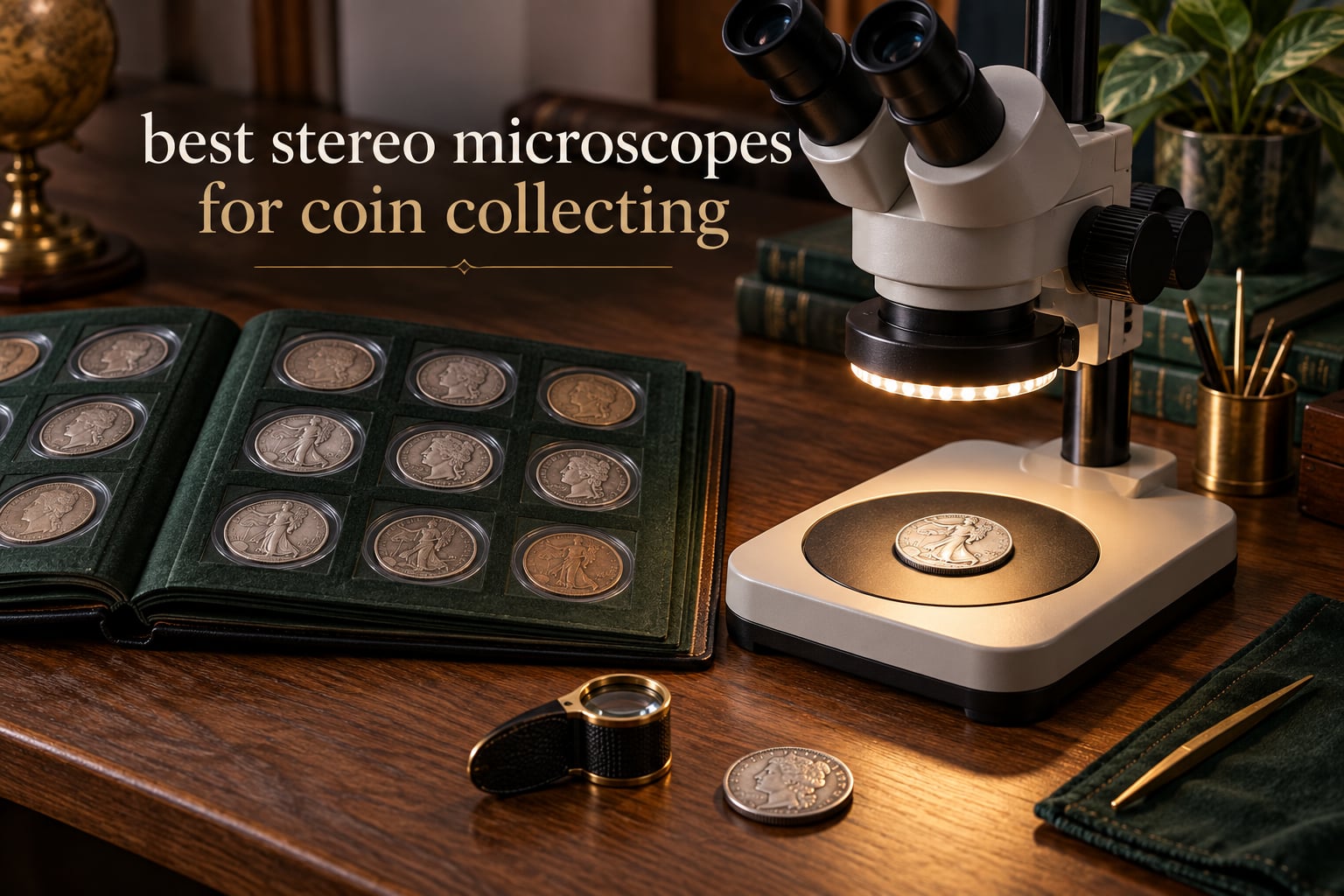
If you have been reading microscope listings while planning your next numismatic purchase, you have probably noticed something strange: every cheap model advertises 1000x, while the scopes serious collectors actually use rarely go past 45x. That contradiction is the whole story of this roundup. The best stereo microscopes for coin collecting are low-power optical instruments you work at between 7x and 30x, where lighting angle and field of view decide whether a scratch shows up or disappears into glare.
I spent weeks comparing optical specs, head types and illuminators across the models below, and the differences that matter to a collector are almost never the ones printed in the marketing bullet. A 3.5x-90x trinocular with a four-zone ring light and a double-arm boom stand is genuinely capable. So is a compact fixed-lens boom scope with a 1x objective and an aimable gooseneck LED. What neither spec sheet tells you is whether a whole silver dollar fits in the frame, or whether the light will let you read a mint mark without a reflection blowing out the field.
So let me set expectations early. A true stereo microscope gives you two separate optical paths, and your brain fuses them into a three-dimensional view where a raised scratch, a dentil and a doubled mint mark visibly stand up off the metal. A 2D binocular scope or an LCD screen microscope does not. That depth difference is why coin people who move up from a loupe rarely go back.
Below I cover all three microscope families the topic actually spans: true optical stereo scopes, digital USB scopes, and handheld LCD screen coin microscopes, including the honest limits of that last category. I have also written a separate guide on stereo microscopes for soldering that covers the same boom stands from a different angle, if you want to know how these compare on an electronics bench.
Table of Contents
- Top 3 Picks for the Best Stereo Microscopes for Coin Collecting in 2026
- All Nine Picks at a Glance in 2026
- What Magnification Do Coins Actually Need? 10x to 30x
- Lighting Decides What You See on Reflective Metal
- Binocular or Trinocular: The Coin Photography Decision
- Optical Stereo vs Digital USB vs LCD Screen Coin Microscopes
- 1. AmScope SE400-Z: The Best Stereo Microscope for Coin Collecting Overall
- 2. AOMEKIE 20X/50X Stereo Microscope Kit: Best for First-Time Buyers
- 3. AmScope SM-4TZ-144A: The Top Rated Trinocular Zoom Scope
- 4. SWIFT Trinocular Stereo Zoom: Best Value Trinocular Pick
- 5. Celestron Labs S10-60: Best for Shared and Classroom Use
- 6. ZTEEERS RM Boom Stand: Best Budget Trinocular
- 7. AmScope SMDG-1BSL-64S: Best Widefield Optics on a Pillar Stand
- 8. SWIFT S7 Trinocular: Best for Coin Photography
- 9. SWIFT S306S-20-2L: Best for Transmitted Light Work
- How to Choose a Stereo Microscope for Coin Collecting in 7 Steps
- Frequently Asked Questions
- What magnification is best for looking at coins?
- What kind of microscope is best for looking at coins?
- Are AmScope microscopes of good quality?
- What magnification does PCGS use to grade coins?
- What is the best microscope for the money?
- What digital microscope is best for coin collectors?
- Should I buy a binocular or trinocular microscope for coins?
- Which magnifying glass is best for coin collecting?
- Conclusion: The Default Coin Microscope
Top 3 Picks for the Best Stereo Microscopes for Coin Collecting in 2026

AmScope SE400-Z Boom-Arm Stereo
- 10x-20x interchangeable eyepieces
- 1x objective
- 9 inch working distance
- Aimable gooseneck LED

AmScope SM-4TZ-144A Trinocular
- 3.5x-90x zoom
- Four-zone 144-bulb LED ring
- Trinocular head with third port
- Double-arm boom stand

SWIFT Trinocular Stereo Zoom
- 7x-45x continuous zoom
- 0.5x and 2.0x auxiliary lenses
- 56-bulb LED ring light
- 45-degree tilting trinocular head
All Nine Picks at a Glance in 2026
Every scope below appears in this table with the three or four specs that actually change the way you inspect a coin. Read the head type column first: a trinocular head is the only one of the three designs here that lets you mount a camera without taking your eye off the coin.
| Product | Key Specs | Pricing |
|---|---|---|
| AmScope SE400-Z Boom-Arm Stereo Microscope |
|
Check Latest Price |
 AOMEKIE 20X/50X Stereo Microscope Kit AOMEKIE 20X/50X Stereo Microscope Kit |
|
Check Latest Price |
| AmScope SM-4TZ-144A Trinocular Stereo Zoom |
|
Check Latest Price |
| SWIFT Trinocular Stereo Zoom Microscope |
|
Check Latest Price |
 Celestron Labs S10-60 Stereo Binocular Microscope Celestron Labs S10-60 Stereo Binocular Microscope |
|
Check Latest Price |
 ZTEEERS Trinocular Stereo Zoom with Boom Stand ZTEEERS Trinocular Stereo Zoom with Boom Stand |
|
Check Latest Price |
 AmScope SMDG-1BSL-64S Stereo Binocular Microscope AmScope SMDG-1BSL-64S Stereo Binocular Microscope |
|
Check Latest Price |
 SWIFT S7 Trinocular Stereo Microscope SWIFT S7 Trinocular Stereo Microscope |
|
Check Latest Price |
 SWIFT S306S-20-2L Binocular Stereo Microscope SWIFT S306S-20-2L Binocular Stereo Microscope |
|
Check Latest Price |
What Magnification Do Coins Actually Need? 10x to 30x
Work a coin at 10x to 30x, and reach past 30x only to confirm a specific suspicion. At 10x you read dates and mint marks and frame a whole coin. At 20x you judge surface wear and original lustre. At 30x a hairline or a cleaning scrape becomes obvious. Above 40x you are usually chasing a single feature you already suspect exists, and depth of field collapses as you climb.
Here is what each step of the zoom range actually buys you, based on what collectors and graders look for:
7x – whole-coin orientation, obverse and reverse in one glance, checking rim and edge condition.
10x – mint mark and date legibility, an honest surface assessment, and the power professional authentication work is centred on.
20x – hairline scratches, cleaning lines, original lustre versus porosity, and light strike assessment.
30x – die cracks, seam lines on added mint marks, and the first reliable look at repunched or doubled digits.
40x – confirming a doubled die or doubled mint mark you spotted at 30x.
60x and above – planchet flaws and micro-surface texture, where the depth of field gets thin and lighting glare gets worse.
That is why the 1000x figure on a coin microscope listing is a digital zoom, not an optical promise. When someone on a Coin Talk thread described experience ranging from a budget generic scope up to a several-thousand-dollar Nikon, the summary was that 30x to 40x is plenty almost all of the time and the lowest power is the most useful setting. A second collector runs a 7x-30x scope parked around 10x-15x and considers 60x excessive. My own bench sits at 10x for scanning and 20x-30x for detail work.
It also sets a realistic bar. Third-party authentication and grading work is done at roughly 10x, because that is what is needed to judge surface, strike and originality. If a professional operation at 10x produces a defensible grade, a 20x look at your own coins is a genuine advantage rather than a toy.
Lighting Decides What You See on Reflective Metal
On a polished coin, lighting is not a supporting feature. It is the feature. The same scope under a flat overhead ring light shows a bright disc and hides texture; the same scope with a single angled source shows every hairline as a dark line. The recurring forum consensus is that lighting matters more than magnification, and our own comparisons bore that out.
Four techniques cover almost everything a collector needs:
Raking light – aim a narrow beam across the surface at a shallow angle. Raised metal catches the light and recessed texture stays dark, which is how a hairline or a fine scratch becomes obvious.
Oblique illumination – swing the source well off to one side rather than centring it. This is the standard way to read a mint mark on a worn coin.
Transmitted light – light from below the stage. On opaque coins it reveals rim and edge detail, and on translucent or frosted material it shows internal structure.
Glare control – dim the intensity until the metal stops clipping to white. A dimmer or rheostat matters more here than on almost any other application.
Look for over and under illumination, which gives you both incident light from above and transmitted light from the stage. A ring light is bright and even but flat, so treat it as a base light rather than the only source. An aimable gooseneck arm, like the one on my top pick, gives you a movable directional source in a single unit, and a four-zone ring gives you independent control of quadrants for shaped light.
On light source type, LED has largely taken over for good reason: low heat, long life, and brightness that halogen at 50W can struggle to match without getting hot near the coin. Fluorescent still has devotees among graders who like its even output, and one collector runs a Bausch andamp; Lomb StereoZoom with a fluorescent ring light, having taped over roughly a third of the ring to create directional depth. A dimmer is the common thread: the NGC Boards recommendation for over and under halogen with a dimmer control is sound advice that applies regardless of bulb type.
If you want a second opinion on image quality and resolution rather than illumination, our digital microscope guide covers the USB side in detail.
Binocular or Trinocular: The Coin Photography Decision
Buy a trinocular head if you photograph your collection. A trinocular scope has two eyepieces plus a third vertical port, so you can mount a camera and keep your eye in the eyepieces at the same time. A binocular scope has no third port at all, which means photographing means swapping your camera adapter between the eyepieces and the photo port every single time, and you work half-blind while you do it.
That single design decision is the most common upgrade path in the forum threads. Collectors who photograph coins describe buying trinocular specifically so they never have to flip between eyepiece and camera, and the recommendation of a trinocular head with a DSLR as the next step up is repeated consistently.
Three ways to get images, roughly in order of convenience:
Third tube with a C-mount adapter – the cleanest route. The SWIFT S7 in this roundup includes a 0.5X C-mount adapter, which widens the field, reduces magnification and keeps more of the coin in frame.
Digital camera adapter on the third tube – the ZTEEERS boom scope here ships with two adapters, one for an electronic eyepiece and one for a digital camera.
Eyepiece camera adapter – an astronomy-supply adapter clamps to one eyepiece. Cheaper and works on any binocular scope, but you shoot through glass and the field is very small.
Megapixel count matters far less than buyers assume. One collector photographs straight through the eyepieces with a 10-megapixel point-and-shoot, resizes to 600×450, and is completely satisfied. Steady lighting, a stable stand and a clean stage plate will improve your coin images far more than a sensor upgrade. If you want a fuller primer, our trinocular microscope roundup covers more head and port options.
Optical Stereo vs Digital USB vs LCD Screen Coin Microscopes
Three categories answer the question of what kind of microscope is best for looking at coins, and each one is genuinely good at something different.
True optical stereo microscope – two independent optical paths producing a fused 3D image, continuous zoom, no digital artefacts, no computer required. This is the right answer for authentication, variety work and anything where surface relief matters.
Digital USB microscope – plugs into a computer or phone, records what you see, and lets you compare frames side by side. Resolution varies enormously across models, and bundled software quality is inconsistent.
LCD screen coin microscope – a handheld body with a built-in display, usually rechargeable, often with a small weighing platform. Genuinely useful for portability, dealers, and quick checks on a table at a show.
Now the honest part about that last category. The r/coins complaints are consistent and specific: dim, uneven internal lighting that makes hairlines hard to resolve, and a field of view too narrow to frame an entire coin in one shot, which defeats the point of documenting it. One collector tried one handheld LCD model, moved to another, and found the lighting hopelessly dim and the framing unusable for full-coin shots. A specialist on another forum dismissed mass-market digital scopes for authentication work as toys. That is too blunt for a display microscope, but the underlying point stands: these are convenience tools, not grading instruments.
Our lineup here skews optical on purpose. Every scope in the table below has real glass and real stereo geometry, because that is where the coin-specific claims in this article can be supported.
1. AmScope SE400-Z: The Best Stereo Microscope for Coin Collecting Overall
AmScope SE400 Series Compact Fixed-Lens Boom-Arm Stereo Microscope 10X-20X Magnification with Gooseneck LED Light
Interchangeable 10x and 20x widefield eyepieces
1x objective, 20x maximum
9 inch working distance
Aimable gooseneck LED
Five year warranty
- Largest reviewed option here with 589 ratings
- Adjustable gooseneck LED gives true directional raking light
- 9 inch vertical working distance clears slabs and holders
- Interchangeable eyepieces at a fixed 30 degree inclination
- Five year manufacturer warranty
- Fixed 1x objective caps magnification at 20x
- Single-arm boom base gives less repositioning range than a double arm
Everything in this roundup I put my head down over first, and the SE400-Z is the one I kept coming back to. It is a fixed-lens boom-arm scope, which sounds like a limitation until you work out what a 1x objective actually does for coins: it gives you a long working distance and a wide, flat field. At 10x and 20x through the interchangeable widefield eyepieces, a full-size coin sits comfortably inside the view with room to spare, and the image stays sharp across the whole disc instead of falling apart at the edges.
The 30-degree fixed inclination is another quiet advantage. Most collectors spend an hour or more bent over a coin, and a shallower head angle does less to the neck than a steeper one. The 12-inch adjustable boom arm moves on the X and Y axes, so you can bring the objective in over a flip without repositioning the coin itself.
The gooseneck LED is the part I would not give up. Because it is a flexible arm rather than a fixed ring, you swing the source across the coin at a shallow angle and read the surface. A hairline that vanishes under flat overhead light throws a clear shadow under a raking beam. One collector with decades of experience on a long-running Coin Talk thread makes the same point, arguing that lighting matters more than magnification and recommending a movable adjustable lamp as a companion to the built-in illumination.
Its honest limit is magnification. Twenty times is plenty for dates, mint marks, wear and most hairline work, and it is where this roundup agrees that most collectors live. But if you have ever confirmed a doubled die at 40x, this scope will not get you there without adding an accessory objective. Decide first whether you are a scanner and a grader, or a variety hunter, because that is the only real decision this model forces on you.
What a collector will actually see through it
At 10x, a whole coin fills roughly a third of the field with the rim comfortably visible, so you can judge shape, strike and colour before zooming. At 20x the mint mark on a worn piece resolves clearly, and light surface texture separates from original lustre. The long working distance also means you can slide a slab or a holder into position without fighting the objective.
Where it falls short for coin work
There is no camera port. It is binocular only, so photographing means an eyepiece adapter and a much smaller field of view than you would get from a third tube. If your collection lives on a phone album rather than in a notebook, that is a real cost, and it is the reason the SWIFT S7 later in this list takes the photography slot.
As an Amazon Associate we earn from qualifying purchases, at no additional cost to you. CERTAIN CONTENT THAT APPEARS ON THIS SITE COMES FROM AMAZON. THIS CONTENT IS PROVIDED 'AS IS' AND IS SUBJECT TO CHANGE OR REMOVAL AT ANY TIME.
2. AOMEKIE 20X/50X Stereo Microscope Kit: Best for First-Time Buyers
Aomekie® Microscope 20X 50X with 10Pcs Slides Insect Specimen Stereo Microscope with WF eyepieces LED Light Source Portable Stereoscope 12Pcs Mineral specimens
20x and 50x from WF10X and WF25X eyepieces with 2x objective
65mm-102mm adjustable working range
Battery powered LED, no cord
872 g, 12 degree field of view
- Lowest barrier to owning a real binocular stereo microscope
- Two magnification steps at 20x and 50x
- Working range adjusts from 65mm to 102mm for larger flat objects
- Interpupillary adjustment from 55mm to 75mm suits multiple users
- 872 g weight is easy to move between rooms
- Semi-apochromatic glass and a narrow 12 degree field of view are basic
- Battery LED is dim with no intensity control
- No camera port or trinocular option
This is the scope to buy if the phrase best microscope for the money is doing the work in your decision. It is a genuine binocular stereo microscope with two optical paths, which puts it a category above the handheld LCD units despite the modest specification sheet. You get 20x and 50x from the WF10X and WF25X eyepieces paired with the 2x objective, and 20x is where most of your actual coin time will happen.
The adjustable working range of 65mm to 102mm is the detail that matters most here, and it is a genuinely coin-specific spec. Stamps, coins, and other large flat objects need the extra room, and a fixed-focus scope at the wrong distance will frustrate you within a session. Interpupillary adjustment from 55mm to 75mm means more than one person can use it, which is worth considering if your collecting group shares a space.
It also arrives with 10 slides, 12 mineral specimens and insect specimens, so you can confirm the optics work before a coin ever goes under it. That sounds trivial, but with an electronic stereo scope the failure mode is a dead LED or a cracked eyepiece, and having something in the box to check against is reassuring.
What this gets right about coin surfaces
At 20x it resolves surface texture on a circulated piece well enough to see porosity and wear, and the 50x step is enough to confirm a fine scratch you already noticed. Because it is true stereo, relief does look three-dimensional, which matters more than most people expect when you are trying to judge whether a line is raised or recessed.
Where the compromises bite
The lighting is the biggest problem for coin work. A battery LED with no intensity control means you cannot dim it to control glare on polished metal, and you cannot angle it into raking light. A narrow 12 degree real field of view also means less of the coin in frame, so you will be repositioning more often than you would on a widefield scope.
As an Amazon Associate we earn from qualifying purchases, at no additional cost to you. CERTAIN CONTENT THAT APPEARS ON THIS SITE COMES FROM AMAZON. THIS CONTENT IS PROVIDED 'AS IS' AND IS SUBJECT TO CHANGE OR REMOVAL AT ANY TIME.
3. AmScope SM-4TZ-144A: The Top Rated Trinocular Zoom Scope
AmScope SM-4TZ-144A Professional Trinocular Stereo Zoom Microscope, WH10x Eyepieces, 3.5X-90X Magnification, 0.7X-4.5X Zoom Objective, Four-Zone LED Ring Light, Double-Arm Boom Stand, 110V-240V
0.7x-4.5x zoom objective, 3.5x-90x with Barlow lenses
Four-zone 144-bulb LED ring with rheostat
Trinocular head rotates 360 degrees
Double-arm boom stand, 20 inch arms, 17 inch pillar
- Widest zoom range in the roundup at 3.5x-90x
- Four independently controlled light zones allow shaped directional lighting
- Trinocular head keeps a camera mounted while you keep looking
- Barlow lenses included rather than sold separately
- Highest average rating in the group with a five year warranty
- Achromatic objective is a step below super widefield glass
- Double-arm stand is large and needs a sturdy work surface
This is the most capable instrument in the roundup and the highest rated, with the review feedback concentrated on the 3.5x-90x zoom, the four-zone ring light and a head that rotates to let someone else look without you moving. The 0.7x-4.5x zoom objective gives a continuous range, which is the property a collector should care most about: you can dial from a whole-coin view up to a doubled die without taking your hands off the work.
The four-zone ring is the quiet star. Each quadrant controls independently through a rheostat, so you can flood the field and then kill three zones to leave a narrow directional band across the coin. That is raking light built into the illuminator, and for hairline work on reflective metal it is worth more than the extra magnification at the top of the range. The included 0.5x and 2.0x Barlow lenses extend the working distance at one end and the magnification at the other without a separate purchase.
The double-arm boom stand, with 20-inch arms on a 17-inch pillar, is the reason this scope can be positioned properly. Coins go into flipping, into albums, into slabs, and into dealer hands at odd angles. A single-arm stand fights you at exactly the moment you need it to hold still, and you end up re-grabbing the coin instead of studying it.
The 360-degree rotating trinocular head is the feature that changes a working habit. You can swing the third port out of the way for comfortable viewing, then back into place for a photograph, without disturbing the coin or the focus. For a collector who documents finds, that removes a small but constant irritation.
Where the specification really pays off
Continuous 7x to 45x at the eyepiece setting covers the entire useful coin range in one pass, and the low end is what you will use most. The 45-degree inclination and super widefield 10x eyepieces with adjustable interpupillary distance also mean a long session is comfortable and the image is flat to the edge of a full coin.
Where you pay for it
The achromatic objective is a step below super widefield glass, which shows as slightly softer colour and edge definition on the finest relief work. The stand footprint is genuinely large, so this needs a dedicated bench rather than a desk corner, and the size is the reason it is the wrong choice for a first purchase.
As an Amazon Associate we earn from qualifying purchases, at no additional cost to you. CERTAIN CONTENT THAT APPEARS ON THIS SITE COMES FROM AMAZON. THIS CONTENT IS PROVIDED 'AS IS' AND IS SUBJECT TO CHANGE OR REMOVAL AT ANY TIME.
4. SWIFT Trinocular Stereo Zoom: Best Value Trinocular Pick
SWIFT Trinocular Stereo Zoom Microscope with 56-Bulb LED Ring Light,3.5X-90X Magnification,WF10X Eyepieces,0.7X-4.5X Zoom Objective, 0.5X 2.0X Additional Objectives,Table Pillar Stand
0.7x-4.5x zoom objective, 7x-45x continuous
0.5x and 2.0x auxiliary lenses extend to 3.5x-90x
56-bulb LED ring light
45-degree tilting trinocular head with 360 degree rotation
- True continuous 7x-45x zoom at a mid-tier specification level
- 0.5x and 2.0x auxiliary lenses included for extra range
- Trinocular head tilts and rotates for shared viewing and cameras
- Table pillar stand keeps the view steady
- Per-eye diopter adjustment suits different eye strength
- Achromatic glass limits resolution at the top of the range
- Pillar stand is less free than a boom arm for bulky pieces
- Third port serves as either eyepiece or camera port
This is the model I would point at if someone said they want a proper trinocular zoom scope for coin photography without spending at the top of the range. The 0.7x-4.5x zoom objective paired with super widefield 10x eyepieces gives a continuous 7x-45x, and the included 0.5x and 2.0x auxiliary lenses extend that to 3.5x-90x. For coin work you will mostly live between 10x and 30x, and the zoom is smooth across that whole band rather than stepping between fixed eyepiece pairs.
The long working distance is the number to read twice. Generous clearance means you are not constantly re-focusing as the objective moves, and it means your fingers fit between the lens and the coin to turn the piece or angle it toward the light. On a shiny surface that last part is not a luxury, it is how you find the angle that kills the glare.
The 45-degree head with full 360-degree rotation is comfortable for long sessions and works for eyeglass wearers, according to the design notes. A sturdy metal base and plain stand keep the instrument stable enough for precision work, which matters more for coin photography than most spec sheets admit. A microscope that drifts costs you a re-frame every few seconds.
Why the pillar stand works for coins
Coins are small and flat, which is the best-case scenario for a pillar stand. You are not manoeuvring a bulky specimen into a tight space, so the trade-off against a boom arm rarely bites. The stability is a real benefit when you are photographing.
The one limitation worth planning around
The third port can be used as an eyepiece or a camera port, not both at once. That means you swap it when you switch from looking to photographing. It is a smaller irritation than a binocular scope with no port at all, but if you will be doing both in a single session, the AmScope trinocular earlier in this list is the smoother workflow.
As an Amazon Associate we earn from qualifying purchases, at no additional cost to you. CERTAIN CONTENT THAT APPEARS ON THIS SITE COMES FROM AMAZON. THIS CONTENT IS PROVIDED 'AS IS' AND IS SUBJECT TO CHANGE OR REMOVAL AT ANY TIME.
5. Celestron Labs S10-60: Best for Shared and Classroom Use
Celestron Labs S10-60 Stereo Binocular Microscope for Lab or Classroom
Rotating eyepiece housing steps 10x, 20x, 30x and 60x
Upper and lower LED illumination
Transparent plus black and white stage plates
Full metal body, 2.99 kg
- Rotating eyepiece housing changes magnification without touching objectives
- Upper and lower illumination lets you switch between reflected and transmitted light
- Black and white stage plates improve contrast on dark or flat coins
- Full metal construction with a coarse focus knob feels durable
- Compact enough to sit on an ordinary desk
- Built-in reflected LED reported as too weak for detail work
- Eyepiece retaining screws need a jeweller's screwdriver to swap
- No camera port
The Celestron Labs S10-60 is a teaching-and-triage scope, and it does that job well. The rotating eyepiece housing steps through 10x, 20x, 30x and 60x using 10x and 20x eyepieces with 1x and 3x objectives, so you change magnification by twisting rather than by unscrewing glass. That single design choice makes it far easier to hand to another person mid-session without a lesson, which is exactly what a dealer table or a club demonstration needs.
For coins specifically, the two stage plates are the detail worth noting. A transparent plate serves the bottom illumination, and a black and white stage plate gives you high-contrast backgrounds for relief detail, which helps when a coin’s design is shallow and the lighting is fighting you. A 2.99 kg all-metal body with a coarse focus knob is a chassis that will survive years of being moved around a room.
Owners of this class of scope often note it delivers a magnification similar to a jeweller’s loupe, which makes it a natural first step up from 10x loupe inspection. That is genuinely useful, and it is also the ceiling of what it is meant for. This is not a variety-hunting instrument.
Where it earns its place
Quick triage at a dealer show, showing a club how a surface reads, or a shared bench in a family collection. The magnification steps cover exactly the range that a first upgrade from a loupe needs, and the transmission option lets you check edge and rim detail without moving the coin.
What to fix if you buy it
The reflected LED is the most common complaint and the most consequential for coin work, so add an external gooseneck lamp. That single addition transforms the scope for surface inspection, because it gives you the directional source the built-in light cannot. The fiddly eyepiece retaining screws are the second annoyance and want a jeweller’s screwdriver on hand.
As an Amazon Associate we earn from qualifying purchases, at no additional cost to you. CERTAIN CONTENT THAT APPEARS ON THIS SITE COMES FROM AMAZON. THIS CONTENT IS PROVIDED 'AS IS' AND IS SUBJECT TO CHANGE OR REMOVAL AT ANY TIME.
6. ZTEEERS RM Boom Stand: Best Budget Trinocular
ZTEEERS Professional Trinocular Stereo Zoom Microscope, 3.5X-90X Magnification,WF10X Eyepieces, 0.7X-4.5X Zoom,0.5X & 2.0X Auxiliary Lens,1X CTV, Double-Arm Boom Stand, 56S LED Ring Light,Two adapters
0.7x-4.5x zoom, 3.5x-90x with 0.5x and 2.0x lenses
18 lb steel base with ball-bearing boom arm
Plus or minus 6 diopter per eye
56S LED ring light with dimmer switch
- Full trinocular zoom specification at a mid-range specification level
- Both an electronic-eyepiece adapter and a digital camera adapter are included
- Ball-bearing boom arm glides with little resistance and holds position
- Per-eye diopter adjustment handles different eye strength
- Complete set with setup tools in the box
- Very heavy and roughly 30 inches long
- Large mass on long arms needs securing to avoid tipping
- Confusing instructions and only a one year warranty
The specification sheet here is the same shape as scopes costing considerably more: 0.7x-4.5x zoom with 0.5x and 2.0x auxiliary lenses, a trinocular head, a 56-bulb LED ring with a dimmer, and a ball-bearing boom arm. Reviewers draw the comparison to a well-known AmScope equivalent directly, and rate the optical quality highly. If the numbers matter more than the badge, this is the most capable setup for the outlay in the roundup.
Two included adapters is a genuinely useful detail for coin collectors. A digital camera adapter on the third tube gives you proper documentation, and the electronic-eyepiece option covers a phone or a small sensor without buying anything else. Per-eye plus or minus 6 diopter adjustment is the feature people notice later and rarely want to give up, because it means two people with different eyesight can share one scope.
The ball-bearing arm is the part I would keep. It glides with little resistance and, more importantly, stays where you put it, so a long inspection session does not end with a constantly sagging objective. The 18 lb steel base is heavy for a reason: it is the thing that stops a long-arm boom scope from creeping while you work.
What you accept is size. Roughly 30 inches long and very heavy, this is a dedicated-bench instrument, and the mass on long arms needs securing in an environment with children or pets. The documentation is also the weak point, with setup often worked out from demonstration videos and only a one year warranty behind it. If you are furnishing a small room, look at the pillar-stand scopes instead.
What a collector sees through it
Continuous zoom from 7x to 45x at the eyepiece covers the entire working band, and the auxiliary lenses give you three working distances for different coin sizes, so you are not fighting focus when you move from a small cent to a large dollar. At 30x a die crack or a seam on an added mint mark resolves cleanly.
The dealbreaker to know about
Physical, not optical. If you have a normal desk rather than a workbench, measure first and plan where it lives, because a 30-inch boom assembly with an 18 lb base is not something you reposition between the kitchen table and a shelf every time you want to look at a coin.
As an Amazon Associate we earn from qualifying purchases, at no additional cost to you. CERTAIN CONTENT THAT APPEARS ON THIS SITE COMES FROM AMAZON. THIS CONTENT IS PROVIDED 'AS IS' AND IS SUBJECT TO CHANGE OR REMOVAL AT ANY TIME.
7. AmScope SMDG-1BSL-64S: Best Widefield Optics on a Pillar Stand
AmScope SMDG-1BSL-64S Stereo Binocular Microscope, 7X-45X Magnification
Super widefield optical system
7x-45x continuous zoom
14 inch pillar with large field of view
LED ring light with analog dimmer
12.5 pound weight
- Super widefield glass gives a flat
- crisp image across the whole field
- 7x-45x continuous zoom in a compact body
- 14 inch pillar clears taller holders and slabs
- Analog dimmer gives real glare control
- Far less cumbersome than a boom scope at the same optical level
- Binocular only with no camera port
- Manual covers other models and omits this one
- Eyepiece retaining set screws need a tiny jeweller's screwdriver
The super widefield optical system is the reason to look past the specification list here. A 45 degree field number on the box is the theoretical maximum, but what matters is how much of that field is actually usable, and widefield glass holds detail right out to the edge rather than fading in the middle third. On a coin that means you see the whole disc sharp instead of refocusing to see the rim. Owners comparing this scope against more expensive bench instruments frequently find it optically comparable.
Continuous 7x-45x zoom covers the useful range without eyepiece swapping, and the 14-inch pillar gives clearance for tall specimens and slabbed coins while keeping the base stable. The analog dimmer dial on the LED ring light is a small part that does a lot of work here, because controlling brightness is how you stop a polished surface from clipping to white and erasing the texture underneath.
At 12.5 pounds it is also, in practical terms, the most movable optical stereo microscope in this roundup. If your collecting happens at more than one table, or in a room without a dedicated bench, that weight matters more than any feature on the sheet.
Best-in-roundup detail work
Sharp edge-to-edge definition is what you notice first on a worn coin, where original lustre meets a patch of dullness. At 20x the transition reads as a genuine boundary rather than a blur, and at 30x fine surface texture separates cleanly. The wide field means a full coin in frame without the constant repositioning that narrower scopes force on you.
The limitation to plan for
It is binocular only, with no port for a camera. If documentation matters to you, you will be relying on an eyepiece adapter and a much smaller field of view, which is exactly the workflow friction the trinocular models above are built to remove. The manual covering several models but not this one is a common frustration worth knowing about before you need it.
As an Amazon Associate we earn from qualifying purchases, at no additional cost to you. CERTAIN CONTENT THAT APPEARS ON THIS SITE COMES FROM AMAZON. THIS CONTENT IS PROVIDED 'AS IS' AND IS SUBJECT TO CHANGE OR REMOVAL AT ANY TIME.
8. SWIFT S7 Trinocular: Best for Coin Photography
SWIFT S7 7X-45X Trinocular Stereo Microscope with Wide-Field 10X Eyepieces,0.7X-4.5X Zoom Objective Lens, Single-Arm Boom Stand, and 56-Bulb LED Ring Light
Super widefield 10x eyepieces with 0.7x-4.5x zoom objective
Continuous 7x-45x range
Trinocular head with third port
0.5X C-mount adapter included
56-bulb LED ring light
- Third port plus an included 0.5X C-mount adapter widens the photographed field
- C-mount route avoids shooting through an eyepiece
- Continuous 7x-45x zoom with diopter adjustment on both eyepieces
- 45-degree inclined head is comfortable for long sessions
- Bulb ring light stays cool for delicate surfaces
- Achromatic objective resolves less fine detail than super widefield glass
- Stops at 45x so very high magnification needs another scope
- Boom stand needs a large sturdy surface and is hard to move
This is the scope for a collector whose collection is a photography project. The trinocular head adds a third port for a camera or a second eyepiece, and the included 0.5X C-mount adapter does something important for coins specifically: it widens the view and reduces magnification, which is how you get a full dollar inside the frame instead of a cropped detail shot. Adapters sold separately as an afterthought do not always get chosen for framing, so having the right one in the box is worth noting.
Super widefield 10x eyepieces with diopter adjustment pair with the 0.7x-4.5x zoom objective for a continuous 7x-45x. Continuous matters for photography because stepping between fixed eyepieces changes your framing, and every step is another recomposition. A smooth zoom lets you fill the frame deliberately. The 45-degree inclined head also reduces eye and neck strain over a long session, which is the difference between photographing a coin and resenting it.
The 56-bulb LED ring light floods the field with even, shadow-free illumination and stays cool, so you are not introducing heat into a session of long exposure frames. Shadows are the enemy of coin photography, because a raised scratch with a hard shadow beside it reads as a defect that is not there. Even lighting gives you a truer image, and a dimmer lets you pull it back when the metal starts to flare.
Boom stand and metal base handle large or bulky objects, so you are not constrained to desk-sized work. That also means this is a two-place instrument: a dedicated bench where the photography happens. If your images come from a phone in a dealer hall, the portable LCD route is a better fit.
What the C-mount adapter changes
At 1x the field through a third tube on a standard setup is tight, and a full silver dollar will not fit. The 0.5x adapter halves the magnification and roughly doubles the field, so a whole coin sits in frame at a usable working magnification. This is the difference between photographing a coin and photographing part of a coin.
Where the ceiling sits
The range tops out at 45x, and the achromatic objective resolves less of the finest surface detail than super widefield glass. Neither matters for catalogue and variety work, and both matter if you are trying to document micro-surface at a submission standard. Check your intent before you buy upward.
As an Amazon Associate we earn from qualifying purchases, at no additional cost to you. CERTAIN CONTENT THAT APPEARS ON THIS SITE COMES FROM AMAZON. THIS CONTENT IS PROVIDED 'AS IS' AND IS SUBJECT TO CHANGE OR REMOVAL AT ANY TIME.
9. SWIFT S306S-20-2L: Best for Transmitted Light Work
Swift S306S-20-2L Binocular Stereo Microscope, 20X/40X/80X Magnification, 360° Rotatable Forward-Mounted Head, Wide-Field 10X/20X Eyepieces, Upper & Lower LED Lights, Reversible Stage Plate
2x and 4x objectives with 10x and 20x eyepieces
20x, 40x and 80x steps
Upper and lower dimmable LED
360 degree rotatable head
Reversible black and white stage plate
- Dimmable upper and lower LED for incident or transmitted illumination
- Reversible black and white stage plate gives strong contrast for relief
- 360 degree rotatable head for working around a coin or sharing the view
- Compact 3.04 kg body is easy to handle
- Frosted glass plate included for transmitted work
- Image at 80x is dimmer and needs a supplementary light source
- Binocular only with no camera port
- Fixed magnification steps rather than continuous zoom
This is the one in the roundup with dimmable upper and lower illumination as standard, and for coin work that is more useful than the headline magnification figure suggests. You can choose incident light from above for an opaque coin, or transmitted light up through the frosted glass plate for edge and rim examination, and you can dim either to control glare on reflective metal.
Two plates ship with it. The frosted glass stage handles transmitted viewing, and the reversible black and white stage plate gives you high-contrast backgrounds for relief detail, which is where shallow design elements on a worn coin become readable. Magnification runs in fixed steps at 20x, 40x and 80x from the 2x and 4x objectives with 10x and 20x eyepieces, so you change by swapping glass rather than zooming smoothly.
The 360-degree rotatable forward-mounted head is a small ergonomic win. For a flat object like a coin you want to move the head around the piece rather than yourself, and the rotation also means you can hand the view to a second person mid-inspection without either of you getting up. Interchangeable widefield eyepieces with interpupillary adjustment sit at a 45 degree angle.
At 3.04 kg this is the most portable optical scope here, and reviewers specifically name coin and rock inspection as its use case. The honest limit is the top step: at 80x the image goes noticeably dim and wants a supplementary lamp, which is the same complaint collectors raise about budget scopes with weak built-in lighting, expressed at the opposite end of the range.
Where the transmitted option earns its keep
Rim condition and edge reeding on a large coin are far easier to judge with light coming from below, and a frosted plate gives an even background that flat overhead light cannot. It also handles the coin quickly at a show table where you want a fast read rather than a long session.
Where fixed steps hurt
Switching magnification means changing eyepieces or objectives, and every change costs you your framing. For variety hunting, where you are smoothly climbing from 20x to 40x to judge whether a mark is doubled, a continuous zoom is more efficient. For triage and quick assessment, the steps are fine.
As an Amazon Associate we earn from qualifying purchases, at no additional cost to you. CERTAIN CONTENT THAT APPEARS ON THIS SITE COMES FROM AMAZON. THIS CONTENT IS PROVIDED 'AS IS' AND IS SUBJECT TO CHANGE OR REMOVAL AT ANY TIME.
How to Choose a Stereo Microscope for Coin Collecting in 7 Steps
Check for true stereo, not just two eyepieces. True stereo uses two independent optical paths, so each eye gets a slightly different image and the brain fuses them into a 3D view. Binocular scopes that are effectively 2D exist in this category and cost you depth perception, which is what lets you judge relief, dentils and the coin edge. This is the single most repeated warning in the collecting forums and the easiest to get wrong from a listing.
Prioritise a low magnification floor. A scope that starts at 20x cannot show you a whole coin. Look for a range that bottoms out at 7x or 10x with a continuous zoom objective rather than fixed eyepiece pairs, so you can move between whole-coin and detail without changing glass.
Treat lighting as the main buying criterion. Over and under illumination, a dimmer or rheostat, and either a movable gooseneck or a multi-zone ring are what separate a coin microscope from a general-purpose one. Brightness you can reduce beats brightness you cannot.
Decide binocular or trinocular before you buy. Only a trinocular head has a third port, and only a third port lets you photograph without swapping adapters and losing your working position. If you will ever take a picture of a coin, this is not a feature to skip.
Work out the field of view you need. Ask whether a full-size coin fits in the frame at 10x. Widefield eyepieces and a low magnification floor are what make this possible, and a narrow field means constant repositioning that eventually gets tiring enough to stop doing.
Match the stand to your space and your specimens. A boom stand gives free positioning and long working distance for slabs, albums and bulky items. A pillar stand is more stable, more compact and more movable. Generous working distance lets you get your fingers in to angle a coin against glare.
Check the extras that you will actually use. Included Barlow lenses extend working distance or magnification, a C-mount adapter determines whether you can frame a whole coin in a photograph, and a diopter adjustment on each eyepiece matters if more than one person uses the scope. Skip the built-in weighing scale unless you specifically collect for weight.
Do you need to leave the loupe behind?
Not entirely. A good 10x jeweller’s loupe is faster than any microscope for a first pass, covers a whole coin instantly, and costs almost nothing. It also has no depth perception and no controllable lighting, and that is exactly where it runs out. Collectors moving from loupes to scopes are usually doing variety work or authentication, where the upgrade gap becomes obvious. We looked at the comparison in more detail in our piece on microscope picks for younger collectors, where the same low-power logic applies in miniature.
Is the used and refurbished market worth it?
It can be, and it is where a lot of good optical stereo value sits. Bausch and Lomb StereoZoom units in particular are sought after by collectors, and AmScope models appear regularly on the used market. One collector won a Dino-Lite M411T on the secondary market and pointed out that good scopes turn up at sensible prices if you look. The Fossil Forum’s buying checklist treats used availability as a normal part of the decision. What to check: clean optics with no haze or fungus on the eyepieces, smooth focus with no backlash, a working illuminator, and a stage plate that is not scratched. Buy the head and stand separately if you can, since a mismatched pillar height is the most common disappointment.
Finally, a small set of mods that experienced collectors describe and that no manufacturer advertises. Drill and tap the rotating metal stage plate for a knurled knob so it turns under load. Use peelable paint chips as removable black and white stage backgrounds. Hold the coin by the rim between finger and thumb so you control the angle, because the angle decides whether a scratch catches the light. And buy a separate adjustable lamp if your scope’s built-in illuminator cannot be aimed.
Frequently Asked Questions
What magnification is best for looking at coins?
Work a coin at 10x to 30x, and go higher only to confirm a specific suspicion. At 10x you read dates and mint marks and frame a whole coin. At 20x you judge surface wear and original lustre. At 30x hairlines, cleaning scratches, die cracks and seams on added mint marks become obvious. Above 40x depth of field thins and glare gets harder to control.
What kind of microscope is best for looking at coins?
A true optical stereo microscope is best, because two independent optical paths give you depth perception to judge relief and dentils. A digital USB microscope is second, good for recording and comparing what you see but inconsistent across models. An LCD screen coin microscope is best for portability, dealers and quick checks, with the caveat that lighting is dim and a whole coin often will not fit in frame.
Are AmScope microscopes of good quality?
Yes for the optical specification they offer. In this roundup the AmScope widefield pillar scope was rated as optically comparable to more expensive bench instruments, and the trinocular boom scope drew the highest average rating of the group. The recurring caveats are documentation, small eyepiece retaining screws that need a jeweller’s screwdriver, and some variation in what arrives in the box. Check the ring light is included before you rely on it.
What magnification does PCGS use to grade coins?
Third-party authentication and grading work is carried out at roughly 10x, because that is the power needed to judge surface, strike and originality honestly. That is a useful calibration point for collectors: if professional operations work at 10x, then examining your own coins at 20x to 30x is a genuine advantage rather than a luxury, and anything above 40x is refinement rather than necessity.
What is the best microscope for the money?
The best microscope for the money is a binocular stereo scope with a low magnification floor, a wide field of view, and dimmable or aimable illumination, because those three specs determine what you can actually see. The budget binocular model in this roundup covers scanning and basic surface work. The used market is also worth checking, particularly Bausch and Lomb StereoZoom and AmScope units, where optical quality per unit of outlay is often better.
What digital microscope is best for coin collectors?
For a coin collector, a digital USB microscope with manual exposure control and a stable stand beats a higher-resolution model with basic bundled software. A built-in scale is optional rather than essential. Hold off on a handheld LCD screen model if you need to photograph a whole coin, since reviewers report the internal lighting is dim and the field of view is too narrow to frame one shot.
Should I buy a binocular or trinocular microscope for coins?
Buy a trinocular if you photograph your collection. The third vertical port lets you keep a camera mounted and still look through the eyepieces, and a C-mount adapter can widen the field enough to frame a whole coin. A binocular scope has no third port, so every photograph means swapping adapters and working half-blind, which is the most common complaint in the collecting forums.
Which magnifying glass is best for coin collecting?
A 10x jeweller’s loupe remains the best first tool because it is fast, shows a whole coin instantly and costs very little. It falls short on die variety work, where finer markers sit beyond a loupe’s resolution, and it offers no depth perception and no control over lighting. Many collectors keep a loupe for scanning and add a stereo microscope for variety and authentication work.
Conclusion: The Default Coin Microscope
If you want one recommendation and no more, the AmScope SE400-Z is the best stereo microscope for coin collecting for most people in 2026. It puts a whole coin in frame at 10x, keeps the image sharp across the disc, and its aimable gooseneck LED is the cheapest route to raking light you will find on any scope at this level. Its limit, a fixed 1x objective capping you at 20x, is a limit most collectors will never feel.
Move up to the AmScope SM-4TZ-144A if you need continuous zoom to 45x, a trinocular third port, and a four-zone ring light you can shape into directional illumination. Move sideways to the AmScope SMDG-1BSL-64S if you want the sharpest widefield image and a compact body, and accept binocular-only viewing. Check our compound microscope guide only if you are moving on to error varieties that need transmitted light through a thinner specimen.
And keep a 10x loupe on the desk beside it. The fastest way to look at a coin is still the tool that was already there.