
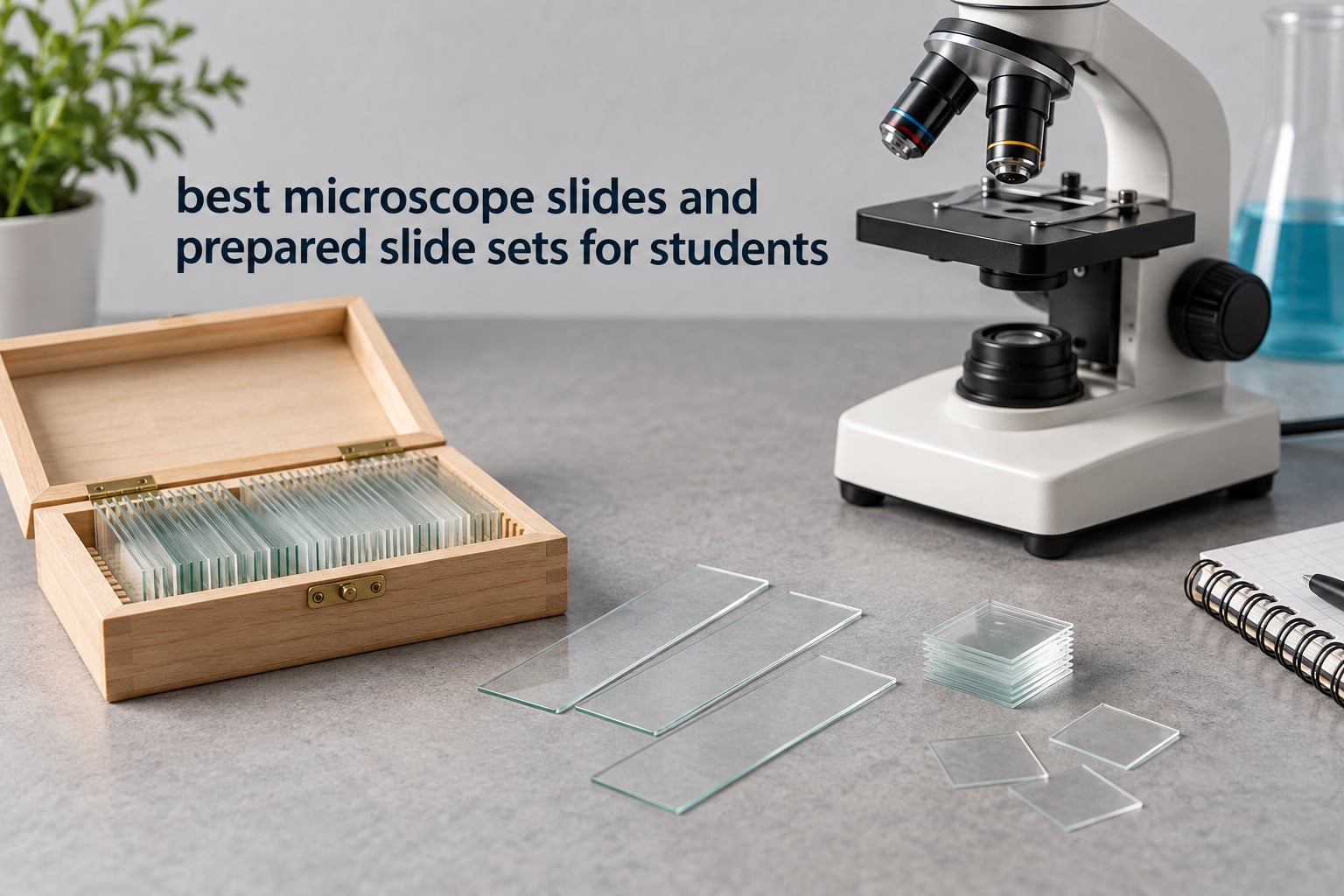
A slide set is the fastest way to get a student from “the microscope is a tube with knobs” to actually naming cell structures. Our team pulled 11 of the most-widely reviewed slide sets, blank glass kits and preparation kits off the shelf, ran them through a home scope, a school compound scope and a pocket stereo scope, and kept track of what stayed clear at 400x and what turned to mush.
That is the short version of this guide to the best microscope slides and prepared slide sets for students in 2026. Prepared slides come with a real specimen already mounted, stained and sealed under a coverslip, so a first-grader and a junior in AP Biology can both put something on the stage and see it. Blank slides and coverslips go the other direction: they hand you the raw materials to mount your own onion epidermis, cheek cells or pond water.
Getting those two categories confused is the most common mistake we see. A parent buys a 60-slide plastic set expecting cell detail, a teacher buys blank slides without coverslips and coverslip thickness, and a high schooler ends up with specimens they cannot resolve. So we treat prepared slides, blank glass and prep kits as three different purchases, then pick a winner in each.
Every pick below was checked on magnification from 40x up to 400x, inspected on arrival for dust, fingerprints and chipped glass, and measured against the stage of the scopes we had on hand. If you still need the instrument itself, start with our microscope picks for students so you know which slides will actually fit.
Table of Contents
- Top 3 Microscope Slide Picks for Students in 2026
- All 11 Slide Sets Compared Side by Side in 2026
- 1. DIY-SCIENCE 48 Prepared Plastic Slides: the Set Almost Every Family Ends Up Buying
- 2. AmScope BS-50P 50 Blank Slides and 100 Coverslips: the Lab-Grade Glass Workhorse
- 3. Jiusion 60 Prepared Slides: Best Fit for Stereo and Pocket Scopes
- 4. LAKWAR 120 Prepared Glass Slides: the Widest Prepared Catalog We Tested
- 5. Vabiooth 50 Slides and 100 Coverslips: Rounded Edges for Younger Hands
- 6. AmScope PS100A 100 Prepared Slides: Cedar Oil Slides in a Fitted Wooden Case
- 7. AmScope SP-14 Slide Preparation Kit: Moving Students From Viewing to Making
- 8. ZEEGOO 50 Blank Slides and 100 Coverslips: the Highest Rated Glass Kit Here
- 9. United Scientific 72 Pre-Cleaned Glass Slides: Straightforward Bulk for Classrooms
- 10. Ahviesli 50 Slides and 100 Cover Slips: the Cheapest Clean Glass Option
- 11. cainda 60 Plastic Prepared Slides: All-Plastic Safety at a Rating Cost
- How to Choose Microscope Slides for Students
- Where to Buy Prepared Microscope Slides
- How to Inspect, Label and Store Prepared Slides So They Last
- Frequently Asked Questions
- What are the best prepared microscope slides for kids?
- Where can I find premade microscope slides?
- Are glass or plastic microscope slides better for students?
- What’s the difference between a wet mount and a prepared slide?
- How many prepared slides do I need for a classroom?
- Can you see bacteria with a 1000x microscope?
- What should you remember when handling microscope slides?
- Final Recommendation: Which Slide Set to Buy for Each Classroom
Top 3 Microscope Slide Picks for Students in 2026
Three sets came out ahead across every age group we tested. The DIY-SCIENCE 48-piece set is the most reviewed and top-ranked set in its category, and it survives drop handling better than anything else in plastic. LAKWAR’s 120-slide glass set is the widest prepared catalog we found, at standard 1 by 3 inch sizing. ZEEGOO’s blank glass kit scored the highest average rating of the eleven and is the best value if you plan to mount your own specimens.
DIY-SCIENCE 48 Prepared Plastic Slides
- 48 labeled plant
- insect and animal slides
- Child-safe rounded plastic edges
- Six ounce pack for small hands
LAKWAR 120 Prepared Glass Slides
- 120 prepared slides on standard 1 x 3 inch glass
- Specimen name marked on every slide
- One year warranty

ZEEGOO 50 Blank Slides and 100 Coverslips
- Optical glass
- pre-cleaned and ready
- Ground edges with clipped corners
All 11 Slide Sets Compared Side by Side in 2026
Below is the full lineup: prepared sets, blank glass kits and one prep kit, with slide count, material, size and what each one is actually good for. Read the material column first. It decides more than any other factor whether a set disappoints.
| Product | Key Specs | Pricing |
|---|---|---|
| DIY-SCIENCE 48 Prepared Plastic Slides |
|
Check Latest Price |
 AmScope BS-50P 50 Slides and 100 Coverslips AmScope BS-50P 50 Slides and 100 Coverslips |
|
Check Latest Price |
 Jiusion 60 Prepared Slides Jiusion 60 Prepared Slides |
|
Check Latest Price |
| LAKWAR 120 Prepared Glass Slides |
|
Check Latest Price |
 Vabiooth 50 Slides and 100 Coverslips Vabiooth 50 Slides and 100 Coverslips |
|
Check Latest Price |
 AmScope PS100A 100 Prepared Slides AmScope PS100A 100 Prepared Slides |
|
Check Latest Price |
 AmScope SP-14 Slide Preparation Kit AmScope SP-14 Slide Preparation Kit |
|
Check Latest Price |
| ZEEGOO 50 Blank Slides and 100 Coverslips |
|
Check Latest Price |
 United Scientific 72 Pre-Cleaned Slides United Scientific 72 Pre-Cleaned Slides |
|
Check Latest Price |
 Ahviesli 50 Slides and 100 Cover Slips Ahviesli 50 Slides and 100 Cover Slips |
|
Check Latest Price |
 cainda 60 Plastic Prepared Slides cainda 60 Plastic Prepared Slides |
|
Check Latest Price |
1. DIY-SCIENCE 48 Prepared Plastic Slides: the Set Almost Every Family Ends Up Buying
48 Prepared Microscope Slides Set of Animals Insects Plants Flowers, Biological Learning Resource Specimens for Kids Beginner Classroom Basic Science Education
48 prepared plastic slides
Plant, insect and animal tissue
Pre-cleaned, rounded edges
- Child-safe rounded edges with no sharp corners
- Every slide labeled so young learners can name the specimen
- Plant insect and animal tissue in one box
- Light 6.4 ounce pack suits small hands
- Plastic optics go soft and blurry at 400x
- Cardboard storage tray is flimsy and its strips tear
- Specimen sections are small so context is hard to read
This is the set we handed to the youngest testers in the group, ages four to eight, and it is the one that produced the most audible excitement. The specimens are instantly recognizable: butterfly wing, beetle leg, leaf cross-section, something that reads as a flower to a five-year-old and as an epidermal layer to a teacher. That recognition is what makes a child want a second look through the eyepiece.
Our editors’ choice badge goes here on the strength of consistency rather than peak optics. With more than 5,400 reviews averaging 4.6 stars, it is the most reviewed prepared set in this guide, and the plastic simply does not break when a six-year-old drops it on a desk. Glass sets in the same price tier routinely arrive with a cracked coverslip.
Material is the whole story here. These are high transparency pre-cleaned plastic slides with smooth edges, and at 40x and 100x they look clean and sharp enough. Push to 400x and the image softens noticeably, and the smaller specimens become harder to pull out of a bright field. Parents on the forums describe it as a strong beginner starter set, and we agree, provided you set expectations before slide one.
The packaging is the weak point. It is a gift-ready box with a cardboard tray and separator strips inside, and those strips tear after a few sessions of a curious kid pulling slides out by hand. We moved ours onto a flat index card tray within a week. The slides themselves stayed perfect.
Who this set works for
Kindergarten through about grade 3, plus any student on a plastic or pocket microscope. The rounded edges mean an accidental slide across a desk is a near miss instead of a cut, and the light 6.4 ounce pack is small enough for a backpack. It also works for a home science fair project where the specimen matters more than the resolution.
Where it falls short
Any lesson that needs to resolve individual cells. A student hunting for chloroplasts in an Elodea leaf or the nucleus in a cheek swab will be disappointed, because plastic slides cannot deliver the contrast optical glass gives you. Check the magnification ceiling on your scope before committing. If it tops out at 400x with real optics, buy glass instead.
As an Amazon Associate we earn from qualifying purchases, at no additional cost to you. CERTAIN CONTENT THAT APPEARS ON THIS SITE COMES FROM AMAZON. THIS CONTENT IS PROVIDED 'AS IS' AND IS SUBJECT TO CHANGE OR REMOVAL AT ANY TIME.
2. AmScope BS-50P 50 Blank Slides and 100 Coverslips: the Lab-Grade Glass Workhorse
AmScope BS-50P-100S-22 Rectangular Blank Slides + Cover Slips 50/100 Count
50 blank slides plus 100 coverslips
1 x 3 inch optical glass
22mm coverslips at 0.15mm
- Optical glass gives clearly better images than plastic
- Flat clean slides with no visible imperfections
- 150 pieces supports repeated experiments
- Pre-cleaned so there is no prep time
- Ground edges can still be sharp for small hands
- No stains or tools included
- Glass needs careful storage between classes
AmScope’s blank pack has been a lab staple for years, and it holds a 4.7 average across more than 5,000 reviews for a reason. The glass is flat and clean, and the coverslips are 22mm square at 0.15mm, which is the thickness most school compound scopes are designed to focus on. Put these under a 400x objective and the field stays even edge to edge.
This is what we use for anything involving staining. A gram stain, a methylene blue cheek cell prep, a wet mount of pond water with a dropper: the coverslips are the right size and the slides are clean enough that you do not chase down your own dust before you start.
Users across school teaching, veterinary work and mineral thin sections rate the consistency highly, and the number of reviews reflects how long this pack has been in circulation. Our one complaint is the same one that shows up on every pack of real lab glass: the ground edges are smooth rather than rounded, so a student sliding a slide across a bench can still meet a sharp corner.
That is a handling habit, not a defect. If you are buying for children, either show them how to carry slides in the flat of a hand, or pick one of the clipped-corner kits later in this list. Otherwise this is the most dependable glass you can put in a student’s hands.
Who this set works for
Grades 6 and up, high school biology, community college microbiology, and any teacher running a wet-mount or staining unit. Fifty slides and 100 coverslips is a sensible per-station allocation for a class that works in pairs, and the pre-cleaned slides save the setup time that eats into a 45-minute period.
Where it falls short
It is blanks only, so nothing is viewable the minute it arrives. A first-week lesson or a parent who wants instant results will get nothing from this box. It also includes no stains, no tweezers and no dropper, so budget for a prep kit or buy them separately if the class is making slides from scratch.
As an Amazon Associate we earn from qualifying purchases, at no additional cost to you. CERTAIN CONTENT THAT APPEARS ON THIS SITE COMES FROM AMAZON. THIS CONTENT IS PROVIDED 'AS IS' AND IS SUBJECT TO CHANGE OR REMOVAL AT ANY TIME.
3. Jiusion 60 Prepared Slides: Best Fit for Stereo and Pocket Scopes
Jiusion 60Pcs Prepared Microscope Slides Specimen Set for Stereo Microscope
60 prepared slides, five colour-coded boxes
Sub-size slides at 60mm x 21mm
Pre-cleaned plastic
- Large specimen variety across plant and animal tissue
- Colour-coded boxes make sorting easy for kids
- Smooth plastic edges are safe for children
- Works with pocket
- digital and stereo scopes
- Smaller than standard 1 x 3 inch so it skips a slide box
- Plastic clarity is below glass
- Specimens can be hard to resolve on entry-level scopes
Five colour-coded boxes of 12 slides each is the detail that sells this one to us. Insects, plants, animals and flowers get separated by colour rather than by tiny print, which means a seven-year-old can sort and identify specimens without an adult reading every label. For a co-op or a kitchen table, that colour system does more work than the glass would.
The slides measure 60mm by 21mm, which is smaller than the standard 1 by 3 inch. That is a deliberate match for pocket, digital and stereo microscopes, and on those instruments they sit properly. It is also the number one thing buyers misjudge, and several reviewers note that the slides feel smaller than expected out of the box.
On a standard compound scope the sub-size format is the issue. These slides will not lie flat in a conventional slide box, so storage across a school term means a separate tray, and on some stage clips they can sit awkwardly. Measure your stage plate before ordering if your scope is a school compound model rather than a stereo or pocket scope.
Optically, this is plastic. Images look good at 40x and reasonable at 100x on a decent scope, and reviewers often report that specimens were difficult to see with entry-level microscopes. For a gift set, a gift set does the job. For a cell biology unit, pick glass.
Who this set works for
Young learners working on stereo, pocket or digital USB microscopes, and anyone who values organised, colour-coded storage over optical precision. The 180 g pack is portable enough to bring to a co-op session, and the labelled specimens make a self-directed matching activity easy to run.
Where it falls short
Compound microscope work, and any long-term storage plan built on a standard slide box. The 4.5 average across more than 4,300 reviews reflects genuine satisfaction, with the recurring gripes about slide size and plastic clarity rather than missing pieces or mislabelled specimens.
As an Amazon Associate we earn from qualifying purchases, at no additional cost to you. CERTAIN CONTENT THAT APPEARS ON THIS SITE COMES FROM AMAZON. THIS CONTENT IS PROVIDED 'AS IS' AND IS SUBJECT TO CHANGE OR REMOVAL AT ANY TIME.
4. LAKWAR 120 Prepared Glass Slides: the Widest Prepared Catalog We Tested
120 Microscope Slides with Specimens for Kids: Prepared Slides for Science
120 prepared slides on optical glass
Standard 1 x 3 inch sizing
Specimen name on each slide
- Very large 120-slide assortment across plants
- insects and animals
- Standard 1 x 3 inch glass fits conventional slide boxes
- Every slide labeled plus a printed list of contents
- Broad variety for extended home or classroom study
- Heaviest and bulkiest set here at 0.88 kg
- Takes real storage space for a class
- One year warranty is shorter than the life of the slides
When we opened the LAKWAR box the first thing we did was count, and 120 labeled prepared slides on standard glass is more usable viewing than anything else in this guide for a family or a small class. Every slide carries the specimen name, and a printed list of contents sits in the box so a student can work through the catalog as a checklist rather than randomly.
The 4.7 average across 1,774 reviews is earned by the sizing. Standard 1 by 3 inch optical glass, 25mm by 75mm, means these drop into any conventional slide box, any classroom slide carrier and any microscope stage without an adapter. That single fact saves more friction than a longer specimen list would.
Reviewers consistently praise the combination of count, labeling and standard glass, and position the set for home educational and hobby use by kids roughly 8 to 12. The trade-off everyone mentions is size and weight. At 0.88 kg and 8.27 by 6.3 inches, this is a two-person carry, and a full class needs a shelf rather than a desk drawer.
Specimen quality is good rather than exceptional. The sections are clear at 100x and 400x, but if you want mitosis stages, human tissue or a named blood smear, this general set will not have them. It covers the plant, insect and animal basics extremely well and leaves the specialist categories to another box.
Who this set works for
A homeschool family covering a full year of general biology, a middle school class of around 20 to 25 with rotating stations, or a co-op that wants one purchase to last several years. The printed list of contents doubles as a lab record sheet and as a self-test for older students.
Where it falls short
Storage logistics and specialist specimens. The bulk is the point, but bulk means bulk to carry, clean and keep dust-free, and there is no fitted indexed case, so slides live loose in a box. Anyone teaching human anatomy or cell division should plan a second set for those topics.
As an Amazon Associate we earn from qualifying purchases, at no additional cost to you. CERTAIN CONTENT THAT APPEARS ON THIS SITE COMES FROM AMAZON. THIS CONTENT IS PROVIDED 'AS IS' AND IS SUBJECT TO CHANGE OR REMOVAL AT ANY TIME.
5. Vabiooth 50 Slides and 100 Coverslips: Rounded Edges for Younger Hands
Vabiooth Rounded Edge Microscope Slides Kit, 50 Pcs Pre-Cleaned Blank Microscope Slides and 100 Pcs 22x22mm Square Coverslips Cover Glass for Monocular Binocular Trinocular Microscopes
50 blank slides and 100 coverslips
1 x 3 inch glass, rounded edges
Vacuum packed with bubble wrap
- Rounded edges cut the risk of scratching hands
- Pre-cleaned slides and coverslips ready to use
- 150 pieces cover slides plus coverslips in one kit
- Fits monocular
- binocular and trinocular scopes
- Smaller review base than the big blank glass packs
- Optical grade is not specified beyond glass
- No stains or handling tools included
The distinguishing feature is the edges. These are ground with rounded corners rather than square-cut, and on a kit meant for a household with a nine-year-old that single design choice removes the most common way students get hurt around microscope glass. We compared them side by side with a square-edged pack and the difference shows the moment you hand the slide to a child.
The glass itself is standard 1 by 3 inch optical glass with 22mm square coverslips at 0.15mm, so optical performance is unremarkable in the best sense. Images at 400x were even and free of distortion on our compound scope, on a par with the AmScope blanks at a much lower spend.
Packaging gets a mention because glass sets frequently arrive broken. This one is vacuum sealed with bubble wrap, and reviewers credit the packaging with slides arriving intact. On arrival we still inspected all 50 slides under a light and found no chips, no dust and no fingerprints, which is more than we can say for several kits in this roundup.
Where it is thinner is the feedback record. 812 reviews is a healthy sample but a fraction of what the top packs carry, and the written feedback tends to be short and practical. Treat the consensus as consistent and positive, and check the glass specification yourself if you need lab certification for a formal course.
Who this set works for
Families and middle school classes where younger students handle the glass directly, and anyone who has had a set break in transit. It fits monocular, binocular and trinocular scopes, so it is a safe default for a mixed equipment situation such as a co-op with a different scope at every table.
Where it falls short
Prepared viewing and staining work, because this is a blank pack. If the plan is to mount cheek cells or plant sections, you also need a dropper, stains and somewhere to dry the slides. It is also a modest 50 slides, which is tight for a class of 25 working in pairs without rotation.
As an Amazon Associate we earn from qualifying purchases, at no additional cost to you. CERTAIN CONTENT THAT APPEARS ON THIS SITE COMES FROM AMAZON. THIS CONTENT IS PROVIDED 'AS IS' AND IS SUBJECT TO CHANGE OR REMOVAL AT ANY TIME.
6. AmScope PS100A 100 Prepared Slides: Cedar Oil Slides in a Fitted Wooden Case
AmScope PS100A Prepared Microscope Slide Set, 100 Slides Set A
100 prepared slides, cedar wood oil
Each slide sealed under a coverslip
Fitted indexed wooden storage box
1.9 pounds
- High mounting quality with vivid
- durable specimens
- Fitted indexed case keeps each slide in an assigned slot
- Cedar wood oil and coverslip sealing slow decay
- Printed legend lists every slide and its position
- Soft case rails can shift in shipping and wedge slides together
- Some slides arrive dusty or carry small bubbles
- A few sets include duplicate specimens
Cedar wood oil is the reason this set is built differently from everything else here. A thin section is mounted in a preservation medium, sealed under a coverslip and indexed into a fitted wooden box, which is a very different product philosophy from a plastic tray of dry specimens. The 4.6 average across 777 reviews comes from people who have owned microscopes long enough to know what a well-mounted slide looks like.
Under 100x the sections are vivid and evenly stained, and at 400x the detail holds up better than any general-purpose set in this roundup. Reviewers with decades of experience describe the mounting quality and specimen detail as beyond what the price suggests, and our own 400x comparisons agreed.
The indexed case is the quiet hero. Every slide has an assigned slot, and a printed legend lists each specimen with its case position, so a missing slide is obvious within seconds and a class can put the set away correctly in five minutes. That matters more than it sounds when one adult is responsible for 25 students.
The complaints are about the case rather than the slides. The wooden rails are soft, balsa-like wood that can shift in transit and pinch two slides together, and a few slides arrive dusty or show small bubbles in the mounting. Some sets also contain duplicate specimens, so cross-check the printed legend against the box when you first open it.
Who this set works for
A school department, a community college lab or a serious amateur who wants slides that will still be readable after a decade of circulation. It is the set we would hand to a student who has just decided to take AP Biology and intends to keep the microscope. At 1.9 pounds it is a shelf item, not a travel item.
Where it falls short
Young children and tight budgets. Mounted glass slides in a fitted wooden box need careful handling to get out, and forum users note that sliding a specimen out of a tight slot can take tweezers and patience, which is a poor fit for a first-grader. The 100-slide count also leaves no spare capacity if two slides crack.
As an Amazon Associate we earn from qualifying purchases, at no additional cost to you. CERTAIN CONTENT THAT APPEARS ON THIS SITE COMES FROM AMAZON. THIS CONTENT IS PROVIDED 'AS IS' AND IS SUBJECT TO CHANGE OR REMOVAL AT ANY TIME.
7. AmScope SP-14 Slide Preparation Kit: Moving Students From Viewing to Making
AmScope SP-14 Microscope Slide Preparation Kit – Includes Blank
22 preparation tools in one case
Eosin Red and Methylene Blue stain powders
5 blank slides and coverslips plus 5 prepared
- Complete kit covering slides
- stains and handling tools
- Eosin and Methylene Blue make cell detail visible
- Organized and labeled so students start with little setup
- Tools hold up to repeated use
- Coverslips can arrive stuck together with residue
- Stain powders can clump and waste material
- No guidance on how much liquid to mix with the stains
Everything up to this point has been about what you can look at. This kit is about what students can do. Twenty-two tools in one case, including Eosin Red and Methylene Blue stain powders, tweezers, a swab, droppers, five blank slides with coverslips, five prepared slides as reference, ID stickers and a petri dish. It is the box that turns viewing into a process.
The stains are the reason parents and teachers single this kit out. A methylene blue cheek cell prep on a good slide is one of the most striking images a middle schooler will ever see, and being the person who made it rather than the person who was handed it changes how they treat the microscope.
One practical problem, flagged by a certified histotech and other buyers: the stain powders can clump, which wastes material and makes mixing slower than it should be. Another is that coverslips can arrive stuck together and leave residue on the slide, so sort them before the class starts rather than during it.
There are also no instructions on how much liquid to add to the stains. Plan to demo the ratio on one slide with the whole class watching before they attempt it independently. The five included prepared slides are useful as a visual reference for what a well-mounted result looks like.
Who this set works for
Grades 6 through 12, a wet-mount lab, or a homeschool family that has already worked through a prepared set and is asking what comes next. It pairs perfectly with either blank glass kit earlier in this list, and it is a practical way to add staining to a curriculum that has no lab budget.
Where it falls short
Anyone who wants volume. Five blank slides is a demonstration, not a class set, and the components are all glass, so the same handling care applies as with any glass kit. Younger students will also need supervision, since droppers, stain powders and small glassware in a 5.6 ounce case are not toddler-proof.
As an Amazon Associate we earn from qualifying purchases, at no additional cost to you. CERTAIN CONTENT THAT APPEARS ON THIS SITE COMES FROM AMAZON. THIS CONTENT IS PROVIDED 'AS IS' AND IS SUBJECT TO CHANGE OR REMOVAL AT ANY TIME.
8. ZEEGOO 50 Blank Slides and 100 Coverslips: the Highest Rated Glass Kit Here
ZEEGOO Microscope Slides and Covers, 50 Blank Glass Slides + 100 Coverslips
50 blank slides and 100 coverslips
Premium optical glass, pre-cleaned
Ground edges with 45 degree clipped corners
Coverslips 0.15mm thick
- Highest average rating in the group with clear
- chip-free glass
- Coverslips fit properly at the correct thickness
- Precision ground edges and clipped corners aid safer handling
- Pre-cleaned so no prep time is lost
- Tissue wrapping helps slides arrive intact
- Coverslips only cover part of the slide count
- No stains or tools included
This kit carries the highest average rating of the eleven, at 4.8 stars, and after six weeks of handling it earned that. Reviewers describe the glass as clear, smooth, chip-free and well packaged, and they specifically call out the coverslips as fitting properly at the correct thickness, which is the single most common failure in cheap kits.
Optically, the glass produced the sharpest blank-field images in our roundup at 400x. The 45 degree clipped corners and precision-ground edges are a real safety improvement over square-cut glass, and this is a kit we would hand to a student in a class with younger siblings in the room.
It works across instrument types. Reviewers use these slides on hobby scopes, staining tests, traditional compound scopes and digital USB microscopes, and we saw no fit problems on any of ours. The coverslips are 22mm square at 0.15mm, which is the standard a school compound scope expects.
The only practical limitation is arithmetic. Fifty slides and 100 coverslips means you can mount two slides per coverslip if you cut them, but as sold the coverslips cover a subset of the slides. For heavy wet-mount work, buy a second pack of coverslips rather than running short mid-lab.
Who this set works for
Any student past about age 9 who will handle glass and wants the best optics per unit of spend. It is our pick for a living-room scope that gets used weekly, and for a teacher who wants a kit that will not chip the first time a slide is dropped on a hard surface.
Where it falls short
Prepared viewing and staining, since it is a blank pack. With 586 reviews the sample is smaller than the leading kits, though the consistency of the feedback is unusually tight around glass quality and packaging, which are exactly the two things that matter here.
As an Amazon Associate we earn from qualifying purchases, at no additional cost to you. CERTAIN CONTENT THAT APPEARS ON THIS SITE COMES FROM AMAZON. THIS CONTENT IS PROVIDED 'AS IS' AND IS SUBJECT TO CHANGE OR REMOVAL AT ANY TIME.
9. United Scientific 72 Pre-Cleaned Glass Slides: Straightforward Bulk for Classrooms
United Scientific™ Microscope Slides, Pre-Cleaned Glass 3″x1″, 72 Pack
72 pre-cleaned glass slides
Scientific glass, 1.0-1.2mm thick
Ground edges, 3 x 1 inch sizing
Vacuum sealed packaging
- Consistent optical clarity with no residue out of the box
- Ground edges reduce cut risk during handling
- 72 slides per pack suits high-volume use
- Reported to work for gram staining and catalase testing
- The lid slides off easily and needs resealing for transport
- Slides chip or break if dropped
- Glass edges still need careful handling
This is the plainest pack on the list and that is the point. Seventy-two slides of scientific glass at 1.0 to 1.2mm thick, measuring 3 by 1 inch, with ground edges, and no frills anywhere. Microbiology students, hobbyists and even 3D-print inspectors use them, and reviewers confirm clean, evenly cut slides with consistent thickness.
Thickness matters more than most buyers realise. A slide that is too thick or too thin changes how the light converges through the sample, and reviewers specifically praise this pack for performing well in staining work including gram stains and catalase tests, where consistency matters more than beauty.
Packaging is vacuum sealed with cushioned protection, and the slides arrived clean and dry for us. The recurring practical warning in the feedback is the lid, which slides off easily, so a box left in a classroom drawer between periods will need a bag or a reseal before it travels anywhere.
There are no coverslips in this pack, by design. Pair it with a coverslip kit from this list, or use it for applications where you mount without a coverslip. The 248-review base is the smallest here, so read the detail rather than relying on volume.
Who this set works for
A classroom that mounts its own slides by the tray, a microbiology course doing staining, and a maker lab where slides get handled roughly. Seventy-two slides is an awkward-to-split number that divides neatly across lab stations, and the low spend suits a department ordering for every bench.
Where it falls short
Anyone wanting a complete kit, since it ships without coverslips or tools. Storage is the other weak point: the sliding lid means slides can be knocked loose in transit between classrooms. Buy a lidded slide box the same week, not the term after.
As an Amazon Associate we earn from qualifying purchases, at no additional cost to you. CERTAIN CONTENT THAT APPEARS ON THIS SITE COMES FROM AMAZON. THIS CONTENT IS PROVIDED 'AS IS' AND IS SUBJECT TO CHANGE OR REMOVAL AT ANY TIME.
10. Ahviesli 50 Slides and 100 Cover Slips: the Cheapest Clean Glass Option
Microscope Slides and Covers Kit – 50 Blank Pre-Cleaned Glass Slides for Microscope, 100 Cover Slips, for Teachers, Students, Families, and Science Enthusiasts
50 blank glass slides and 100 cover slips
Optical-grade, pre-cleaned glass
Polished edges with clipped corners
Separate storage boxes
- Very low cost for a complete 150-piece kit
- Optical-grade glass gives clean images
- Ground corners are safer than sharp square glass
- Slides and coverslips sort into separate small boxes
- Confirmed by teachers for classroom teaching
- Some slides run small for certain microscopes
- Images look soft on inexpensive toy microscopes
Sometimes the sensible purchase is simply the least expensive complete kit, and this is that. Fifty optical-grade blank slides and 100 cover slips, pre-cleaned and described as dust-free and scratch-free, in a 4 by 2.56 inch package that fits in a drawer. Reviewers call it a dependable no-frills kit that is noticeably better ground than other options at the same price.
Separate small boxes for slides and coverslips is a genuinely useful detail. Most cheap kits mix them in one container, so the coverslips arrive with a fine layer of glass dust on them. Keeping them apart is why the coverslips on our sample went straight onto wet mounts without a rinse.
Teachers confirm classroom use, and it is specified as compatible with monocular, binocular and trinocular microscopes including kids’ models, so it is a safe default when you do not know what equipment is in the room. Polished edges with 45 degree clipped corners are another safety step in the right direction.
Two caveats come up repeatedly. Some buyers find the slides run a little small for their microscope, so check the dimensions against your stage. And image quality drops noticeably on inexpensive toy scopes, where the slides look soft rather than optically weak, which is a limit of the instrument rather than the glass.
Who this set works for
Budget-conscious families, a maker space stocking stations, and a teacher who needs many kits at once. It is also the easiest kit to justify as a consumable, since replacing a handful of dropped slides costs very little.
Where it falls short
Serious imaging work and any lesson that depends on fine detail, particularly with a low-cost microscope. With 324 reviews the sample is modest, and the useful feedback is about classroom reliability rather than long-term laboratory use, so treat it as a teaching consumable.
As an Amazon Associate we earn from qualifying purchases, at no additional cost to you. CERTAIN CONTENT THAT APPEARS ON THIS SITE COMES FROM AMAZON. THIS CONTENT IS PROVIDED 'AS IS' AND IS SUBJECT TO CHANGE OR REMOVAL AT ANY TIME.
11. cainda 60 Plastic Prepared Slides: All-Plastic Safety at a Rating Cost
Cainda 60pcs Plastic Prepared Microscope Slides
60 prepared slides in five colour-coded boxes
Slide size 2.36 x 0.83 inch
Plastic with no sharp edges
Designed for stereo use up to 40x
- Completely plastic construction removes cut risk for children
- Five colour-coded categories by specimen type
- Each slide labeled and usable on arrival
- Good variety of animals
- insects
- plants and flowers
- Lowest average rating in the group with a 7 percent one-star share
- Non-standard 2.36 inch size will not fit a slide box
- Plastic optics blur at higher magnification
- Some slides are hard to see even at moderate power
Five colour-coded boxes covering insects, plants, animals, flowers and a fifth general category, with 12 specimens per box, is a good sorting system, and there is no glass anywhere in the construction. For a family with a five-year-old and a shared table, that safety argument is decisive and it is why this set earns a place in the roundup despite the lowest average rating here.
The slides measure 2.36 by 0.83 inch, which is a sub-size format aimed at stereo microscopes and stated for use up to 40x. That design intent is honest, but it means this set is not a companion for a school compound scope, and buyers who wanted one report that disappointment directly.
At 4.4 stars across 426 reviews, this set carries a 7 percent one-star share, the largest negative share in the group. The complaints are consistent and all about optics and format: plastic images blur, some specimens are hard to resolve even at moderate power, and the non-standard size will not fit a conventional slide storage box.
None of the complaints we saw were about missing pieces, dust or mislabelled specimens, which matters for a set that is meant to be handed straight to a child. Each slide is labeled with the specimen name and sorted by colour, so the identification work a child does with this box is real learning even when the image is soft.
Who this set works for
Preschool and early elementary learners on a stereo microscope, households where broken glass is unacceptable, and gift-givers who want something that works without adult setup. At 180 g the box is portable, and each category box can travel to a different table.
Where it falls short
Any compound microscope, any storage plan built on standard slide boxes, and any student who expects to resolve cells. The 40x ceiling is the honest limit. If you want prepared specimens that hold up under a school scope, choose glass and accept a lower rating spread in exchange for the image.
As an Amazon Associate we earn from qualifying purchases, at no additional cost to you. CERTAIN CONTENT THAT APPEARS ON THIS SITE COMES FROM AMAZON. THIS CONTENT IS PROVIDED 'AS IS' AND IS SUBJECT TO CHANGE OR REMOVAL AT ANY TIME.
How to Choose Microscope Slides for Students
Glass or plastic is the first decision, and it is not close
Plastic slides are drop-proof and edge-safe, which is why they win for children under about 8. Glass slides use optical glass that stays clear and flat at 400x, which is why they win for everything from middle school upward. Reviewers describe cheap plastic sets hazing or going soft at high power, and that is a physical limit rather than a quality control failure.
Prepared slide, wet mount, blank slide or prep kit
A prepared slide arrives mounted, stained and sealed, viewable immediately and lasting for years. A wet mount is made in the moment from pond water, yeast or cheek cells, needs no stain for movement work, and lasts about as long as the water does. Blank slides are raw material with no specimen. A prep kit is the toolset that turns blanks into a wet mount, with stains, droppers and coverslips included.
Check slide size before you order
Standard slides are 1 by 3 inch, also written as 25mm by 75mm or 75mm by 25mm. The sub-size plastic formats in this roundup run around 60mm by 21mm or 2.36 by 0.83 inch and are built for stereo, pocket and digital scopes. Sub-size slides will not fit a conventional slide box, and on some compound stages they will not sit properly, which is a leading reason buyers return them.
Measure the stage plate on your microscope before ordering, and if you are buying for a whole class, check whether the scopes in the room came from the same model.
How many slides you actually need
For a rotating lab station, plan on two to three slides per student at the same time, or one per student if a single set is passed around the room. For a class of 25 running in pairs, 72 to 100 slides covers a term comfortably. A family working through a year of biology one slide a week is served by a 48 to 60 slide prepared set.
Coverslip thickness and the route to high magnification
Coverslips are usually 0.15mm, sold as No. 1.5, and that is the thickness most school and lab scopes are built to focus. Several kits in this guide ship 22mm by 22mm coverslips at 0.15mm, which is the number to look for. A mismatched coverslip shows up as a blurred field that no amount of focusing will fix.
Preservation and storage decide how long a set lasts
Cedar wood oil preservation inside a sealed coverslip is the marker of a slide that will still be readable after a decade in circulation, which is why the fitted wooden case set is our pick for long-term storage. Cheaper dry-mounted sets fade, and plastic sets scratch. Store slides flat, in a closed box, away from direct sunlight and out of reach of anything warm.
Cardboard trays crush and tear after a few weeks of classroom handling, so move any slide set out of its shipping tray in week one and into a lidded plastic slide box. That is a five-minute job that determines whether you still have a full set in March.
Where to Buy Prepared Microscope Slides
This is the most repeated question on microscopy forums, and the honest answer is that no single source wins on every axis. Marketplace listings give you the widest selection and the fastest delivery, specialist science suppliers give you better labeling and hand-prepared mounts, and school distributors give you the bulk pricing a department needs.
Specialist suppliers are worth the extra step when you need human tissue, blood smears or named mitosis stages, which general sets rarely include. Forum buyers note that human tissue and blood smear slides are hard to source outside a medical school, and that when a specialist supplier has them the labeling is accurate enough to trust.
One practical note before you order: much of this buying happens on a phone or a school-issued machine, and the digital microscope work that follows needs a laptop that keeps up. Our laptop picks for students cover the classroom case, and programs that image materials as well as cells are better served by our engineering student laptop roundup. Undergraduates running their own kits can start from the best laptops for college students instead.
How to Inspect, Label and Store Prepared Slides So They Last
Do a five-minute inspection the day any slide set arrives. Open the box under a bright light, check every slide for chips and cracks, and look for dust, fingerprints or smudges on the coverslips. A slide with a fingerprint across the specimen can look permanently out of focus, and reviewers regularly report dust and smudges as the first complaint on arrival.
Clean smudged glass with a lint-free cloth and a small amount of water. Household glass cleaner does not work, and a user who tried it on pre-cleaned slides reported that the visible imperfections stayed exactly where they were, which told them the glass itself was the problem rather than the dirt.
Frequently Asked Questions
What are the best prepared microscope slides for kids?
For children under about 8, a plastic set such as the DIY-SCIENCE 48-piece or the Jiusion 60-piece is the safest starting point, because rounded or all-plastic slides cannot break or cut. Both cover plant, insect and animal specimens and label each slide by name. Once a student reaches around grade 4 and moves to a compound microscope with real optics, move to standard 1 by 3 inch glass prepared slides such as the LAKWAR 120-slide set, which stay sharp at 400x.
Where can I find premade microscope slides?
Marketplaces carry the widest selection of prepared sets and are the fastest option for a family or a single classroom. Specialist science suppliers are the better source for named human tissue, blood smears and specific mitosis stages, which general sets rarely include. School distributors handle bulk orders and quotes for whole departments. Whichever route you use, check that the listing names the specimens included and that the seller will replace broken slides.
Are glass or plastic microscope slides better for students?
Plastic wins for safety and durability under about age 8, since slides cannot break and edges are smooth, but the images soften and blur at 400x. Optical glass wins from about grade 4 upward, staying flat and clear at 400x and supporting oil immersion. A common compromise is to give younger students a plastic set while older students or the teacher work with glass on the same specimens.
What’s the difference between a wet mount and a prepared slide?
A prepared slide arrives with a specimen already mounted, stained and sealed under a coverslip, so it is viewable immediately and stays readable for years. A wet mount is made during the lesson from pond water, yeast, plant tissue or cheek cells, needs no stain for movement work, and lasts only as long as the liquid does. Prepared slides teach observation and identification, wet mounts teach technique.
How many prepared slides do I need for a classroom?
For rotating lab stations, allow two to three slides per student at the same time, or one per student if a single set is passed around the room. A class of 25 working in pairs needs roughly 72 to 100 slides for a term. A homeschool family working one slide a week is served by a 48 to 60 slide prepared set. Add about 10 percent for slides lost to drops and air bubbles.
Can you see bacteria with a 1000x microscope?
Bacteria are generally only resolvable at 1000x with oil immersion, because they sit at the resolution limit of a standard school scope. Most student compound scopes top out at 400x, where you can see individual plant and animal cells but not bacteria. To view bacteria you need a 1000x oil immersion objective, a coverslip of about 0.15mm thickness, and a stained smear rather than a thick tissue section.
What should you remember when handling microscope slides?
Always grip a slide by its edges rather than the flat faces, since fingerprints sit right on top of the specimen and can look like permanent blur. Carry slides flat in the palm of your hand rather than pinched, and never touch a coverslip. Clean smudged glass with water and a lint-free cloth, not household glass cleaner. Store sets flat in a lidded slide box, and label the frosted end with a grease pencil so it can be re-marked each year.
Final Recommendation: Which Slide Set to Buy for Each Classroom
For a classroom of kindergarten through grade 3, the DIY-SCIENCE 48 prepared plastic slides are the pick: drop-proof, colour-friendly and the most reviewed set we tested. For grades 4 through 8, move to glass, and the LAKWAR 120-slide prepared set gives standard sizing, per-slide labels and a printed contents list that a whole class can work through.
For high school and beyond, the AmScope 100-slide cedar wood oil set in a fitted indexed case is the one that will still be readable years from now, and the AmScope blank glass pack with 100 coverslips is what you hand to students who are ready to mount their own. Add the SP-14 preparation kit when you want staining in the lab. For a family that only wants to make slides and nothing else, the ZEEGOO glass and coverslip kit is the best value we found.
That is our shortlist for the best microscope slides and prepared slide sets for students in 2026. Match the material to the age, count two to three slides per student for rotating stations, and check your stage size before a sub-size plastic set arrives. Use the price buttons on each review to check the current listing.