
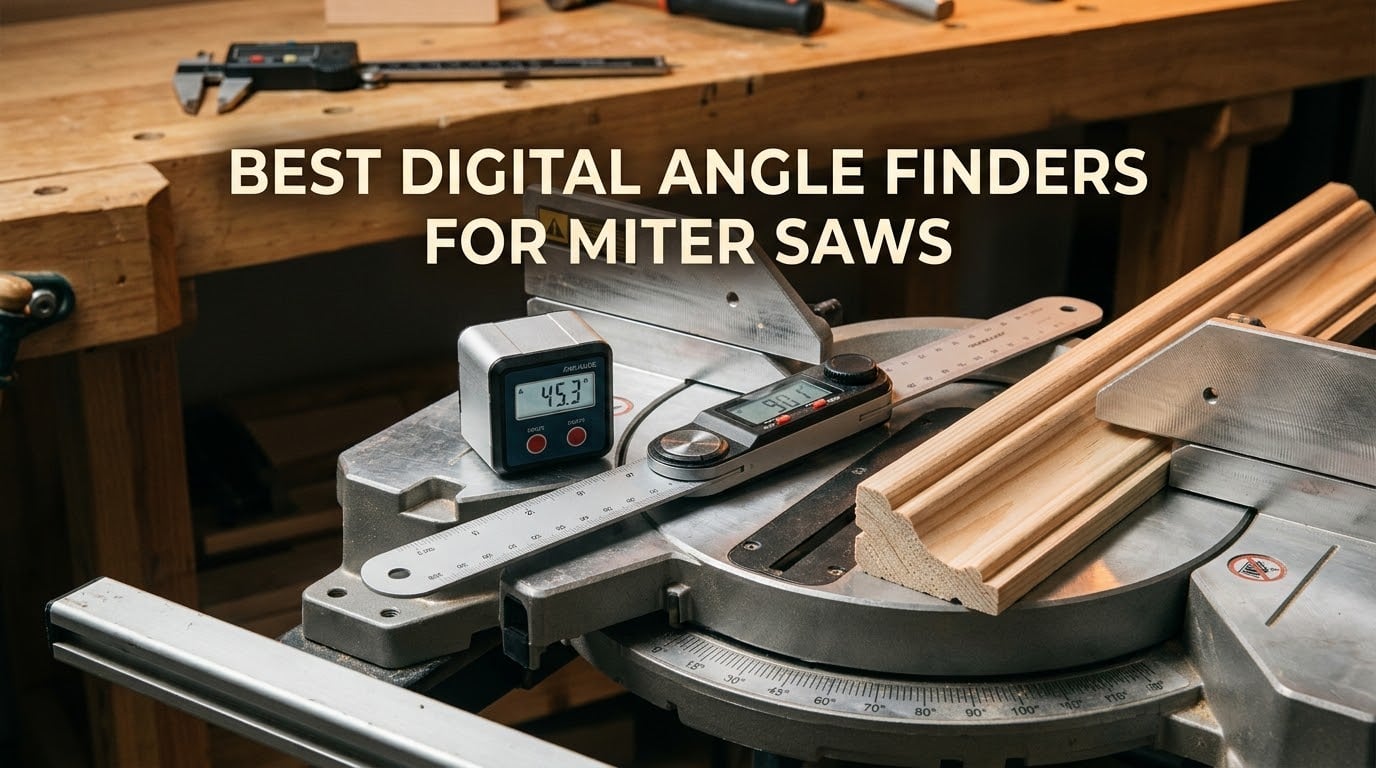
A miter saw only cuts the angle you dial in, and the angle it thinks it is cutting is often a little wrong. Factory gauges drift, detent screws loosen, and a saw that was square last winter is a fraction of a degree off now. A digital angle finder for a miter saw is the cheapest way to find out, and to copy a real wall corner onto the miter dial without guessing.
We put ten of them through their paces in 2026, from pocket cubes that clamp to a blade guard to long 400mm arms that reach across a wall corner in one go. The list below covers every form factor that matters for saw work: the magnetic angle gauge cube, the long-arm digital protractor, and the ruler-style 2-in-1 miter finder that does double duty as layout steel.
If you are still choosing the saw itself, start with our [8 Best Miter Saws Expert Reviews](https://reggaesound.net/best-miter-saws/) and our [8 Best Sliding Miter Saws Tested and Reviewed](https://reggaesound.net/best-sliding-miter-saws/) before worrying about the finder. The finder only helps if the blade is sharp and the fence is true.
Table of Contents
- Top 3 Digital Angle Finders for Miter Saws (October 2026)
- All 10 Digital Angle Finders Compared in 2026
- How We Picked and Compared These Angle Finders
- 1. Klein Tools 935DAG Digital Angle Gauge – the Most Consistent Pocket Gauge
- 2. Wixey WR300 Digital Angle Gauge – the Backlit Workhorse
- 3. Trend DLB Digital Level Box – the Small Saw-Stop Specialist
- 4. GemRed 82305 Stainless 7 Inch Digital Protractor – the Ruler That Measures Angles
- 5. Neoteck NTK033 Digital Angle Finder – the Budget Full 360 Degree Range
- 6. GemRed DAG-V1 Digital Angle Gauge – the Backlit Aluminium Cube
- 7. Neoteck 16 Inch 400mm Digital Angle Finder – the Long-Arm Trim Workhorse
- 8. Proster PST263 400mm Digital Angle Finder – the One With a Lock Knob
- 9. S&F Stead and Fast 7 Inch Digital Angle Finder – a Fine Readout With a Ruler Built In
- 10. LEXIVON LX-DAF7 Digital Angle Gauge – Full Range With a Case and Spare Battery
- How Accurate Does a Digital Angle Finder Need to Be?
- Magnetic Cube vs Long-Arm Protractor vs Ruler Finder
- How to Use a Digital Angle Finder on a Miter Saw
- Digital or Mechanical? Where a Speed Square Still Wins
- How to Test a New Finder Before You Trust It
- What to Look for When Buying a Miter Saw Angle Finder
- Frequently Asked Questions
- The Best Digital Angle Finder for Your Miter Saw
Top 3 Digital Angle Finders for Miter Saws (October 2026)

Klein Tools 935DAG
- 0-90 and 0-180 degree range
- Auto-rotating display
- Strong magnetic base
- Zero calibration
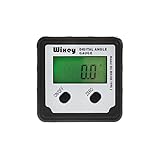

Trend Digital Level Box DLB
- Zero reference function
- Backlit auto-orient display
- Adjustment arrows
- Magnetic base
The Klein 935DAG is the one we trust most. It carries the highest rating and the largest review base in the group, and owners switching from a no-name cube to it report that two copies finally read the same. The Wixey WR300 is the value pick, with a large backlit display. The Trend DLB is the small one you keep on the saw itself for dialling stops.
All 10 Digital Angle Finders Compared in 2026
| Product | Key Specs | Pricing |
|---|---|---|
| Klein Tools 935DAG |
|
Check Latest Price |
| Wixey WR300 Digital Angle Gauge |
|
Check Latest Price |
| Trend DLB Digital Level Box |
|
Check Latest Price |
 GemRed 82305 Stainless 7 Inch Digital Protractor GemRed 82305 Stainless 7 Inch Digital Protractor |
|
Check Latest Price |
 Neoteck NTK033 Digital Angle Finder Neoteck NTK033 Digital Angle Finder |
|
Check Latest Price |
 GemRed DAG-V1 Digital Angle Gauge GemRed DAG-V1 Digital Angle Gauge |
|
Check Latest Price |
 Neoteck 16 Inch 400mm Digital Angle Finder Neoteck 16 Inch 400mm Digital Angle Finder |
|
Check Latest Price |
 Proster PST263 400mm Digital Angle Finder Proster PST263 400mm Digital Angle Finder |
|
Check Latest Price |
 S&F Stead and Fast 7 Inch Digital Angle Finder S&F Stead and Fast 7 Inch Digital Angle Finder |
|
Check Latest Price |
 LEXIVON LX-DAF7 Digital Angle Gauge LEXIVON LX-DAF7 Digital Angle Gauge |
|
Check Latest Price |
How We Picked and Compared These Angle Finders
Every finder in this list was judged on the same seven things, and we weighted them for miter saw work rather than general carpentry. Accuracy came first, but published accuracy alone was not enough, because the gap between a printed spec and a real reading is where most complaints live.
Our criteria were: the stated accuracy tolerance against the readout resolution, whether the magnet holds hands-free on a steel blade guard and a cast fence, whether the display stays readable in an unlit shop and through safety glasses, how the tool is powered and what happens when the cell dies, whether the zero reference survives between measurements, and whether the body survives a drop into a sawdust-filled truck bed.
We also weighted form factor heavily. A pocket cube and a 400mm arm are not competing products; they solve different problems, and the mistake most buyers make is buying a cube for a job that needs an arm. We read owner reports for repeatability between two identical gauges, since users who have compared two of the same model tend to know more about real accuracy than the box does.
1. Klein Tools 935DAG Digital Angle Gauge – the Most Consistent Pocket Gauge
Klein Tools 935DAG Digital Electronic Level and Angle Gauge
0-90 and 0-180 deg ranges
Auto-rotating display
V-groove edges
3.5 oz body
- Genuinely strong magnet that grips blades and fences
- Reads both 0-90 and 0-180 in one tool
- Auto-rotating display readable upside down
- Zero calibration for relative angle work
- Keeps calibration after being knocked against a blade
- Zero reference only works close to 0 degrees
- Readout can blank if tilted the wrong way
- Small screen is hard to read in dim shops
- Needs batteries and a few owners report tools eventually failing to power up
The 935DAG is the gauge I keep clipped to the miter saw itself. At 3.5 ounces it disappears in a pocket, and the magnet is strong enough to hold it on a steel blade guard while I work with both hands on the handle.
It measures 0-90 and 0-180 in the same body, which sounds minor until you are squaring a saw fence and then checking a compound bevel in the same session. The auto-rotating reverse contrast display flips the numbers when you turn the tool over, so you can read it from either side of a fence without crouching.
Zero calibration is the feature that matters most here. You set it on a surface you trust, and everything after that is relative, which is exactly what you need on a saw whose table is not perfectly level or whose fence is a fraction proud.
The V-groove edges along the top are a bonus for conduit and pipe, though they do nothing for saw work. The body is ABS plastic rather than metal, and at 2.36 by 2.2 inches it is genuinely pocket sized rather than pocket capable.
What we like about the Klein 935DAG on a miter saw
Repeatability is the headline. FineWoodworking forum users who bought two identical low-cost cubes and found them reading a quarter of a degree apart on the same surface reported the opposite result after moving to Klein 935 gauges, saying two copies agreed within a tenth of a degree on every surface tested. That kind of agreement is what lets you zero once and trust the number for the rest of the job.
Owners also report that it holds its calibration after being knocked hard against a blade, which happens constantly when the tool lives on a saw. For miter work the reading is relative, so the useful habit is to zero on the saw table, swing the head, and read the difference.
Where the Klein 935DAG falls short
The zero reference only functions near 0 degrees, so you cannot store an arbitrary reference angle and come back to it later. If your workflow needs a stored offset, that is a real gap.
The display is also the smallest in this group, and a few owners note it is difficult to read in poor light or through safety glasses. The auto-rotation fixes orientation but not brightness. And like every battery-powered gauge here, it needs cells, with a handful of long-term owners reporting units that eventually refuse to power up.
As an Amazon Associate we earn from qualifying purchases, at no additional cost to you. CERTAIN CONTENT THAT APPEARS ON THIS SITE COMES FROM AMAZON. THIS CONTENT IS PROVIDED 'AS IS' AND IS SUBJECT TO CHANGE OR REMOVAL AT ANY TIME.
2. Wixey WR300 Digital Angle Gauge – the Backlit Workhorse
Wixey Digital Angle Gauge for Table Saw & Miter Saw, Magnetic
+/-0.2 deg accuracy
0.1 deg resolution
180 deg range
Alloy steel, 91 g
- Accuracy checks out against machinist squares
- Large backlit LCD readable in dim shops
- Zero function compensates for unlevel saws
- Pocket sized with auto shut-off
- Magnet holds on blades and fences
- Battery drains fully if a cell is left installed
- Auto shut-off does not cover long storage
- Magnet is on the base only
- Some find it needs holding on weakly magnetized blades
The WR300 is the most recommended name in this category by a wide margin, and for miter saw work it earns that. It is an alloy steel body with a 0.1 degree readout and a stated accuracy of plus or minus 0.2 degrees, which is the honest combination for a tool in this price band.
Where it wins for me is the backlit LCD. The numbers are large and the backlight means I can read it in a garage with the saw on and the light off, which is exactly the scenario a digital angle finder exists for.
The zero calibration function is what makes this a saw tool rather than a curiosity. Park it on the miter saw base or the table, zero, and then every reading is a relative change. On an old saw with a slightly warped table, that turns an impossible measurement into a simple one.
It also comes in a 6 by 4 inch footprint, so it sits low on a blade and does not get knocked off. That low profile matters more than it sounds when the tool is meant to live on a saw.
Why the Wixey still earns its place
Users consistently report that the reading checks out against machinist squares and engineering angle sets, which is the standard I would want from a tool in this tier. For setting a bevel, a miter, or a compound cut, plus or minus 0.2 degrees is well inside what trim work tolerates.
The most common real use we see is setting the initial blade angle and then fine-tuning with a test cut. That workflow sidesteps the accuracy question entirely, because the test cut is the final authority.
Where the Wixey WR300 causes trouble
Battery drain is the recurring complaint, and it is the single most important thing to know about this gauge. FineWoodworking users report finding it with dead cells because the battery stays installed between uses, and the recommendation across the thread is to remove the cell when the tool is stored or carry a spare. Auto shut-off helps during a session but does nothing over a month on a shelf.
The magnet is on the base only, not the sides, so it will not attach to thin or non-ferrous surfaces and can need holding on a weakly magnetized blade. FineWoodworking owners who own both the Wixey and a Klein report that the Klein does not drain batteries the way the Wixey did, which is the honest reason to consider the swap.
As an Amazon Associate we earn from qualifying purchases, at no additional cost to you. CERTAIN CONTENT THAT APPEARS ON THIS SITE COMES FROM AMAZON. THIS CONTENT IS PROVIDED 'AS IS' AND IS SUBJECT TO CHANGE OR REMOVAL AT ANY TIME.
3. Trend DLB Digital Level Box – the Small Saw-Stop Specialist
Trend Digital Level Box and Angle Finder, Magnetic Base and Backlit LCD Display for Table Saw, Miter Saw and Blade Angle Setup, Black, DLB
Zero reference function
Backlit auto-orient LCD
Adjustment arrows
1.1 inch cube
- Produces a true 90 or 45 reference on an unlevel platform
- Survives repeated drops while staying calibrated
- Compact body fits tight saw spaces
- Backlit screen with auto orientation is easy to read
- Arrows show which way to move the blade
- Reading drift reported by some owners
- Needs calibration before each use
- Base magnet is weak on some fences
The DLB is a 1.1 inch cube, which makes it one of the smallest saw-specific gauges here. It is the one I would bolt to a saw stop and leave there, because the footprint is small enough not to interfere with a head or a fence.
The zero function is its real strength. Zero it against the saw table and it will give you a true 90 or 45 degree reference even on a platform that is not level, which is the situation most home shop saws are actually in.
The backlit LCD adjusts its own orientation as you turn the tool, and the arrow indicators show whether to raise or lower the blade. That single feature saves more time on setup than any accuracy figure I can quote.
What works well about the Trend DLB
Owners describe it as durable enough to survive repeated drops while staying calibrated, and for a shop tool that gets knocked around that is the practical test. The compact aluminium body fits into tight spaces where a full level will not, and the body is a digital level box rather than a plain angle gauge, so it doubles for checking a surface for level.
Buyers commonly cite it for dialling in a new chop saw, table saw or miter saw stops, and the zero-reference capability is what stands out in those reports. It ships with a one year manufacturer warranty.
Where the Trend DLB is not the right pick
Some owners report reading drift, which is looser than the pocket gauges here and the reason I do not put it at number one. It also needs calibrating before use, or readings can shift from session to session.
The base magnet is the other weak point. It will not hold on every level or fence, and on a powder-coated or non-ferrous surface you will be holding the tool rather than trusting it. If your saw has an aluminium fence, look at a gauge with a stronger base or use the tool handheld.
As an Amazon Associate we earn from qualifying purchases, at no additional cost to you. CERTAIN CONTENT THAT APPEARS ON THIS SITE COMES FROM AMAZON. THIS CONTENT IS PROVIDED 'AS IS' AND IS SUBJECT TO CHANGE OR REMOVAL AT ANY TIME.
4. GemRed 82305 Stainless 7 Inch Digital Protractor – the Ruler That Measures Angles
GemRed 82305 Digital Angle Finder Protractor Stainless Steel 7inch 200mm
+/-0.3 deg accuracy
7 inch folded, 400mm total
Stainless steel
CR2032 included
- Ruler and protractor in one tool
- Doubles as layout steel for long trim runs
- Laser etched stainless scales resist corrosion
- Locking function holds the angle
- Digital readout is easier on aging eyes
- No backlit display so low light is hard
- Zero reference is lost after self shut-off
- Loose coin cell compartment
- Square corners at the pivot take some practice
This is the only ruler-and-protractor combination among the cube-style tools in the group, and for crown molding and baseboard work that is the point. It measures inside and outside angles directly, so you do not have to translate a reading into a saw setting with a second tool.
The stainless steel body is 15.75 inches long when open and 400mm across both arms, with laser etched scales.
Users in the trades report that it feels sturdier than the construction suggests, and that the etched marks stay readable after heavy shop use.
Accuracy is stated at plus or minus 0.3 degrees, and users report measuring repeatedly within 0.1 to 0.2 degrees of true. That is a wider band than the pocket cubes here, and on a long arm the mechanical angle holds while the readout carries the stated tolerance.
The locking function holds the angle for reading, and a single button zeroes it. Both of those matter when you are alone on a ladder with a scrap of molding in one hand.
Why trim carpenters reach for this one
The digital readout is easy on aging eyes compared with an analog scale, and because the tool also works as a ruler, it replaces a separate layout steel on the truck. One reviewer in the trades describes it as cutting angle-checking time roughly in half, and for repeat inside corner work that is the difference between one fitting and three.
The battery is a CR2032 coin cell and it is included, pre-fitted, with no searching through a drawer for the right size. For a tool that spends weeks in a truck, that removes an entire category of annoyance.
Where the GemRed 82305 falls short
There is no backlight. Reading it in an unlit shop or under a sink is genuinely difficult, and that is a real limitation for anyone working in crawlspaces or at night.
The zero reference is lost after the unit self-shuts off, so you have to re-zero it each session. Owners also report that the coin cell compartment is loose enough that the battery can partially fall out, and that the square corners at the pivot and the stiffening mechanism take some getting used to.
As an Amazon Associate we earn from qualifying purchases, at no additional cost to you. CERTAIN CONTENT THAT APPEARS ON THIS SITE COMES FROM AMAZON. THIS CONTENT IS PROVIDED 'AS IS' AND IS SUBJECT TO CHANGE OR REMOVAL AT ANY TIME.
5. Neoteck NTK033 Digital Angle Finder – the Budget Full 360 Degree Range
Neoteck Digital Angle Finder LCD Digital Angle Gauge Waterproof Protractor Inclinometer Bevel Box for Helicopter Bevel Angle of Miter Saw Automobile Test and Repair and ect-Blue
0-360 degree range
Accuracy +/-0.2 degrees
2.28 inch body
Needs 2 AAA cells
- Full 0-360 degree range
- Accuracy of plus or minus 0.2 degrees
- Small and light enough for a pocket or tool bag
- Base magnets hold firmly on iron surfaces
- Auto power off after 3 minutes
- Batteries are not included and two AAA cells are needed
- Plain non-backlit LCD is hard to read in poor light
- Readings need a flat reference face to stay honest
- Higher share of three star reviews than the gauges above it
The NTK033 is the value entry here. It is a 2.28 inch digital level box with a full 0-360 degree range, and it pairs a magnetic base with a claimed accuracy of plus or minus 0.2 degrees, one of the least expensive ways in this group to get a magnetic angle gauge with that tolerance.
That 360 degree range is the quiet advantage. Most pocket gauges stop at 90 or 180, which is enough for a simple miter but not for a compound or compound-bevel setup where you need the full circle of reference.
It is light at 0.12 kg and small enough to live in a tool bag rather than a drawer, and the base magnets hold firmly to iron surfaces, which covers a steel blade guard and a cast iron fence.
Auto power off after three minutes is a genuinely useful feature for a tool that gets set down mid-task, and it does more to prevent dead-cell complaints than most of the competition.
Where the Neoteck NTK033 earns its slot
For a first angle finder, or a backup that lives permanently in the saw dust hood, the specification is competitive. Owners use it as a value pick for miter saw bevel setup and general angle checks, and the full range covers compound work that shorter gauges cannot do.
The small footprint is a real advantage on a crowded miter saw table. It will not foul the head, the fence, or a workpiece, which is a problem with some of the larger bodies in this list.
Where the Neoteck NTK033 disappoints
The batteries are not included. You need two AAA cells and the box does not supply them, which is an annoying first experience for a tool bought by a new user.
The display is plain and unlit, so it is difficult to read in poor light. It also carries the lowest average rating in this group at 4.4, with a higher share of three star reviews than anything else here. If accuracy consistency between two identical gauges matters to you, spend up and move up the list.
As an Amazon Associate we earn from qualifying purchases, at no additional cost to you. CERTAIN CONTENT THAT APPEARS ON THIS SITE COMES FROM AMAZON. THIS CONTENT IS PROVIDED 'AS IS' AND IS SUBJECT TO CHANGE OR REMOVAL AT ANY TIME.
6. GemRed DAG-V1 Digital Angle Gauge – the Backlit Aluminium Cube
GemRed Digital Angle Gauge DAG-V1 for Measuring and Layout
+/-0.2 deg accuracy
0-360 degree range
Aluminium alloy frame
1 AAA, about 50 hours
- Reversible backlit LCD readable in sun and dark
- 0-360 degree range in one tool
- Sturdy aluminium alloy frame rather than plastic
- Factory calibrated to the stated tolerance
- Error indicator when tilted past 30 degrees
- Only the base is magnetic and the sides are not
- Readings shift if the X axis is not flat
- Case feels cheap and may crack if dropped
- Body is on the light side
The DAG-V1 is the cube I reach for when the shop light is off. The reversible backlit LCD is why, readable in direct sun and in the dark, with numerals large enough to make out through safety glasses.
It runs on a single AAA for roughly 50 hours with auto shut-off after five minutes, and the cell is included along with a belt pouch. That is a better power story than the multi-cell gauges in this list.
Two measuring modes cover true level and relative angle between two surfaces, which is the mode you want on a miter saw. Owners use it for squaring saws, checking driveshaft alignment and similar setup work, and report that it is factory calibrated to its stated tolerance rather than being a hopeful claim.
The frame is aluminium alloy rather than plastic, which is why it still feels solid after a season of being knocked against a fence. It also carries an error indicator that warns you when the tool is tilted past 30 degrees, a small touch that prevents the confident wrong reading that plagues this category.
Why the GemRed DAG-V1 suits a dark shop
The backlight is the reason. It is reversible, so the display flips with the tool, and it is bright enough to read at arm’s length on a saw table with the overhead light off. Owners highlight the backlit reversible display and the honest accuracy specification as the two things they value most.
For a trim carpenter working in a finished house with no work light, that is not a minor feature. It is the difference between using the tool and putting it back in the bag.
Where the GemRed DAG-V1 is weaker
Only the base is magnetic. The sides are not, so on a thin or awkward surface you cannot roll the tool onto its edge and clamp it, which limits the hands-free positions available on a saw.
Owners also report that readings can be thrown off if the X axis is not flat, and the tool is at least honest about that. The included case feels inexpensive and can crack if dropped, and some users find the body itself a bit light for the price.
As an Amazon Associate we earn from qualifying purchases, at no additional cost to you. CERTAIN CONTENT THAT APPEARS ON THIS SITE COMES FROM AMAZON. THIS CONTENT IS PROVIDED 'AS IS' AND IS SUBJECT TO CHANGE OR REMOVAL AT ANY TIME.
7. Neoteck 16 Inch 400mm Digital Angle Finder – the Long-Arm Trim Workhorse
Neoteck 16 inch Digital Angle Finder 225°Aluminum Protractor LCD Backlight
0-225 deg range
+/-0.5 deg accuracy
400mm arm
1.21 lb
- Handles baseboard
- shelving and cabinet work comfortably
- Repeated readings of the same angle are consistent
- Backlit display readable in poorly lit shops
- Bubble vials give horizontal and vertical reference
- One owner matched a FARO 3D scanner
- Bulky and heavy at over a pound
- Lock knob does not fully lock the angle
- Awkward in a small shop
- Not a digital level despite the shape
This is the long-arm option for people who measure a whole wall corner rather than a small workpiece. The 400mm arm spans most inside corner situations in a single placement, which is where a pocket cube stops being useful.
Range is 0-225 degrees, accuracy plus or minus 0.5 degrees, and increments move in 0.1 degree steps. That accuracy figure is loose next to the cubes, but on a long arm the mechanical angle is usually the more accurate part.
Owners treat it as a workhorse for trim, molding and machine setup, and report that repeated measurements of the same angle stay consistent. One owner compared readings against a FARO Focus 3D scanner and found them matching, which is about the strongest validation you can get from a consumer tool.
The backlit LED display and the horizontal and vertical bubble vials both earn their place. The vials give a quick reference check on a surface before you trust the number, which is a fast way to catch a bad zero.
What works well about the Neoteck 16 Inch
Reach. At 400mm the arm covers baseboard, shelving and cabinet work in one go, and it is the tool I would use to read a room corner before dialling a compound miter. If you install trim for a living, the single-placement measurement is the whole value proposition.
The data hold function via the red button means you can set the angle, lift the tool off the corner, and walk to the saw with the number still displayed. That is a small feature that prevents the most common error in the whole workflow.
Where the Neoteck 16 Inch gets in the way
It weighs over a pound, and holding 1.21 pounds in the air at head height to read a ceiling corner is tiring in a way that a 3.5 ounce cube never is. Owners also report that the knob does not fully lock the angle, so the hold button is doing work the lock should be doing.
The larger format is awkward in a small shop and unnecessary for short arms. Despite the shape, it is not a digital level, so do not expect it to replace one.
As an Amazon Associate we earn from qualifying purchases, at no additional cost to you. CERTAIN CONTENT THAT APPEARS ON THIS SITE COMES FROM AMAZON. THIS CONTENT IS PROVIDED 'AS IS' AND IS SUBJECT TO CHANGE OR REMOVAL AT ANY TIME.
8. Proster PST263 400mm Digital Angle Finder – the One With a Lock Knob
Proster Digital Angle Finder – 16″ Aluminum 400mm Lock Knob Level Gauge
0-225 deg range
+/-0.5 deg accuracy
400mm steel rule arm
9V battery included
- Mechanical lock knob holds a transferred angle firmly
- Aluminium and stainless build resists warping
- Backlit LCD with data hold and low battery alarm
- Dual bubble vials for quick reference
- 9V battery and pouch included
- Accuracy of plus or minus 0.5 degrees is looser than the cubes
- It is an angle finder and not a digital level
- Bubble vials are reference only
The PST263 exists because of one feature: a real mechanical lock knob. When you have found a wall corner angle, you tighten that knob and the arm stays exactly where you put it while you walk to the saw and transfer the number.
That sounds trivial until you have used a tool that creeps. On a long arm with any play in the pivot, a locked angle is the difference between transferring a number and transferring an approximation.
The build is aluminium alloy with a 400mm stainless steel rule arm, and owners specifically call out that it resists the warping seen in plastic protractors. For a tool that gets clamped, leaned on and carried, that rigidity is the point.
The backlit LCD has data hold and a low battery alarm, and the 9V battery is included. Auto power off after five minutes handles the mid-task set-down that drains coin cells.
Why the lock knob matters for angle transfer
Buyers like the rigid aluminium and stainless build and the lock knob for transferring angles to a miter saw or marking cut lines. Once the knob is down, you can also use the locked arm as a bevel gauge to scribe a line directly onto the workpiece, which is faster than reading a number and marking with a pencil.
Dual horizontal and vertical bubble vials add a quick reference before you trust a reading, and there is a hanging hole so it lives on pegboard rather than in a pile.
Where the Proster PST263 falls short
Accuracy is plus or minus 0.5 degrees, looser than the tighter digital levels in this group. For marking and layout that is fine; for a fine compound miter on a long run of crown, I would want a tighter tolerance or a longer test cut check.
It is an angle finder and not a digital level, despite the name on the box, and the bubble vials are reference only rather than measuring tools. Know which one you are holding before you trust it.
As an Amazon Associate we earn from qualifying purchases, at no additional cost to you. CERTAIN CONTENT THAT APPEARS ON THIS SITE COMES FROM AMAZON. THIS CONTENT IS PROVIDED 'AS IS' AND IS SUBJECT TO CHANGE OR REMOVAL AT ANY TIME.
9. S&F Stead and Fast 7 Inch Digital Angle Finder – a Fine Readout With a Ruler Built In
S&F STEAD & FAST Stainless Steel Digital Angle Finder Tool, 7 Inch / 200 mm
+/-0.3 deg accuracy
0.05 deg resolution
400mm etched scale
CR2032 included
- 0.05 degree resolution is finer than most rivals at this size
- Doubles as a stainless steel ruler with a continuous scale
- Etched stainless scales resist corrosion and stay readable
- Unique serial number on each tool
- Zero and hold functions with a pre-installed battery
- 7 inch and 200mm size is short for long trim runs
- No backlit display for low light
This is the one to buy if you want the smallest possible angle display. The 0.05 degree resolution is as fine as anything else in this group, and the large LCD can show decimal degrees or degrees and minutes depending on how you prefer to read it.
Accuracy is stated at plus or minus 0.3 degrees, so the fine resolution should not be confused with fine accuracy. It tells you the reading is precise, not that it is right.
The stainless steel body doubles as a ruler with a continuous etched scale running across both arms to 400mm, which means one tool covers layout and angle. Reviewers like the ruler-plus-protractor combination for miter cuts, crown molding, baseboards and general carpentry layout.
Each tool carries a unique serial number for traceability, which is a nice touch and unusual at this size. Zero and hold functions are present, and the CR2032 is pre-installed so it works out of the box.
What works well about the S&F Stead and Fast
The etched stainless scales resist corrosion and stay readable after months in a damp truck, which matters for anyone working outside. The combination of fine resolution with a continuous scale across both arms makes it useful for marking as well as measuring.
Auto power off after five minutes protects the coin cell, and because the battery is pre-installed there is nothing to forget before the first job.
Where the S&F Stead and Fast falls short
The 7 inch and 200mm size is short for long trim or molding runs. It will not replace a framing square or a long arm when you are spanning a full wall corner, and reaching across a wide opening means repositioning several times.
There is also no backlit display, so low light reading is harder. If you work at night, this is not the tool for you even though the readout resolution is otherwise excellent.
As an Amazon Associate we earn from qualifying purchases, at no additional cost to you. CERTAIN CONTENT THAT APPEARS ON THIS SITE COMES FROM AMAZON. THIS CONTENT IS PROVIDED 'AS IS' AND IS SUBJECT TO CHANGE OR REMOVAL AT ANY TIME.
10. LEXIVON LX-DAF7 Digital Angle Gauge – Full Range With a Case and Spare Battery
LEXIVON Aluminum Digital Angle Finder Gauge, 7-inch/180mm Multi-Purpose Protractor, Includes XL Display and Rugged Zippered Pouch (LX-DAF7)
360 deg range
0.05 deg resolution
7 inch anodized aluminium
Reverse angle mode
- Extra large LCD is stable and easy to read
- Lock knob holds a set angle for transfer
- Flush fulcrum gives accurate angle registration
- Rugged zippered pouch with spare battery and screwdriver
- 0.05 degree resolution with reverse angle mode
- Readout accuracy worsens past 90 degrees by up to about 1.8 degrees
- 7 inch size is short for long cuts
- Not a precision instrument for critical compound work
The LX-DAF7 is the most complete package we found. The 7 inch anodized aluminium body has laser etched millimetre and inch markings, and the rugged zippered pouch, spare battery and screwdriver all come in the case.
Its four-button interface covers zero, hold and flip, reverse angle, and power. The 360 degree range handles inside, outside and reverse angles, which is the full set of corner configurations.
Owners value the flush fulcrum alignment, which lets angles register and lock accurately against a known reference, and the extra large LCD is stable and easy to read. The ergonomic angle lock knob holds a set angle for transferring to the saw.
Each tool is serial numbered and tested to plus or minus 0.3 degree accuracy, with 0.05 degree resolution on the display. Reviewers find it excellent for hobby and small-shop angle work, and the case is a genuine bonus for anyone who loses tools.
What works well about the LEXIVON
The build quality and the included kit are the draw. Detailed owner testing shows the mechanical angle transfer is good, meaning the locked fulcrum holds what you set it to, and that is the part that has to be right on a saw.
The reverse angle mode saves a step on outside corners, and the large display is easy on the eyes without a backlight, which is unusual in a body this size.
Where the LEXIVON LX-DAF7 is not precise enough
The digital readout accuracy is worse than advertised beyond 90 degrees, with errors up to roughly 1.8 degrees on supplementary angles. For a simple miter or a layout job that is harmless; for a fine compound cut at an obtuse angle, check the number against a square before you trust it.
The 7 inch size is also short for long cuts, and it is not a replacement for a construction site framing square. Owners are clear that it is not a precision instrument for critical compound miter work, and for that reason it sits at the back of this list despite the excellent kit.
As an Amazon Associate we earn from qualifying purchases, at no additional cost to you. CERTAIN CONTENT THAT APPEARS ON THIS SITE COMES FROM AMAZON. THIS CONTENT IS PROVIDED 'AS IS' AND IS SUBJECT TO CHANGE OR REMOVAL AT ANY TIME.
How Accurate Does a Digital Angle Finder Need to Be?
Most digital angle finders are accurate to within plus or minus 0.1 to 0.3 degrees, and that is more than enough for miter saw work. The number that matters is not the accuracy but the deviation it produces over the length of your moulding.
At 0.2 degrees of error, the deviation over a 12 inch run is about 3/64 inch, and over a 10 foot run of trim it grows to roughly 1/4 inch. FineWoodworking users confirm that same math when describing a tilt box accurate to 0.2 degrees, and note that it is fine for a table saw or sharpening jig but not for a dovetail angle.
Accuracy and resolution are two different things, and confusing them is the most common mistake in this category. A tool that displays 0.01 degrees can still be accurate only to 0.2 degrees, and the extra decimals are there so the reading can change as you move the tool, not because the tool knows more than it knows.
Which accuracy you need depends on the job. For a straight miter on baseboard, 0.3 degrees is fine. For a mitred crown return that has to close cleanly against a wall, aim for 0.2 degrees or better. For a picture frame where every joint shows, use a drafting square and a mechanical protractor instead, because at that scale no digital gauge in this list is the right tool.
Magnetic Cube vs Long-Arm Protractor vs Ruler Finder
A magnetic cube is the right choice for saw setup, blade angle checks and squaring a fence. A long-arm digital protractor is the right choice for reading a room corner or a full inside corner in one placement. A ruler-style finder is the right choice when you also need layout steel and work in and out of tight spots all day.
There is one more option that wins on the two cuts that make up most miter saw work. For setting 90 and 45 degrees, a plastic speed square or a drafting square is both faster and more accurate than any digital gauge here, and experienced users across the woodworking forums consistently reach for one first. The strongest pro endorsement we found for a digital finder was a 45 degree raked-back box frame needing a 30 degree bevel plus a 35.3 degree miter, cut with a cube and a protractor and fitted up perfectly. That is the case for digital: odd angles, not cardinal ones.
How to Use a Digital Angle Finder on a Miter Saw
Used correctly, a digital angle finder does two jobs: it tells you what angle a corner actually is, and it tells you what your saw is actually doing. Both matter, and the second one is where most people stop early.
First, zero the tool. Place it on the surface you will measure from, usually the miter saw table or the saw base, and set the zero reference. Everything you read after that is relative to that surface, which is the only reason a cheap gauge beats an expensive one.
Second, measure the real corner. Put the finder in the actual inside or outside corner and read the number. For crown molding and baseboard, read the corner first and set the saw second, never the other way around.
Third, transfer the number to the saw and dial it in. If the head does not have a detent for your angle, set the head close, then place the gauge on the saw fence or the miter scale and fine-tune until the reading matches the corner angle you measured.
Fourth, check the detents. Put the gauge on the miter scale and read the actual angle at each stop, including the factory 90 and 45 positions. On many saws these are off by a fraction of a degree, and that is the number you adjust with the detent screw.
Fifth, make a test cut. Scraps are free, and a test cut with a gap check using a 0.001 inch gauge is the only measurement that tells the truth. If the cut is off, adjust the detent and repeat. A digital finder makes the cut correct; only the test cut makes the saw correct.
Digital or Mechanical? Where a Speed Square Still Wins
Are digital angle finders worth it? For anything that is not 90 or 45 degrees, yes. For the cardinal angles that make up most miter saw work, a speed square is faster, cheaper and at least as accurate.
The reason is physical. A plastic speed square has no battery, no sensor, no zero reference and no calibration to think about. You put it on the fence and read the mark. A digital gauge adds a chip, a display and a power source, and every one of those is a possible failure point that buys you nothing at exactly 90 degrees.
The honest answer from working tradespeople is that digital finders are not precision tools. That is not a criticism of this category; it is a description of it. What they do well is capture an awkward real-world angle that no mechanical tool can hold, and that is the whole reason to own one.
Keep both. A speed square in your back pocket and a digital gauge clipped to the saw covers more than either does alone, and the combination costs less than most single premium tools in the wider category.
How to Test a New Finder Before You Trust It
You can check any of these gauges in ten minutes before it cuts a single piece of trim, and the check is the same for every model. Zero the tool on a known-flat surface such as a granite slab or a machinist square, and confirm it reads zero or a consistent reference.
Then measure a known angle and compare. A 90 degree square and a 45 degree square give you two fixed points, and if your finder cannot hold within its stated tolerance at both, the unit is not worth keeping regardless of what the box promises.
If you care about consistency, which most people do once they own one, buy two of the same model and lay them on the same surface. FineWoodworking users validate this way, and it is how two identical low-cost cubes were caught reading a quarter of a degree apart while two Klein gauges agreed within a tenth of a degree. Treat a spread wider than the printed tolerance as a return.
Finally, test the magnet and the power. Clip it to the actual surface you will use, which may be a powder-coated fence rather than bare steel, and confirm it holds hands-free. Then check the battery behaviour by leaving it overnight and seeing whether it still powers up, because the drain complaint is the most common fault in this category.
What to Look for When Buying a Miter Saw Angle Finder
Match the form factor to the job before you match anything else. A pocket cube for saw setup, a long arm for reading wall corners, and a ruler-style finder if you want one tool to cover layout as well. Buying a cube and then trying to span a 6 inch corner with it is the most common regret we hear.
Look for a backlight if you work in dim spaces. A finished house with no work light, an attic, a crawlspace, or a night shift all turn an unlit screen into a tool you stop using.
Check the magnet arrangement, not just whether a magnet exists. A base-only magnet is fine on a cast iron table and useless on the side of a thin steel fence, and a strong magnet that grips a steel blade guard is the single best quality-of-life feature on a saw.
Treat accuracy and resolution as separate lines on the spec sheet. Accuracy is how far the reading can be from the truth; resolution is how small a step the display can show. Buy on accuracy, and only care about resolution when you are transferring an angle that needs fine adjustment.
Finally, think about power and storage. A coin cell that self-shuts off is convenient; a cell left installed in a gauge with no auto shut-off will be dead when you next need it. Some owners carry spares or remove the cell between jobs, and that habit alone solves the most common complaint about the most popular gauge in this category.
If you are still working out which saw the finder will live on, our guides to the [8 Best Compound Miter Saws](https://reggaesound.net/best-compound-miter-saws/) and the [9 Best Cordless Miter Saws Expert-Tested Picks](https://reggaesound.net/best-cordless-miter-saws/) will help you match the machine to the trim work. For metalwork and grinding angles, we covered a different category in our [12 Best Angle Grinders Honest Reviews](https://reggaesound.net/best-angle-grinders/).
Frequently Asked Questions
What is a good digital angle finder for miter cuts?
A magnetic digital angle gauge with a stated accuracy of plus or minus 0.2 degrees or better is a good choice for miter cuts. The Klein Tools 935DAG is our overall pick for its repeatability, the Wixey WR300 is the best value option with a large backlit display, and a long 400mm arm is worth adding if you regularly read whole wall corners rather than small workpieces.
Which digital angle finder is the most accurate?
Among the tools we compared, the Klein Tools 935DAG was the most consistent in owner testing, with two copies agreeing within a tenth of a degree. Tools rated at plus or minus 0.2 degrees, such as the Klein, the Wixey WR300 and the GemRed DAG-V1, are tighter than the plus or minus 0.3 degree and 0.5 degree models. Remember that readout resolution is not the same as accuracy.
Are digital angle finders worth it?
Yes for anything that is not 90 or 45 degrees, where a speed square is faster and at least as accurate. Digital finders earn their place by capturing awkward real-world corner angles and by checking what a miter saw is actually doing rather than what its gauge claims. Keep a speed square in your pocket as well.
How accurate is a digital angle finder?
Most models in this category state accuracy of plus or minus 0.1 to 0.3 degrees, with long-arm protractors around plus or minus 0.5 degrees. At 0.2 degrees of error the deviation is roughly 3/64 inch over a 12 inch run and about a quarter inch over 10 feet, which is fine for trim but not for fine joinery.
Why does my miter saw not cut square?
The usual cause is detent error or a factory gauge that no longer matches the real head angle, not a blunt blade. Use a digital angle finder to read the actual angle at each stop including the 90 and 45 positions, adjust the detent screw until the reading matches, then confirm with a test cut and a 0.001 inch gap check. Check blade sharpness and fence squareness at the same time.
The Best Digital Angle Finder for Your Miter Saw
For most people, the best digital angle finder for a miter saw is the Klein Tools 935DAG. It has the highest rating and the largest review base in this group, a strong magnet that grips a blade guard, and the best record for two identical tools agreeing with each other. The Wixey WR300 is the pick if you want a bigger backlit screen and can live with removing the battery between uses.
For dark shops, the GemRed DAG-V1 has the best backlit reversible display and a single cell that lasts. For reading whole room corners, add a 400mm arm, and the Proster PST263 is the one with the lock knob that holds a transferred angle. Whatever you buy, keep a speed square in your pocket for 90 and 45, and always confirm a setting with a test cut.
This list was re-checked for 2026, and the picks change only when the data behind them does.